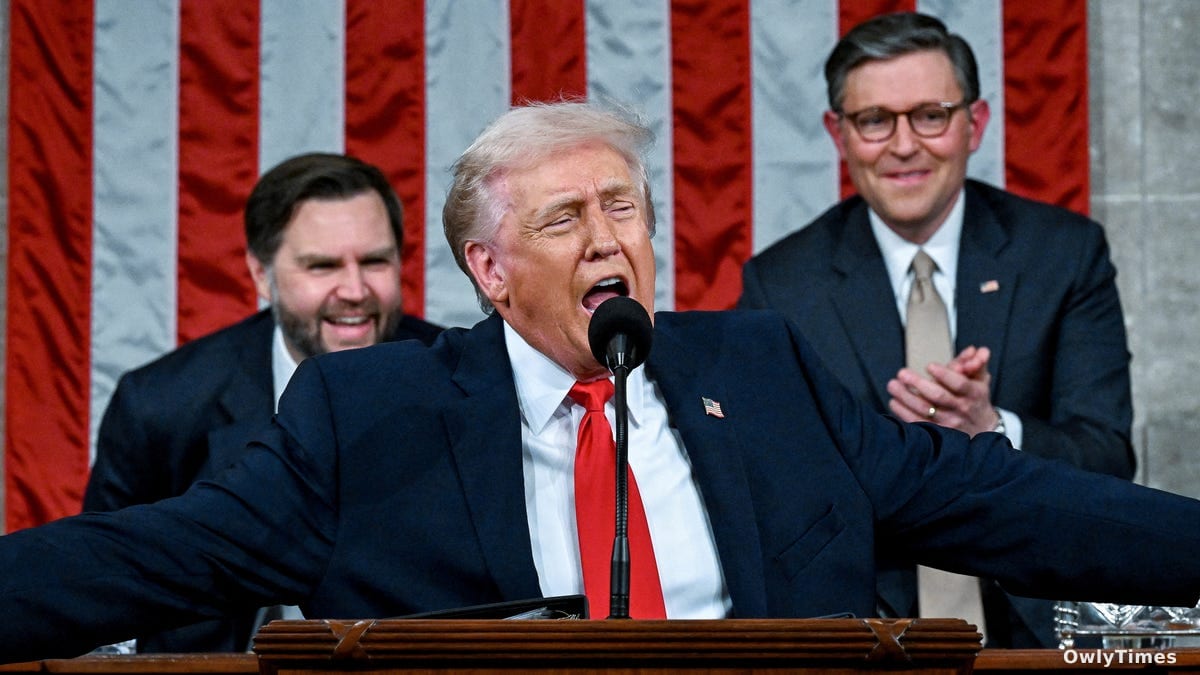

The strategic calculation behind President Trump’s extended State of the Union address wasn’t about persuading the opposition – it was about solidifying a base and signaling a shift in priorities toward demonstrating strength, both domestically and internationally, for a second term. The sheer length of the speech, breaking his own record, and the deliberate spotlighting of individual Americans – from athletes to those facing economic hardship – wasn’t a policy unveiling, but a performance designed to project an image of a thriving nation under his leadership. This wasn’t a call for unity, but a reaffirmation of identity for his supporters, a message delivered directly to them, even through the antagonism directed at Democrats.
The immediate beneficiaries of this strategy are clear: President Trump himself, reinforcing his brand as a strong leader, and the Republican party, particularly in key swing states like Michigan. The focus on individual stories, while seemingly anecdotal, serves to personalize the administration’s successes and bypass traditional media narratives. However, the losers are arguably more diffuse. The Democratic party, repeatedly cast as obstructionist and even destructive, faces the challenge of responding to a narrative that resonates with a significant portion of the electorate. More subtly, the broader American public loses out on substantive policy debate, replaced by a spectacle of partisan theater. The cost of this spectacle is a further erosion of trust in political institutions, a trend that Byron McCauley rightly identifies as a core concern.
This piece references the hollandsentinel.com report.
Macomb County, Michigan, serves as a crucial case study in understanding this dynamic. Long a bellwether with its mix of Reagan Democrats, union households, and working-class voters, the county’s continued support for Trump in 2024 underscores the potency of his message in these communities. Barb VanSyckel, Vice Chair of the Macomb County Republican Party, articulates a sentiment often overlooked in national discourse: a desire for government to simply “stay out” of people’s lives. This isn’t necessarily a rejection of government assistance, but a prioritization of individual responsibility and economic stability. Her nuanced perspective on the economy – acknowledging the struggles of young families while recognizing her own comfortable retirement – highlights the complexities within the Republican base. This mirrors a historical pattern; the rise of conservative movements often coincides with periods of economic anxiety among the working class, a dynamic seen in the post-war era with the rise of Barry Goldwater and, later, Ronald Reagan.
The most telling aspect of McCauley’s reporting, however, isn’t the policy positions themselves, but the tone of the conversation with VanSyckel. Her lament about the “infighting” within the Republican party and the lack of “critical thinking” speaks to a deeper frustration with the increasingly polarized nature of American politics. This echoes a sentiment expressed by figures across the political spectrum, a yearning for a return to civility and reasoned debate. The contrast between VanSyckel’s willingness to have a beer with President Obama and the current climate of animosity is stark. The incident with Congresswoman Rashida Tlaib’s “f**k ICE” pin, juxtaposed with Trump’s call for unity based on national sovereignty, exemplifies this breakdown in decorum. This isn’t simply a matter of political disagreement; it’s a fundamental clash of values and a rejection of the possibility of common ground.
The defining moment of the evening, according to VanSyckel, was the President’s request for Congress to demonstrate support for prioritizing citizens over undocumented immigrants, and the subsequent refusal of Democrats to stand. This moment, framed as a moral test, encapsulates the core ideological divide driving American politics today. It’s a deliberate appeal to nativist sentiments, a tactic employed by political leaders throughout American history, from the Know-Nothing movement of the 19th century to contemporary debates over immigration policy. The question now isn’t whether Trump can maintain this level of support, but whether the Democratic party can effectively counter this narrative and offer a compelling alternative vision for the country. The political chess move to watch next is how Democrats respond to the framing of immigration as a loyalty test, and whether they can articulate a vision of inclusivity that resonates with voters beyond their traditional base.





