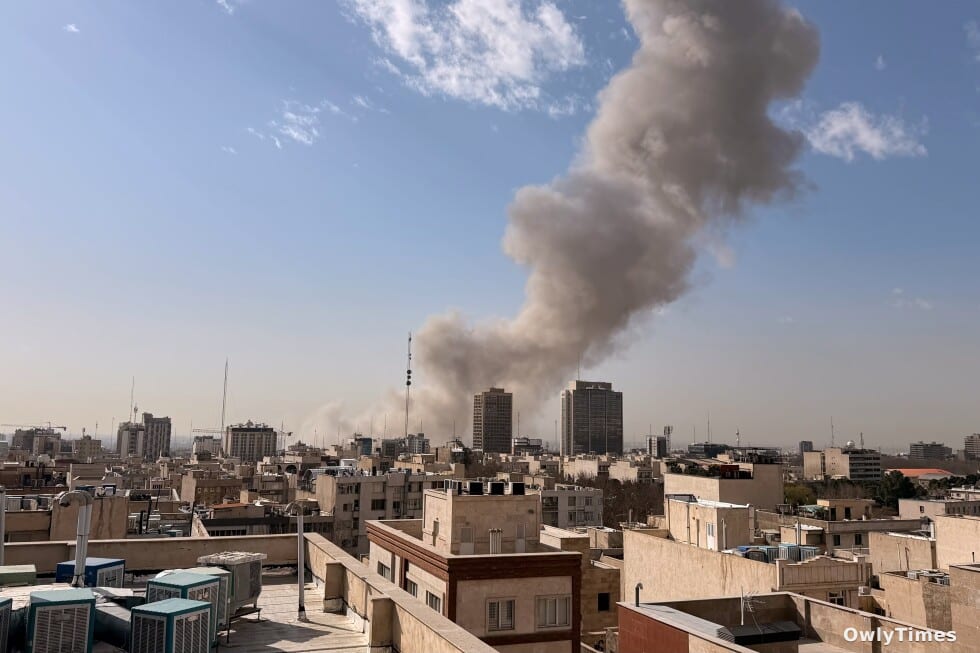

The calculated gamble to dismantle Iranian leadership, executed jointly by the U.S. and Israel, wasn’t simply about neutralizing an immediate threat – it was a strategic provocation designed to exploit existing internal fissures within the Islamic Republic. President Donald Trump’s simultaneous call for the Iranian public to rise up against their government reveals the core objective: regime change through engineered instability. This isn’t a new playbook, but the scale and directness of the action, coupled with the explicit encouragement of internal revolt, elevates the risk exponentially. The immediate aftermath – conflicting reports on the fate of Supreme Leader Ayatollah Ali Khamenei, retaliatory missile and drone strikes from Iran, and a flurry of diplomatic activity – lays bare the winners and losers in this escalating conflict.
The initial strikes, targeting areas around Khamenei’s offices and reported nationwide, with a claimed death toll exceeding 200, were a high-stakes attempt to decapitate the Iranian power structure. The swift, and deliberately contradictory, messaging – Abbas Araghchi’s assertion of Khamenei and President Masoud Pezeshkian’s survival immediately undermined by Benjamin Netanyahu’s claim of the leader’s demise – speaks to a deliberate effort to sow confusion and panic within Iran. This tactic mirrors historical instances of information warfare employed during periods of regime instability, such as the dissemination of false reports during the Romanian Revolution of 1989, designed to accelerate the collapse of the Nicolae Ceaușescu government. The benefit here accrues to those seeking a weakened Iran, primarily Israel and Saudi Arabia, while the immediate loser is the existing Iranian leadership and, tragically, the Iranian civilian population.
Reporting from AP informs this analysis.
The speed with which Iran retaliated – launching missiles and drones toward Israel and U.S. bases – was predictable, but the limited damage reported thus far suggests a calibrated response, perhaps intended to signal resolve without triggering a full-scale war. The U.S. military’s claim of minimal damage, while reassuring domestically, should be viewed with skepticism. The true extent of the damage, and the potential for escalation, remains obscured. Trump’s justification for the strikes – Iran’s nuclear program and missile development – is a long-standing grievance, but the timing suggests a broader calculation. The listing of grievances “stretching back to the beginning of the Islamic Republic” isn’t a post-hoc rationalization; it’s a framing device, positioning the strikes as the culmination of decades of perceived Iranian hostility. This echoes the rhetoric employed by the U.S. during the lead-up to the Iraq War in 2003, where historical grievances were used to justify a preemptive invasion.
The White House’s release of images depicting Trump and his national security team monitoring the operation at Mar-a-Lago, complete with the somewhat theatrical “Operation Epic Fury” branding, is a carefully constructed display of presidential command and control. The blurred screens and map, while ostensibly for security, contribute to the impression of a meticulously planned and executed operation. This performative aspect of leadership is a recurring theme in times of crisis, intended to project strength and reassure both domestic and international audiences. However, the simultaneous reports of Vice President JD Vance monitoring from the Situation Room and Chairman of the Joint Chiefs Gen. Dan Caine being physically present at Mar-a-Lago raise questions about the chain of command and the level of coordination. The fact that the administration felt the need to publicly demonstrate control suggests underlying anxieties about perceptions of leadership.
The conflicting reports surrounding Khamenei’s fate are the most critical element to watch. If confirmed dead, the ensuing power struggle within Iran could be chaotic and unpredictable, potentially creating opportunities for external actors to exert influence. However, even if Khamenei survives, the strikes have demonstrably weakened his authority and emboldened hardliners within the regime. The reported deaths of other senior officials – the commander of the Islamic Revolutionary Guard Corps, the defense minister, and key advisors – further destabilize the Iranian leadership structure. The claim by Brig. Gen. Effie Defrin that Israel struck targets where senior officials were gathered, and will continue to do so, signals a sustained campaign aimed at dismantling the Iranian military and political elite.
The next political chess move to watch isn’t a military escalation, but the reaction within the U.N. Security Council. Iran’s call for “immediate action” will likely be met with resistance from the U.S. and its allies, but the debate itself will expose the divisions within the international community and reveal the extent of support for, or opposition to, the U.S.-Israeli actions. Will the Council be able to forge a consensus, or will it become another arena for geopolitical maneuvering? The answer to that question will determine whether this crisis can be contained, or whether it spirals into a wider regional conflict.





