
Is the future of vision care less about “cures” and more about elegantly sidestepping limitations? We’re bombarded with headlines about gene editing and regenerative medicine promising to fix what ails us, but the story of Liz Baker, a Chattanooga resident living with Stargardt’s disease, reveals a different, and arguably more immediate, path forward. The real story here isn't the elusive search for a Stargardt’s cure – it’s how existing technology, specifically devices like eSight, is quietly restoring independence and agency to the seven million Americans currently living with vision impairment, as reported by the CDC.
Baker’s journey began with subtle struggles – sitting closer to the board in class, a common childhood accommodation. But by her freshman year at the University of Georgia, her vision had plummeted to 20/200 acuity, a point where everyday tasks became profoundly difficult. “I had challenges in terms of reading textbooks, seeing, recognizing faces, seeing boards, really, everything that requires detailed vision,” she explained. This isn’t a rare scenario; Stargardt’s disease, a genetic eye disorder causing central vision loss, typically manifests in childhood or adolescence. For years, Baker navigated a world blurring at the edges, relying on others and adapting as best she could. The frustrating part, she implies, wasn’t just the loss of sight, but the feeling of lost participation in her own life.
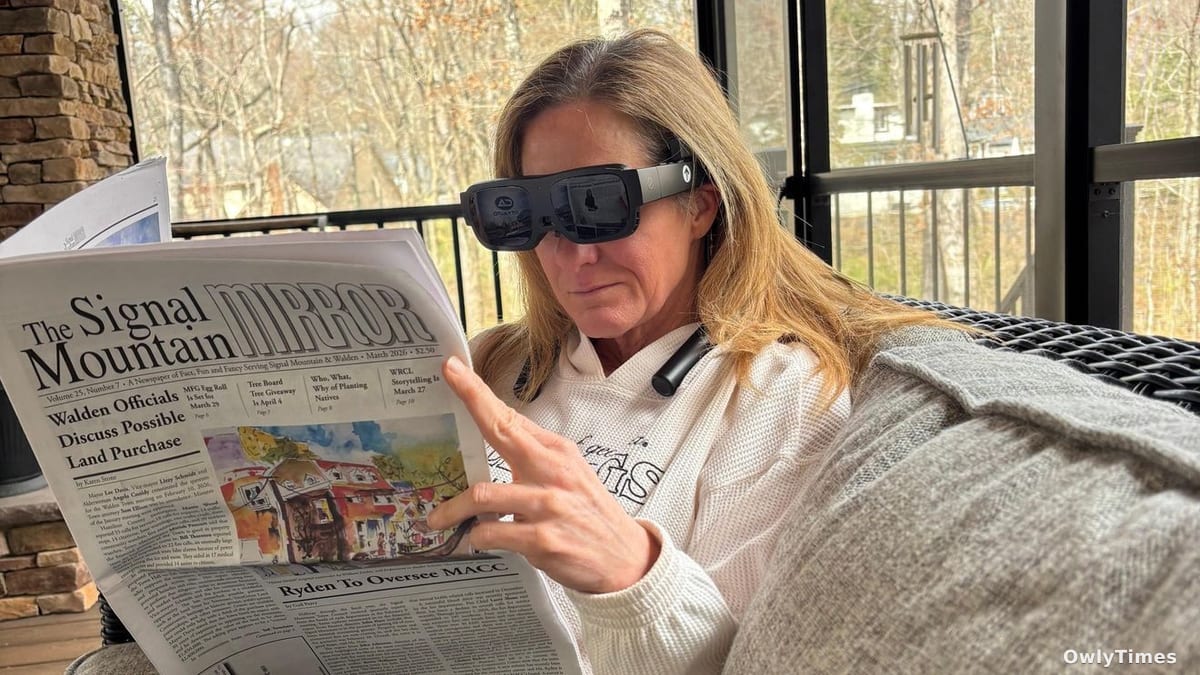
The turning point wasn’t a breakthrough in genetic research, but a second opinion that introduced her to eSight. This isn’t a cure, it’s crucial to understand. eSight is a Class 1 FDA-approved medical device that uses a high-resolution camera and specialized software to project an enhanced image onto the remaining functional retina. It doesn’t repair the damaged cells, it works around them, amplifying the existing vision. And for Baker, the impact has been transformative. She describes regaining the ability to contribute at home – grocery shopping, sorting mail, even helping with recipes – tasks that had become reliant on her husband’s assistance. This isn’t about restoring perfect vision; it’s about restoring a sense of self-sufficiency.
Based on the original newschannel9.com report.
This shift in focus – from cure to adaptation – is significant. The biotech industry pours billions into research for conditions like Stargardt’s, and while that work is vital, it’s often decades away from widespread availability. Meanwhile, devices like eSight, costing around $15,000, are available now, offering tangible improvements to quality of life. The price point is, of course, a barrier for many, highlighting the need for better insurance coverage and accessibility programs. But the fact remains: for a significant portion of the visually impaired population, these technologies represent a viable, immediate solution. Baker’s story also underscores the importance of seeking second opinions and advocating for oneself within the healthcare system. It took another doctor recognizing eSight as an option to unlock this new level of independence.
Beyond eSight, the low-vision aid market is expanding rapidly, encompassing specialized eyewear, magnification tools, and increasingly sophisticated software. Baker’s own active lifestyle – completing an Ironman race and participating in the Paralympics – demonstrates the potential for individuals with vision impairment to not just cope, but thrive. But here’s what we should be watching for: the integration of these assistive technologies with emerging AI platforms. Imagine eSight, or a similar device, coupled with AI-powered object recognition and scene description. Instead of simply amplifying existing vision, the device could actively interpret the visual world, providing real-time contextual information. Will we see a future where vision impairment isn’t defined by what someone can’t see, but by how effectively they can navigate the world with the aid of intelligent technology? That’s the question we need to be asking.