
The rapid integration of artificial intelligence into daily life isn’t simply a technological shift; it’s reshaping how people approach fundamental needs, including healthcare. A new tracking poll from KFF reveals that roughly a third of American adults – 32% – are now turning to AI chatbots for health information and advice, a figure that, while still trailing established sources like physicians and internet search engines, signals a significant and accelerating trend. What’s particularly noteworthy isn’t just that people are using AI for health, but who is using it, and why. The data suggests AI is filling gaps in access and affordability, even as it raises legitimate concerns about data privacy and the reliability of information.
The 32% overall figure breaks down into 29% seeking advice on physical health and 16% on mental health within the past year. To put this in perspective, 80% of adults consulted a healthcare professional for health information in the same period, and 68% used traditional internet searches. However, the comparison isn’t entirely straightforward. Many internet searches now deliver AI-generated summaries, meaning exposure to AI in healthcare is likely far higher than active seeking. The KFF poll highlights a subtle but crucial distinction: people aren’t necessarily choosing AI over traditional methods, but are increasingly encountering it as part of their information journey.
This article draws on reporting from kff.org.
The demographic disparities are striking. Younger adults, aged 18-29, are leading the charge, with 36% using AI for physical health questions and 28% for mental health support in the last year. This contrasts sharply with those 50 and older, where usage drops to 8% for mental health. This age gap isn’t surprising, given younger generations’ greater comfort with technology, but the data also reveals a more concerning pattern. Uninsured adults are nearly twice as likely (30% vs. 14%) to seek mental health advice from AI, as are Black (21%) and Hispanic (19%) adults compared to White adults (12%). These figures aren’t simply about tech savviness; they point to AI becoming a substitute for care among those facing systemic barriers to healthcare access.
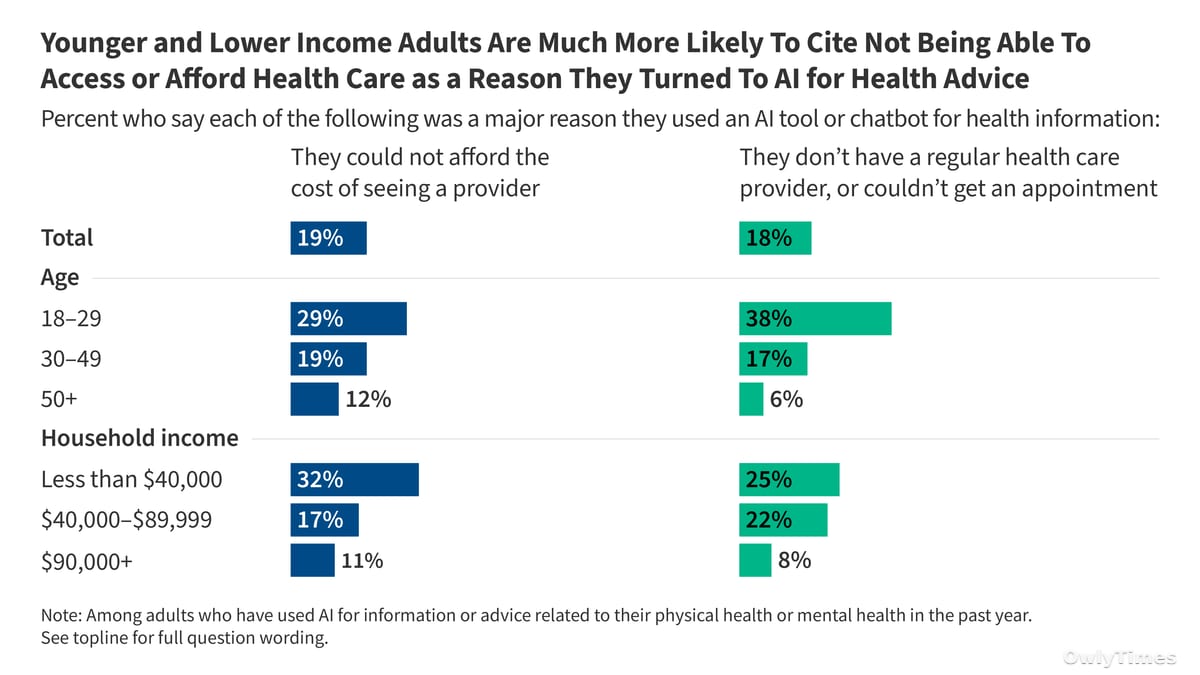
The motivations driving this trend are multifaceted. A clear majority – 65% – cite the desire for quick and immediate advice as a “major reason” for turning to AI. This speaks to a broader cultural expectation of instant gratification, but also to the frustrating delays often inherent in the healthcare system. However, the poll also reveals a significant contingent – 41% – using AI to gather information before seeing a provider, and 36% valuing the privacy it offers. Critically, nearly one in five (18%) report using AI because they lack a healthcare provider or can’t secure an appointment, a number that jumps to 38% among those aged 18-29. Financial constraints are also a major factor, with 19% citing cost as a barrier, rising to 29% among younger adults and 32% of those earning less than $40,000 annually.
Despite the perceived benefits, a substantial 77% of the public expresses concern about the privacy of their medical information when shared with AI tools. This apprehension is well-founded. While some companies claim conversations with health-specific AI won’t be used for training purposes, the fundamental risk of data breaches and misuse remains. Paradoxically, this concern hasn’t stopped people from sharing personal data. 41% of those using AI for health have uploaded medical information like test results or doctor’s notes, representing 13% of all adults. This suggests a willingness to trade privacy for convenience, or perhaps a lack of full understanding of the potential risks.
Interestingly, satisfaction levels among AI users are high. 92% are “somewhat” or “very” satisfied with the quality of responses regarding physical health, and 85% feel the same about mental health advice. However, “very satisfied” responses remain relatively low, at 19% and 27% respectively, indicating a degree of cautious optimism rather than unreserved endorsement. Trust in AI for health information is also moderate, with 69% trusting it “a great deal” or “a fair amount” to provide reliable information, but this drops significantly to 18% among those who haven’t used it. This highlights the importance of direct experience in shaping perceptions of AI’s value.
The KFF poll doesn’t offer definitive answers about the long-term impact of AI on healthcare. It does, however, paint a picture of a rapidly evolving landscape where technology is increasingly being used to address unmet needs, particularly among vulnerable populations. A crucial question moving forward is whether this reliance on AI will ultimately improve health outcomes, or exacerbate existing inequalities. Will the convenience and accessibility of AI-driven advice lead to earlier diagnosis and better self-management, or will it result in delayed or inappropriate care due to inaccurate information or a lack of human oversight? As more health-specific AI chatbots enter the market, and as these tools become more sophisticated, it will be vital to track not only how people are using them, but also what happens after they receive AI-generated advice – specifically, are they following up with healthcare professionals, and are those professionals aware of the information their patients have already obtained? The answer to that question will determine whether AI becomes a valuable supplement to, or a dangerous substitute for, traditional healthcare.