
Is the AI arms race already decided? Everyone’s fixated on ChatGPT’s user numbers and Nvidia’s trillion-dollar valuation, framing the US-China tech rivalry as a simple story of “brains” versus “bodies.” The real story here isn’t who’s building the flashiest chatbot or the most lifelike robot – it’s how China’s forced innovation, born from American restrictions, is quietly reshaping the playing field, and what that means for the rest of us. We’re not just talking about Silicon Valley bragging rights; we’re talking about a fundamental shift in global power, and the potential for a future where American technological dominance is no longer a given.
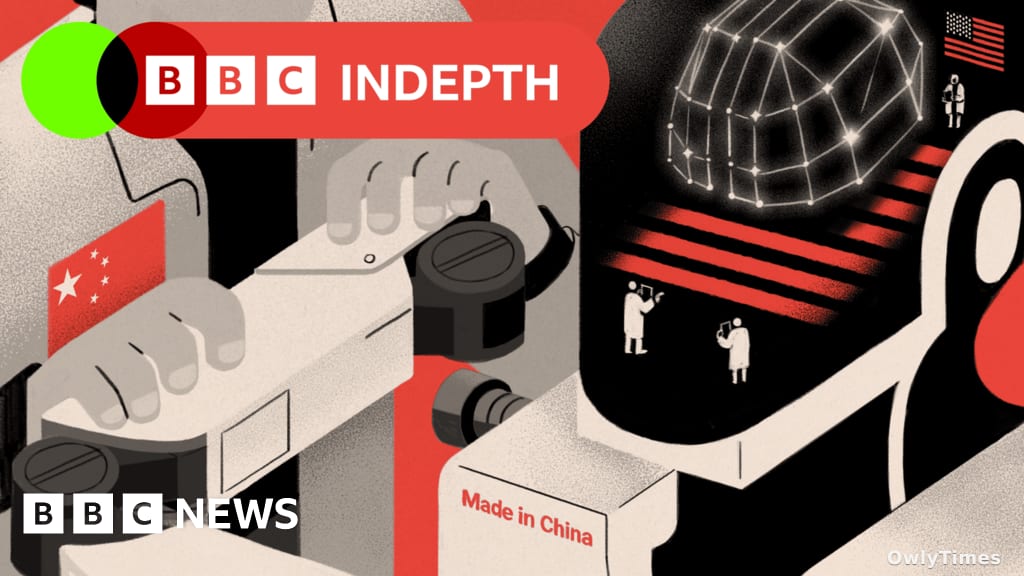
For decades, the narrative was clear: the US innovates, China manufactures. But the current battle for Artificial Intelligence supremacy, echoing the Cold War’s nuclear arms race, is far more nuanced. As Nick Wright of University College London succinctly puts it, it’s a contest between AI “brains” – the algorithms and large language models (LLMs) – and AI “bodies” – the robots and physical systems. Traditionally, America held the upper hand in the “brains” department, while China excelled at building the “bodies.” That’s why the launch of OpenAI’s ChatGPT in November 2022 felt like a defining moment. Parmy Olson, author of Supremacy: AI, ChatGPT, and the race that will change the world, recalls the immediate explosion of interest: “You could go on any sort of social network and there was just this flood of posts from people talking about all the different ways that they were using this new little text box that had appeared on the internet.” With over 900 million weekly users – nearly one in eight people on the planet – ChatGPT’s success cemented the US lead in LLMs, prompting a multi-billion dollar scramble from competitors like Anthropic, Google, and Perplexity.
But the US advantage wasn’t just about clever coding. It was, and remains, about control of the underlying hardware. The most powerful computer chips, essential for training these complex AI models, are largely designed by one company: Nvidia. Valued at $5 trillion, Nvidia isn’t just a tech company; it’s a strategic asset, and the Joe Biden administration understands this perfectly. Since 2022, Washington has aggressively tightened export controls, building on a policy dating back to the 1950s, to prevent China from accessing these crucial chips. The logic is simple: deny China the tools to build its own AI “brains,” and maintain American dominance. This policy leverages the “foreign direct product rule,” effectively extending US jurisdiction over any product containing US technology, even if manufactured elsewhere – like in Taiwan, a key US ally. The proximity of Taiwan to mainland China adds another layer of geopolitical tension to this technological standoff.
However, this strategy may have backfired spectacularly. In January 2025, coinciding with Donald Trump’s second inauguration, China unveiled DeepSeek, its own AI-powered chatbot. DeepSeek, while functionally similar to ChatGPT, achieved comparable performance at a fraction of the cost. The impact was immediate and devastating: Nvidia suffered the largest single-day market value loss in US stock market history – a staggering $600 billion. As Karen Hao, an AI journalist, points out, the export controls inadvertently forced Chinese developers to become resourceful. “It ended up… accelerat[ing] China's self-reliance,” she says. DeepSeek demonstrated that China could build competitive AI “brains” without relying on American chips, a revelation that sent shockwaves through Washington. The key? A focus on efficiency and a different approach to development.
Reporting from the BBC informs this analysis.
This difference lies in the contrasting philosophies of innovation. American AI firms fiercely guard their intellectual property, while China embraces a more “open source” approach, readily sharing code and fostering collaboration. As Selina Xu, a researcher working with former Google boss Eric Schmidt, explains, this allows Chinese companies to build upon existing models, accelerating development and reducing costs. “The American closed-proprietary models are probably better, but maybe just not by that much,” she says. “The Chinese model, maybe it's only 90% as good, but it is 10% as expensive.” This cost advantage is crucial, particularly as AI becomes increasingly democratized.
But the story doesn’t end with LLMs. China has long held a significant lead in AI “bodies,” particularly in robotics. Driven by government funding and subsidies, China boasts an estimated two million working robots – more than the rest of the world combined. Shenzhen and Shanghai are already showcasing the integration of robots into daily life, from drone deliveries to automated factories. Beijing sees humanoid robots as a solution to its rapidly aging population, envisioning them filling labor shortages in care work and other sectors. China now accounts for 90% of all humanoid robot exports. However, even these advanced robots still require a “brain” – an operating system powered by agentic AI, the kind of AI that can independently plan and execute complex tasks. And here, the US still maintains an edge, particularly with companies like Boston Dynamics and their Spot robot, which uses agentic AI for inspections and even, alarmingly, battlefield applications.
The race isn’t about building the best AI, it’s about building AI that’s most effectively integrated into the economy and society. As Greg Slabaugh of Queen Mary University of London argues, “Victory’ is unlikely to be a singular moment… Instead, what matters is sustained advantage: who leads in capability, who embeds AI most effectively across their economy, and who sets global standards.” The US and China are playing by different rules – one prioritizing market dominance and proprietary technology, the other emphasizing state control and rapid deployment.
Here’s what to watch for: in the next 18 months, expect to see a surge in “low-cost, good-enough” AI applications emerging from China, specifically targeting markets underserved by expensive American solutions. This won’t necessarily be groundbreaking technology, but it will be accessible technology, and that accessibility will be a powerful force. The question isn’t whether the US will remain a leader in AI innovation, but whether it can adapt to a world where technological leadership is no longer synonymous with global dominance.