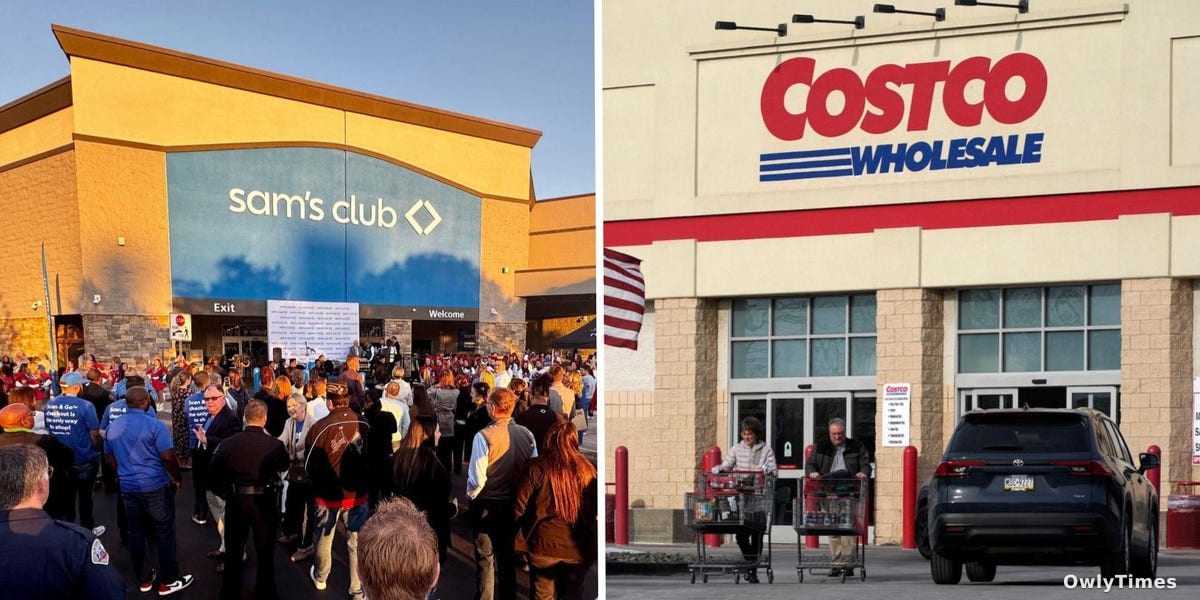

$8 in savings across 12 items isn’t just pocket change – it’s a signal of shifting dynamics in the $686 billion warehouse club market. A recent price comparison between Costco’s Kirkland Signature and Sam’s Club’s Member’s Mark store brands reveals a subtle but statistically significant advantage for Sam’s Club, with a total cost of $150 for 12 matched items versus $158 at Costco. While the difference appears modest, it underscores a broader trend: the intensifying competition between these retail giants, and the increasingly sophisticated strategies they employ to attract and retain members. This isn’t simply about cheaper sugar; it’s about a calculated effort to win share of wallet in a consumer environment increasingly sensitive to price.
The roots of this rivalry are surprisingly intertwined. Both Costco and Sam’s Club trace their lineage back to Sol Price, a retail innovator who mentored a Costco co-founder and inspired Walmart’s Sam Walton to create a similar bulk-buying concept. Both operate on a membership model – $65 annually at Costco, $50 at Sam’s Club – predicated on offering discounted prices in exchange for a recurring fee. However, the latest data suggests Sam’s Club is more aggressively leveraging its private label, Member’s Mark, to undercut Costco’s Kirkland Signature on key staples. The comparison, conducted across locations in Wisconsin, focused on functionally similar products, though exact matches weren’t always available, highlighting a strategic difference in product assortment.
See the original Business Insider story for the full account.
The most striking finding wasn’t the overall price difference, but where those savings materialized. Sam’s Club consistently offered lower prices on everyday essentials like sugar, laundry detergent, and chicken nuggets – often by a margin of 5-8% per unit. This isn’t accidental. Follow the money: these are high-volume items, meaning even small price discrepancies translate into substantial savings for frequent shoppers. The data reveals a clear pattern: Sam’s Club is willing to sacrifice margin on these core products to drive foot traffic and membership renewals. Conversely, Costco frequently positioned its Kirkland Signature offerings as “premium” alternatives – for example, offering only an organic sugar option at a higher price point. This suggests a deliberate strategy to appeal to a different segment of the market, one willing to pay a premium for perceived quality or ethical sourcing.
However, the picture isn’t entirely one-sided. Costco demonstrated price leadership in specific categories, notably batteries, bottled water, and whole bean coffee, achieving savings of up to 8% per pound. This suggests a more nuanced competitive landscape than a simple “who’s cheaper” narrative. The analysis also revealed several ties, particularly in categories like pain medication and dish soap, where price differences were negligible. This points to a broader industry trend: intense price competition is driving down margins across the board, forcing both clubs to optimize their supply chains and negotiate aggressively with manufacturers. The fact that both private labels offer significant discounts – up to 89% off name-brand allergy medication – demonstrates the power of scale and private label penetration.
The limited scope of this comparison – 12 matched items out of 17 initially considered – is a crucial caveat. Costco offered a wider overall selection within its Kirkland line, suggesting a broader range of potential savings for consumers willing to explore beyond the core staples. Furthermore, the study focused solely on price, neglecting factors like product quality, store experience, and ancillary services (gas stations, optical centers, etc.). These qualitative factors are significant drivers of customer loyalty and can offset price differences. The $8 difference, while measurable, represents less than a 5.3% total savings on the basket of goods, a difference that may not sway all consumers.
What this means for your wallet: the warehouse club landscape is becoming increasingly competitive, and consumers are the beneficiaries. Don’t assume automatic savings with either membership. Instead, analyze your shopping habits. If you prioritize organic options and a wider product selection, Costco may be the better value. If you’re focused on maximizing savings on everyday essentials, Sam’s Club appears to have a slight edge. The key question now is: will this price pressure force both clubs to further refine their strategies, potentially leading to a wider rollout of discounts or the introduction of new membership tiers? Watch for changes in membership pricing and the expansion of private label offerings in the coming months – these will be the clearest indicators of where this retail battle is headed.