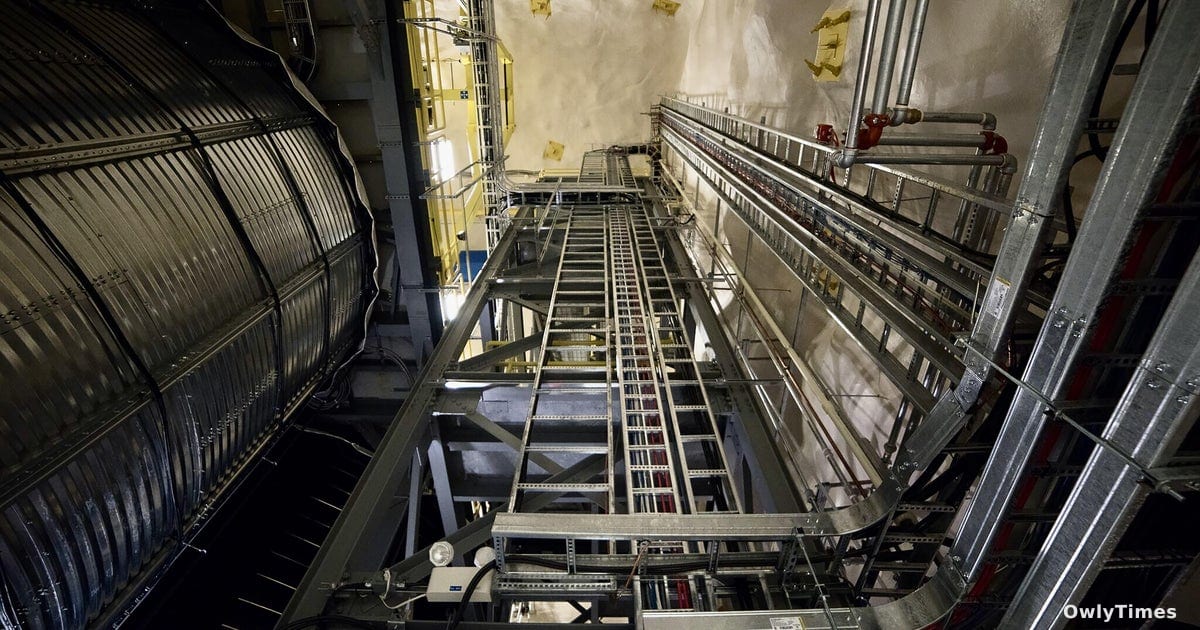

The air in Chicago bit with a familiar, sub-zero chill on Tuesday, a day when bundled-up residents barely registered a high of -2 Celsius (28 Fahrenheit). But 6,800 feet underground, in an active nickel mine near Sudbury, Ontario, a different kind of cold was taking hold – a cold so profound it dwarfs even a Chicago winter. There, the Super Cryogenic Dark Matter Search (SuperCDMS), a collaboration involving Northwestern University, achieved a milestone: reaching temperatures just thousandths of a degree above absolute zero, a staggering -459.7 Fahrenheit. This isn’t about breaking records for the coldest day; it’s about silencing the universe, atom by atom, in the hope of hearing a whisper from the dark.
The Hunt for the Invisible Universe
For decades, scientists have known that the matter we can see – stars, planets, even ourselves – accounts for only about 15% of the universe. The remaining 85% is dark matter, a mysterious substance that doesn’t interact with light, making it invisible to telescopes. We know it’s there because of its gravitational pull on galaxies, preventing them from flying apart. But what is it? That’s the question driving the SuperCDMS experiment, and the reason for this extreme pursuit of cold. The challenge isn’t just finding something that doesn’t interact with light; it’s isolating a signal from the constant “noise” of the universe – cosmic rays, vibrations, even the heat generated by the detectors themselves.
Drawn from CBS News.
The location of SNOLAB, deep within the Earth, is the first layer of defense against this interference. But even that isn’t enough. To truly listen for the faint interactions of dark matter, the experiment needs to be cooled to temperatures where atomic motion is almost entirely suspended. As Enectali Figueroa-Feliciano, a Northwestern University professor of physics and astronomy, put it in a news release, “Reaching this ultracold temperature means our experiment has crossed a major threshold.” It’s a threshold that demands not just technological prowess, but a fundamental shift in how we perceive temperature itself. The popular understanding of zero degrees Celsius as the freezing point of water, or even zero Fahrenheit as a brutally cold day, feels almost quaint when compared to the scale SuperCDMS is operating on. As Cecil Adams pointed out in a 2014 “Straight Dope” column, even Fahrenheit’s scale was built on arbitrary measurements, a far cry from the absolute stillness of absolute zero.
Beyond the Thermometer: Why This Matters Now
This isn’t simply a physics experiment; it’s a reflection of our evolving relationship with the unknown. In an era defined by readily available information, the search for dark matter represents a humbling acknowledgement of how much we don’t know. The universe isn’t revealing its secrets easily, and answering these fundamental questions requires pushing the boundaries of human ingenuity – and enduring extreme conditions, both for the scientists and their equipment. The $24 million project, funded by agencies in the US and Canada, is a testament to the enduring power of basic research, even when the practical applications are decades away.
The SuperCDMS isn’t just aiming to detect any dark matter particle; it’s focused on “light dark matter,” particles with roughly half the mass of a proton. This is crucial because many existing dark matter detection methods are designed to find heavier particles. If light dark matter exists – and current theories suggest it might – it’s been evading detection all along. This focus also highlights a growing tension within the field: the lack of conclusive evidence despite decades of searching. The SuperCDMS represents a strategic pivot, a bet on a different kind of dark matter, and a new approach to finding it.
Simulating the Unseen at Fermilab
The next phase of the experiment involves calibrating the detectors, a process that requires understanding how they respond to known particles. This is where Fermilab and Northwestern’s NEXUS facility, located 350 feet underground, comes into play. Scientists are using a neutron beam to simulate the interactions dark matter particles might have with the detectors, essentially “teaching” the experiment what to look for. This meticulous process of simulation and calibration is vital, ensuring that any signal detected isn’t simply a false positive. It’s a painstaking effort, but one that underscores the rigor required to claim a discovery in a field as elusive as dark matter research.
A Cold Future for Particle Physics?
The success of SuperCDMS in reaching its target temperature isn’t just a win for the collaboration; it’s a potential turning point for particle physics. Beyond the search for dark matter, the experiment could unlock new insights into previously inaccessible energy scales and reveal unknown particle interactions. But the real question isn’t just if they’ll find dark matter, but what happens if they do. Will it confirm existing theories, or will it force a radical rethinking of our understanding of the universe? And, perhaps more importantly, will this success inspire a new generation of scientists to tackle the biggest mysteries of the cosmos, even if it means venturing into the coldest, darkest corners of the Earth – and beyond?





