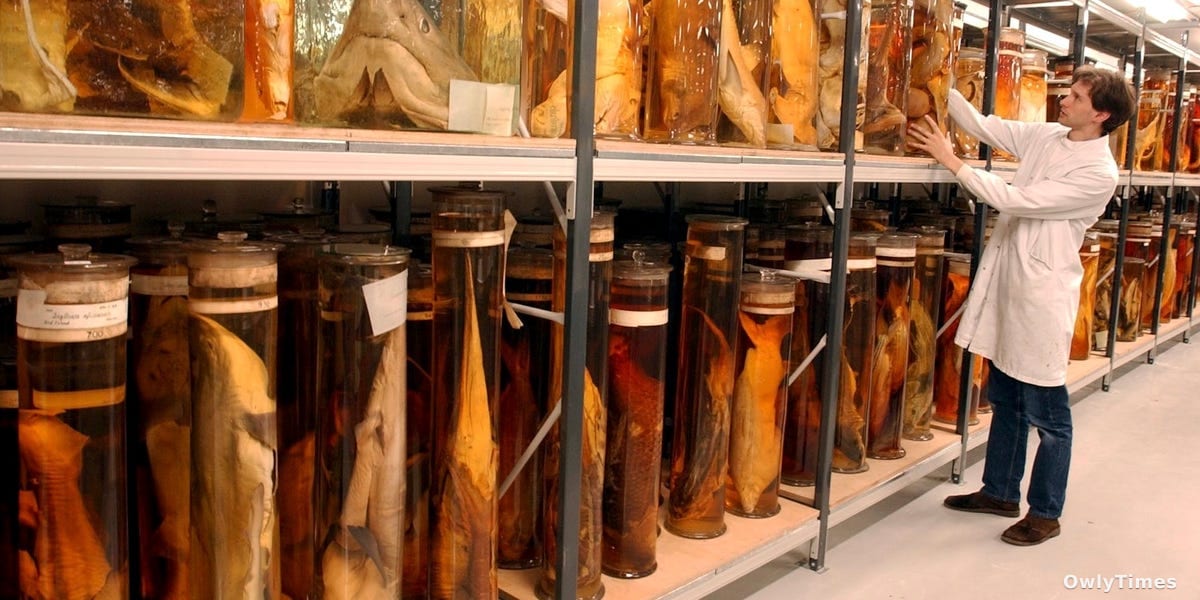

The question of how we preserve the past is often as complex as understanding the past itself. While Charles Darwin’s meticulous notes and groundbreaking theories have been readily available to scientists for nearly two centuries, a surprisingly fundamental detail remained obscured: the precise composition of the liquids preserving the specimens he collected during his voyage on the HMS Beagle. This isn’t merely a historical curiosity; it speaks to a broader challenge facing natural history museums worldwide – how to best care for invaluable, fluid-preserved collections when the original preservation methods are undocumented and direct analysis risks damaging the specimens. A recent study, however, utilizing a remarkably non-invasive technique, is beginning to lift the veil on this long-held secret, offering a new path toward safeguarding these vital resources.
The specimens themselves, housed within the archives of London’s Natural History Museum, represent a tangible link to Darwin’s observations that fueled On the Origin of Species. These aren’t simply dried, pressed plants or fossilized bones; they are three-dimensional organisms suspended in time, offering potential for analyses unavailable even to Darwin himself. Yet, until recently, identifying the preservation fluids meant a difficult choice: open the jars, risking evaporation, contamination, and potential degradation of the delicate tissues within. As Wren Montgomery, a research technician at the NHM, points out, “Analyzing the storage conditions of precious specimens, and understanding the fluid in which they are kept, could have huge implications for how we care for collections and preserve them for future research for years to come.” The problem wasn’t a lack of specimens, but a lack of information about their environment.
See the original popularmechanics.com story for the full account.
The solution, as it often does in modern science, involved lasers. A team led by physicist Sara Mosca of the Central Laser Facility at the United Kingdom's Science and Technology Facilities Council employed spatially offset Raman spectroscopy (SORS) – a technique that allows for the chemical analysis of materials through their containers. Traditional Raman spectroscopy, which relies on analyzing the scattering of laser light, struggles with opaque containers like glass jars. The signal is dominated by the jar itself, obscuring the chemical signature of the liquid within. SORS cleverly circumvents this issue by taking multiple laser measurements, at slightly different angles, and subtracting the readings. This reveals the chemical composition of both the container and, crucially, the contents without ever opening the jar. As Mosca explained, “Until now, understanding what preservation fluid is in each jar meant opening them, which risks evaporation, contamination, and exposing specimens to environmental damage.”
The results, published in ACS Omega, are significant. The team successfully identified the liquid in nearly 80 percent of Darwin’s specimen jars. While the specific formulas varied, a clear pattern emerged. Mammal and reptile specimens were “most often ‘fixed’ with formalin and then suspended in ethanol,” a common practice even today. Invertebrates, however, were typically stored in formaldehyde or buffered formaldehyde, sometimes with additives like glycerol or phenoxetol to maintain tissue integrity. It’s important to note that “nearly 80 percent” isn’t 100 percent. The remaining 20 percent likely contain fluids too degraded or too complex for the current SORS setup to analyze effectively. Furthermore, the study doesn’t reveal when these preservation methods were adopted – whether Darwin himself employed these techniques consistently, or if they were modified by museum staff in the years following his death.
Limitations to consider extend beyond the incomplete analysis. SORS, while non-destructive, isn’t a perfect technique. The sensitivity of the method is dependent on the concentration of the chemicals present, and complex mixtures can be difficult to decipher. The team also relied on existing databases of Raman spectra for comparison, meaning the accuracy of the identification is limited by the completeness of those databases. This highlights a broader issue in the field of heritage science: the need for more comprehensive spectral libraries of materials commonly used in preservation.
The implications of this work extend far beyond the Natural History Museum’s archives. Museums globally hold vast collections of fluid-preserved specimens, representing a wealth of biodiversity data. Knowing the precise composition of these fluids is critical for assessing their long-term stability and developing appropriate conservation strategies. Will current preservation fluids continue to protect these specimens for another two centuries? Or are we facing a silent degradation of irreplaceable biological material? The next research steps will likely focus on refining the SORS technique to analyze more complex mixtures and expanding the spectral libraries used for identification. Perhaps even more exciting is the potential to adapt this technology for in situ monitoring of fluid-preserved specimens, allowing curators to track changes in fluid composition over time and proactively address potential degradation issues. The question now isn’t just what Darwin used to preserve his specimens, but how we can ensure his legacy – and the biodiversity it represents – endures for generations to come.