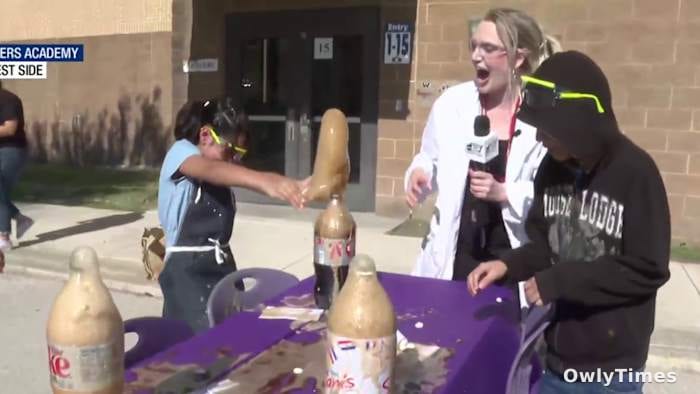

Can a simple interaction between confectionery and carbonated beverages serve as a meaningful gateway to understanding physical chemistry? As the 2025-2026 school year draws to a close, the "Science with Sarah" segment, led by KSAT Weather Authority Meteorologist Sarah Spivey and photojournalist Robert Samarron, has utilized the iconic Diet Coke and Mentos experiment to illustrate principles of nucleation. While often relegated to the realm of backyard novelty, the mechanics behind this geyser provide a tangible, albeit messy, lesson in thermodynamics and surface chemistry.
The Physics of Nucleation
At the heart of this experiment is not a chemical reaction in the traditional sense, but a physical one. When a roll of Mentos is dropped into a 2-liter bottle of Diet Coke, the resulting eruption is a byproduct of rapid carbon dioxide release. The surface of a Mentos candy is not as smooth as it appears to the naked eye; it is covered in microscopic pits and craters. These imperfections serve as nucleation sites, providing a vast amount of surface area for dissolved carbon dioxide gas to escape the liquid phase and form bubbles.
Many observers mistake the violent output for a chemical change, but the Diet Coke remains chemically identical after the event—it simply loses its dissolved gas. By using a homemade paper tube and an index card as a makeshift dispenser, students can ensure that the candy enters the soda simultaneously, maximizing the speed of nucleation. This methodology highlights how physical surface structure can dictate the kinetics of gas release, a concept that is foundational in fields ranging from chemical engineering to meteorology.
Separating Spectacle from Scientific Rigor
It is essential to distinguish between the visual spectacle of the geyser and the underlying scientific inquiry. The headlines surrounding such demonstrations often focus on the height and power of the eruption, which can obscure the controlled variables required for a successful trial. For instance, the use of a 2-liter bottle is not arbitrary; the volume of the container and the headspace available are critical variables that dictate the scale of the pressure release compared to smaller, less effective alternatives.
Despite the excitement, there are limitations to consider regarding the reproducibility of this experiment in a classroom setting. Factors such as the temperature of the soda, the freshness of the carbonation, and the exact speed at which the Mentos are introduced can lead to widely varying results. While these variables are excellent for teaching students about experimental design and the necessity of keeping conditions consistent, they also mean that the experiment is more of a qualitative demonstration than a precise quantitative measurement.
Educational Continuity and Practical Application
This demonstration, published on May 13, 2026, represents the conclusion of the "Science with Sarah" series for the academic year. The utility of such experiments lies in their ability to make invisible physical processes—like gas saturation and bubble formation—observable. As educators and parents look toward the next academic cycle, the focus remains on translating these high-energy demonstrations into deeper discussions about the properties of matter.
The transition from this school year to the next will provide a new baseline for engagement. The next reading of participation metrics for the GMSA@9 Wednesday segments will indicate whether these hands-on, highly visual demonstrations continue to successfully bridge the gap between complex physical concepts and public scientific literacy. By encouraging students to document their own variations in geyser height, they shift from passive observers to active participants in the scientific method.