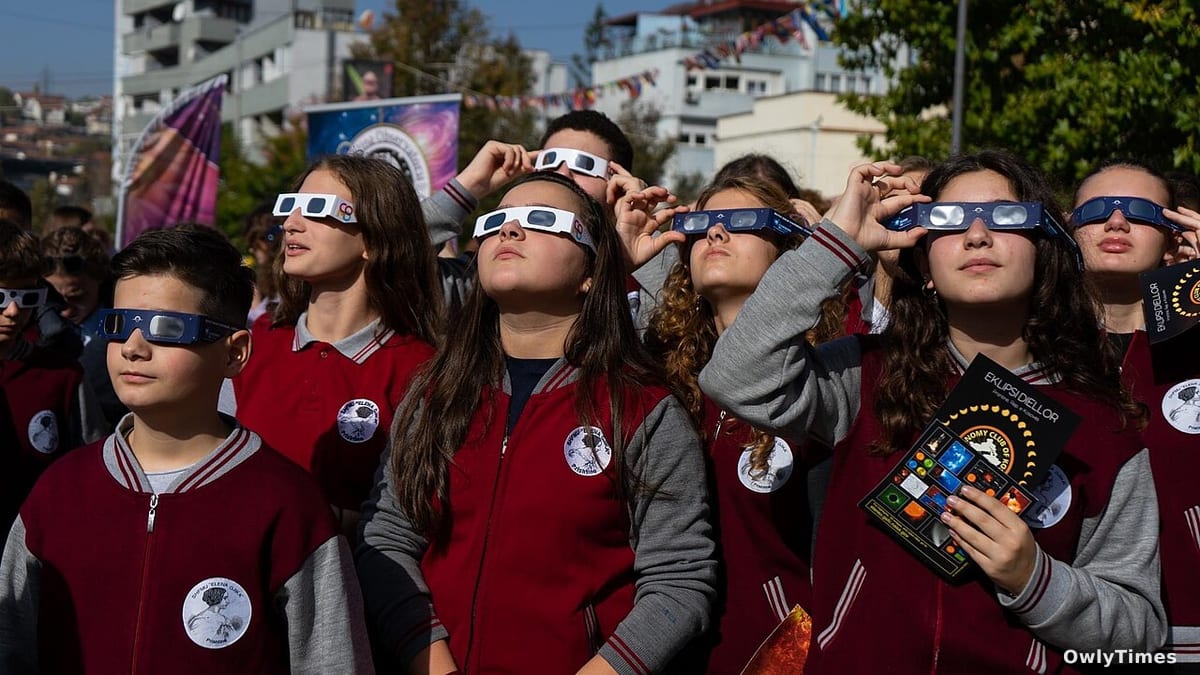

Is NASA outsourcing its science now? That’s not a cynical question, but a legitimate one to ask when considering the recent release of the Eclipse Megamovie dataset. While headlines tout groundbreaking images of the sun’s corona, the real story here isn’t just what was captured, but how – through the coordinated effort of 52,469 photographs uploaded by hundreds of citizen scientists. We’re entering an era where the line between professional research and passionate amateurism is blurring, and the implications are far more profound than just pretty pictures of space.
Beyond the Filters: The Power of Calibrated Data
The April 8th eclipse wasn’t just a spectacle; it was a massive, distributed data-gathering operation. NASA’s Eclipse Megamovie project, spearheaded by teams at Sonoma State University, the University of California, Berkeley, and NASA’s Goddard Space Flight Center, leveraged the collective power of 143 “observatories” – everyday people with cameras. But this wasn’t just about snapping photos with a smartphone. The project, with support from Troy Wilson at EdEon STEM, demanded precision, requiring volunteers to capture calibration frames alongside the eclipse itself. This meticulous approach resulted in the first-ever white-light eclipse dataset with calibration, spanning a cumulative 90+ minutes of coronal observations. Why is calibration so crucial? Because without it, you’re just looking at pretty pictures. Calibration allows scientists to remove distortions and accurately measure the corona’s evolution, revealing details previously hidden.
Of those 143 observatories, only 28 ultimately produced fully calibrated, “level 3” images, highlighting the complexity of the task. This isn’t a failure rate, though; it’s a testament to the rigor of the scientific method. The data itself is available in FITS format – the standard for astronomical data – meaning it’s not locked behind paywalls or proprietary software. Anyone, from a seasoned astrophysicist to a curious high school student, can download and analyze it. This accessibility is a deliberate choice, and a significant departure from the traditionally guarded world of scientific data.
This piece references the science.nasa.gov report.
The Democratization of Discovery
For decades, access to cutting-edge scientific tools and data was limited to those within academic institutions or government agencies. The cost of equipment, the complexity of analysis, and the sheer gatekeeping of knowledge created a significant barrier to entry. The Eclipse Megamovie project flips that model on its head. It’s not about giving the public data; it’s about enabling the public to create data. Jessi McKenna, a volunteer with the project, expressed the collaborative spirit, stating, “Thank you for all you do and have done for us…Everyone in the group has been amazingly supportive of each other.” This isn’t just about collecting images; it’s about building a community of citizen scientists.
Consider the implications: a retired engineer with a telescope can contribute to our understanding of solar flares. A high school student can learn data analysis skills by working with real astronomical data. This isn’t just good science; it’s good for science education and public engagement. It also addresses a growing problem within STEM fields – a lack of diversity. By lowering the barriers to entry, citizen science projects like this can attract talent from underrepresented groups.
What This Means for the Future of Space Exploration
The success of Eclipse Megamovie 2024 isn’t an isolated incident. NASA and other space agencies are increasingly turning to citizen science for data collection and analysis. Projects like Zooniverse, which allows volunteers to classify galaxies and identify planets, have already yielded significant results. But the eclipse project demonstrates a new level of sophistication. It’s not just about “counting things”; it’s about collecting precise, calibrated data that can be used for advanced scientific research.
This shift has practical implications for future missions. Imagine a network of amateur astronomers around the world monitoring near-Earth objects, providing early warning of potential asteroid impacts. Or a fleet of citizen-operated sensors tracking atmospheric conditions on Mars. The cost savings are substantial, but the real benefit is the increased coverage and resilience. A single, expensive satellite can fail. A distributed network of citizen scientists is far more robust.
The Next Eclipse and Beyond
The data from the April 8th eclipse will keep researchers busy for years, allowing them to study solar jets, plumes, and the dynamic behavior of the corona. But the long-term impact of this project extends far beyond the immediate scientific findings. The real question now isn’t what we learned about the sun, but how we can replicate this model for other scientific endeavors.
Watch for NASA to announce expanded citizen science initiatives in the coming months, specifically targeting the 2026 annular eclipse and the 2028 total solar eclipse. More importantly, expect to see a growing demand for accessible data analysis tools and educational resources. The future of space exploration isn’t just about rockets and robots; it’s about empowering anyone with a camera and a curiosity to become a part of the scientific process. The next time a celestial event graces our skies, don’t just look up – prepare to contribute.





