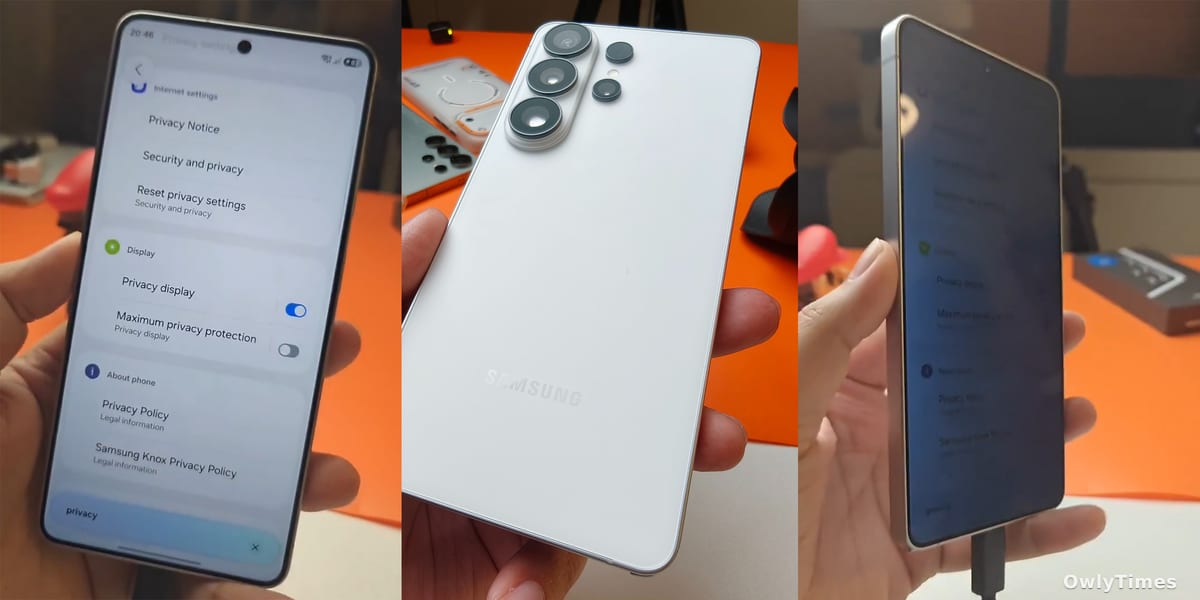

Is the future of smartphones less about bigger screens and more about not being seen? That’s the question swirling around Samsung’s upcoming Galaxy S26 launch, but it’s not the one everyone’s asking. The real story here isn’t the incremental design tweaks or the horsepower bump – it’s the debut of Samsung’s “Privacy Display,” and what it signals about our growing anxieties around digital surveillance. While tech blogs obsess over megapixel counts, Sahil Karoul, a tech YouTuber, just bypassed the entire launch cycle, acquiring a Galaxy S26 Ultra in Dubai and giving the world a sneak peek. And it’s the privacy feature, not the phone itself, that’s truly grabbing attention.
Karoul’s early access, documented on Twitter/X and Instagram, reveals a device that looks…well, like a slightly refined Samsung phone. The white color variant is aesthetically pleasing, and yes, the S Pen still exists, though apparently sticking it in backwards results in an awkward protrusion – a minor detail, but indicative of Samsung’s continued commitment to a feature many users barely touch. The comparison shots with the iPhone 17 Pro Max and a tragically broken Galaxy S25 Ultra are standard fare for these leaks, but they’re ultimately noise. The core innovation is the Privacy Display, which, as demonstrated by Karoul, effectively blacks out the screen when viewed from an angle.
This isn’t a new concept – privacy screen protectors have existed for years. But integrating it directly into the hardware, and potentially offering granular control over which parts of the screen are obscured (as hinted at in previous leaks), is a game changer. Consider the implications: open on a train without fear of shoulder surfing, discreetly view sensitive information in a public space, or simply reclaim a sliver of personal space in an increasingly transparent world. Samsung isn’t selling a phone; they’re selling a feeling of control. And they’re doing it at a time when trust in tech companies is at an all-time low.
The timing is particularly interesting given Samsung’s other recent announcements. The addition of “Hey Plex,” the hotword for the Perplexity AI search engine, alongside “Hey Google” and Bixby, speaks to a broader strategy of diversifying AI assistants. And the reboot of Bixby, focusing on device controls and AI integration within One UI 8.5, suggests Samsung is attempting to carve out a niche for itself beyond simply being a hardware provider. But even these moves feel secondary to the privacy push. Why offer more AI if users don’t feel safe using it?
This piece references the 9to5Google report.
The Galaxy Buds 4 leaks, showcasing a new metallic finish and downplaying comparisons to Apple’s AirPods, further illustrate Samsung’s attempt to differentiate itself through design and features. But these are incremental improvements. The Privacy Display, however, is a fundamental shift in how we interact with our devices. It acknowledges a growing user need – the need for digital solitude – and attempts to address it directly. The February 25th launch will be closely watched, but the real test won’t be the pre-order numbers. It will be whether users actually use the Privacy Display, and how much they’re willing to pay for the peace of mind it offers.
Here’s what to watch for: in the next six months, expect to see a surge in privacy-focused features across the smartphone landscape. If Samsung’s Privacy Display proves popular, Apple will almost certainly respond, and the entire industry will be forced to reckon with the fact that users aren’t just demanding more features – they’re demanding more control over their own data, and their own visibility. The question isn’t if privacy will become a key selling point, but how aggressively other manufacturers will scramble to catch up.