
Is the "Full-Domain AI" era of the automotive industry actually about making cars smarter, or is it just a high-stakes race to build the most expensive supercomputer on four wheels?
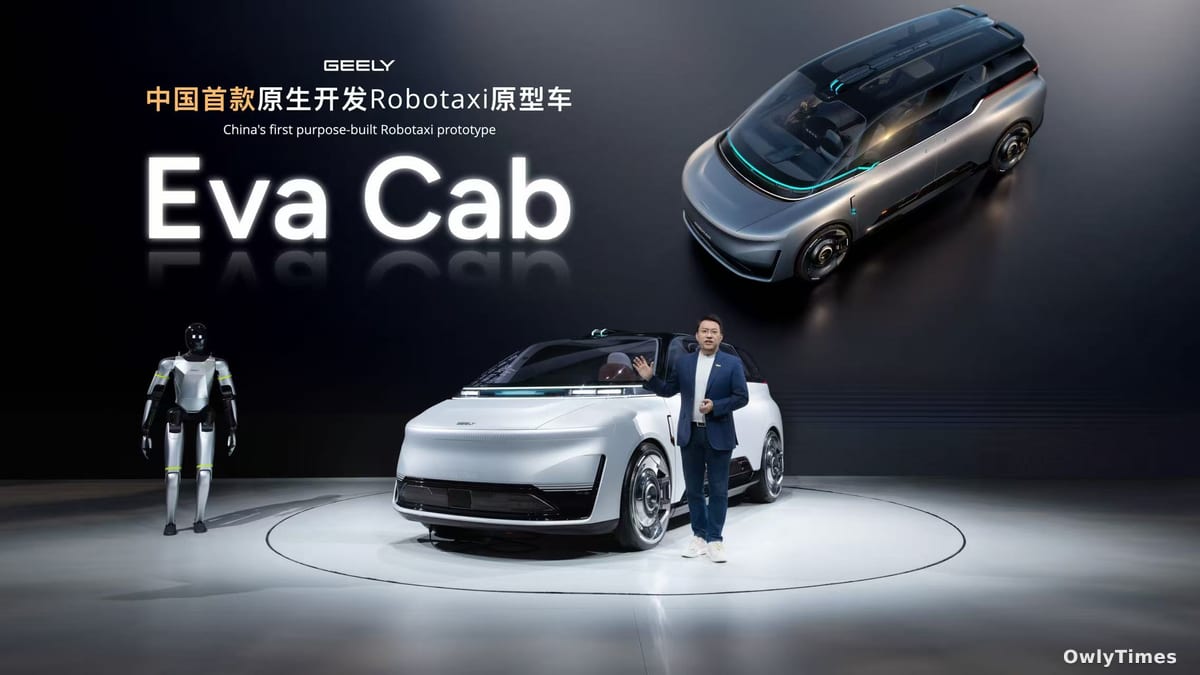
The real story here isn’t the flashy unveiling of the EVA Cab at Auto China 2026—it’s the fundamental shift in what an automaker actually sells. Geely Auto Group is no longer just manufacturing metal and rubber; they are positioning themselves as a sprawling "Full-Domain AI" ecosystem provider. By bundling bipedal robots, quantum-grade security, and massive computational power under one roof, Geely is betting that the future of transport won’t be won by better engines, but by who can best simulate a human "worldview" inside a chassis.
The Architecture of a Robotaxi
The EVA Cab, developed alongside AFARI Technology and CaoCao Mobility, is essentially a mobile data center designed to navigate open public roads. Under the hood, the hardware specs are staggering: the vehicle integrates the NVIDIA SuperChip, NVIDIA Thor U, and the Qualcomm Snapdragon 8397. This trifecta delivers more than 3,000 TOPS of computing power.
To put that in perspective, this massive leap in processing has boosted the parameter count seven-fold and the inference frame rate three-fold compared to previous iterations of the WAM (World Action Model). When you combine this with the world’s first 2,160-line digital LiDAR system—which scans the environment at a rate of 25.92 million points per second—you realize this isn't a car; it's a surveillance and decision-making engine that happens to have seats.
Security in the Age of Quantum Hype
While the industry is obsessed with self-driving capabilities, Geely is betting that consumer trust will be the final hurdle. Their EEA 4.0—or "Quantum-Grade AI Electrical/Electronic Architecture"—is the company’s answer to the terrifying prospect of a hacked vehicle. By incorporating quantum encryption for everything from Bluetooth keys to OTA updates, they are trying to solve the "security theater" problem that plagues connected vehicles.
This pivot to "Full-Domain AI 2.0" didn't happen overnight. It is the result of five years of infrastructure spending, beginning with the Smart Geely 2025 strategy and the 2022 launch of the Geely Xingrui Intelligent Computing Center. That facility now boasts 23.5 EFLOPS of power, a figure that dwarfs the computational capacity of most traditional automotive R&D labs.
The Reality of Scale
For the ordinary user, this "AI-first" transition is moving from the lab to the street faster than many expect. Geely isn't just theorizing; they reported cumulative sales of 3,024,567 units in 2025, a 39% year-on-year increase. Their new energy vehicle (NEV) segment is growing even faster, up 90% year-on-year to 1,687,767 units.
However, the real test of this "mobility bot" vision lies in the transition from pilot programs in cities like Hangzhou and Suzhou to mass-market availability. The next reading of the deployment schedule for the CaoCao Mobility customized edition of the EVA Cab in 2027 will show whether these "Full-Domain" AI promises can survive the messy, unpredictable reality of urban traffic.