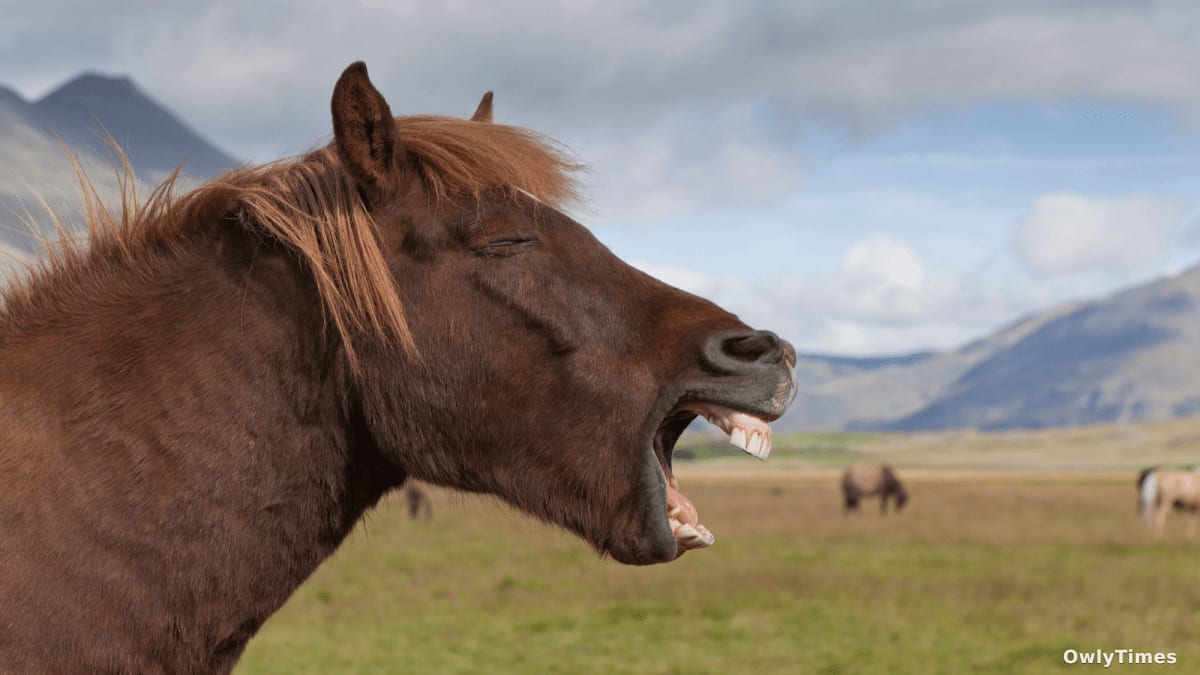

Beyond the Whinny: Unraveling a Horse’s Complex Vocalizations
For millennia, the sound of a horse’s whinny has resonated across landscapes, a signal instantly recognizable yet surprisingly enigmatic. While we’ve shared a close relationship with horses for roughly 4,000 years – a period of significant co-evolution – the precise mechanics of their vocal communication have remained largely a mystery. Recent research, however, is beginning to lift the veil, revealing a sophisticated system far more complex than a simple exhale. The focus isn’t just that horses whinny, but how they achieve the full range of their vocalizations, a question that’s led scientists to a surprising discovery about a “whistle” within the horse’s larynx.
The initial puzzle, as Elodie Floriane Mandel-Briefer, a biologist at Copenhagen University, explains, lies in the dual nature of the whinny itself. It possesses both a low-frequency component, expected given a horse’s size, and a remarkably high-frequency element that seems disproportionate for such a large animal. About a decade ago, Mandel-Briefer and her team identified this phenomenon as biphonation – the overlapping of two distinct pitches. While the low frequency is produced through standard vocal fold vibration, a process common to most mammals including humans, the source of the high frequency remained elusive. Headlines often simplify this to “horses whistle,” but the reality, as revealed in a recent Current Biology study, is a far more nuanced biomechanical process.
See the original popsci.com story for the full account.
Mandel-Briefer and her colleagues undertook an interdisciplinary investigation, literally dissecting the mechanics of equine sound production. A crucial, and somewhat unconventional, element of their methodology involved using larynges sourced from a horse meat supplier. By carefully blowing air through these tissues, the team initially replicated only the low-frequency component. Through experimentation, however, they successfully generated the high frequency as well, demonstrating that both elements originate within the larynx itself – not, as in human whistling, from the lips. To definitively prove the presence of a laryngeal whistle, they then introduced different gases: air and helium. Helium’s unique physical properties predictably shifted the whistle’s frequency upwards, while the tissue-vibration-based low frequency remained unchanged. This controlled experiment provided conclusive evidence that the high-frequency component is indeed produced by a laryngeal whistle.
The significance of this finding extends beyond simply identifying the mechanism. The team’s work demonstrates that horses uniquely combine vocal fold vibration and laryngeal whistling to create biphonation – a vocal strategy, as far as we currently know, unparalleled in the animal kingdom. This isn’t merely a quirk of equine anatomy; it likely evolved to enhance communication. A 2015 study by the same group showed a correlation between whinny frequency and emotional state, with the high-frequency component signaling whether an emotion is positive or negative, and the low frequency indicating its intensity. Furthermore, the higher frequency travels further, allowing horses to convey messages across greater distances.
It’s important to note, however, that this sophisticated vocal system isn’t universal among equids. While Przewalski’s horses, close relatives of domesticated horses, also exhibit biphonation, more distant cousins like zebras and donkeys lack the high-frequency component. This suggests that the ability to produce these complex whinnies represents a specific adaptation within the horse lineage, potentially allowing for a richer and more nuanced communication repertoire. This raises questions about the selective pressures that drove this evolution – what specific communication needs did biphonation address for horses that weren’t present for other equids?
Looking ahead, researchers are now focused on understanding how horses interpret these complex vocalizations. While we know how the sounds are produced and some of what they signify, deciphering the full range of information encoded within a whinny remains a challenge. Future studies will likely involve analyzing whinnies in various social contexts, correlating vocalizations with observed behaviors, and potentially even utilizing machine learning to identify subtle patterns undetectable to the human ear. Ultimately, a deeper understanding of equine communication isn’t just a matter of scientific curiosity; it’s crucial for improving horse welfare and strengthening the human-animal bond. Will we eventually be able to “translate” a horse’s whinny with the same accuracy we understand a dog’s bark? That’s the question driving the next wave of research.