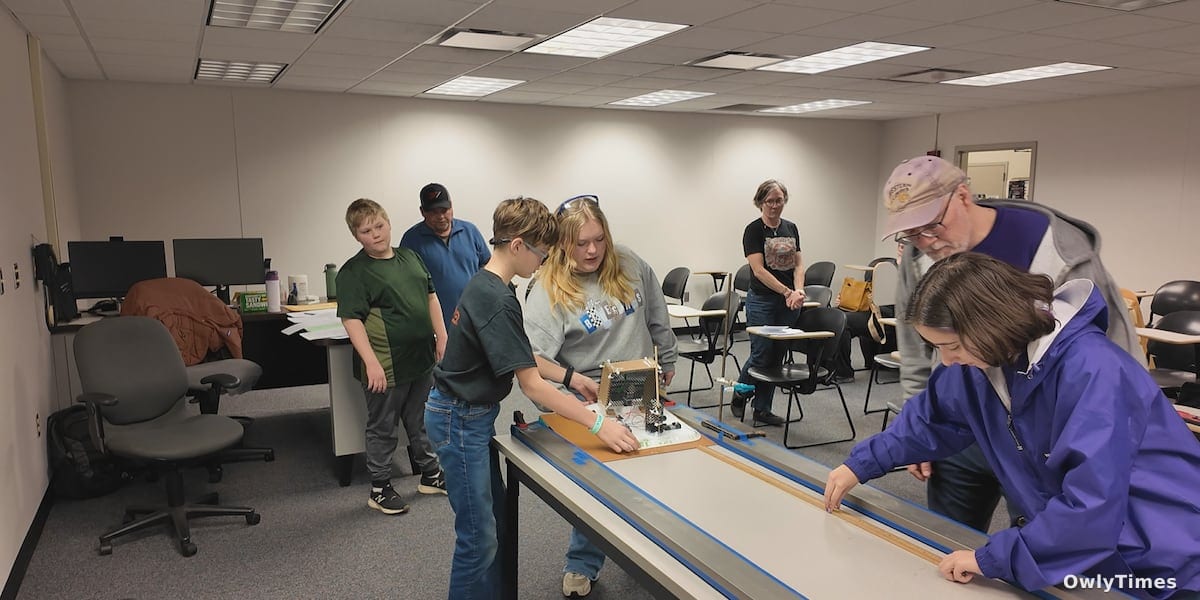

The quiet ambition brewing in Macomb, Illinois this past Saturday wasn’t about college recruitment or athletic scholarships—it was about hovercrafts, scramblers, and the meticulous study of the human body. While national attention often focuses on standardized test scores as a measure of student success, the Western Illinois University Regional Science Olympiad offered a different kind of assessment: one built on applied knowledge, collaborative problem-solving, and a genuine spark of scientific curiosity. The event, involving roughly 250 middle and high school students, isn’t simply a competition; it’s a crucial, and often overlooked, pipeline for cultivating the next generation of STEM professionals, and a revealing indicator of where current science education excels – and where it could improve.
Beyond Rote Memorization: The Value of Applied Science
The Science Olympiad’s structure is deliberately broad, encompassing disciplines from engineering and astronomy to biology and chemistry. This isn’t about reciting the periodic table; it’s about using that knowledge to build a working hovercraft, as students from Carthage Middle School demonstrated, or designing a “scrambler” – a vehicle with a launching mechanism. Elizabeth Pearson, a coach at Carthage, highlighted the hands-on nature of the projects, emphasizing that students weren’t just learning concepts, they were actively applying them. This approach directly addresses a common critique of traditional science education, which often prioritizes memorization over practical understanding. A 2022 National Assessment of Educational Progress report showed only 22% of eighth graders performing at or above proficient in science, a figure that underscores the need for more engaging, application-focused learning experiences. The Olympiad, in effect, provides a concentrated dose of exactly that.
Based on the original kwqc.com report.
A Catalyst for Career Paths: Seeing Science in Action
The impact of this experiential learning extends beyond the immediate competition. For Ashlyn Brewer, a freshman at Farmington Central High School, the event wasn’t just a Saturday activity; it was a pivotal moment in solidifying her future aspirations. “It confirmed that I want to go into the medical field,” she stated, specifically citing a deepened interest in becoming a surgeon. This isn’t an isolated case. The Olympiad allows students to explore diverse scientific fields, potentially uncovering passions they wouldn’t encounter in a standard curriculum. James LaPrad, director of the School of Education at Western Illinois University, echoed this sentiment, noting that the event “excites kids about science and learning science” and provides exposure to fields they might not otherwise consider. This is particularly important in rural areas like Western Illinois, where access to STEM role models and opportunities can be limited.
The Competitive Drive and the Pursuit of Mastery
While the focus is on learning, the competitive element shouldn’t be dismissed. Students like Laynie Lekies, an eighth grader at Farmington Central Junior High, clearly enjoy the challenge. Her enthusiasm for the “Tower” event – a building challenge requiring structural ingenuity – demonstrates the intrinsic motivation that can be fostered through well-designed scientific challenges. This drive to excel, coupled with the collaborative nature of many events, cultivates valuable skills beyond scientific knowledge, including teamwork, problem-solving, and resilience. Lielah Zacarias, also an eighth grader at Farmington Central, exemplifies this forward-looking attitude, stating, “The more we learn, the better we’ll get. I’m hoping that we can make a place in state.” This ambition isn’t simply about winning; it’s about continuous improvement and a commitment to mastering complex concepts.
Looking Ahead: State, Nationals, and the Broader Ecosystem
The Macomb regional competition is merely the first step. Students now await results to determine who will advance to the Illinois Science Olympiad State Tournament on April 18th at the University of Illinois in Champaign-Urbana, with the ultimate goal of reaching the national level. However, the success of events like this hinges on sustained support. While the enthusiasm of students and dedicated coaches like Elizabeth Pearson is undeniable, resources – funding for materials, access to specialized equipment, and teacher training – are often limited. The question now isn’t just who will qualify for state, but how can we ensure that more schools, particularly those in underserved communities, have the resources to participate and provide their students with these invaluable learning opportunities? The future of STEM innovation may well depend on the answer.