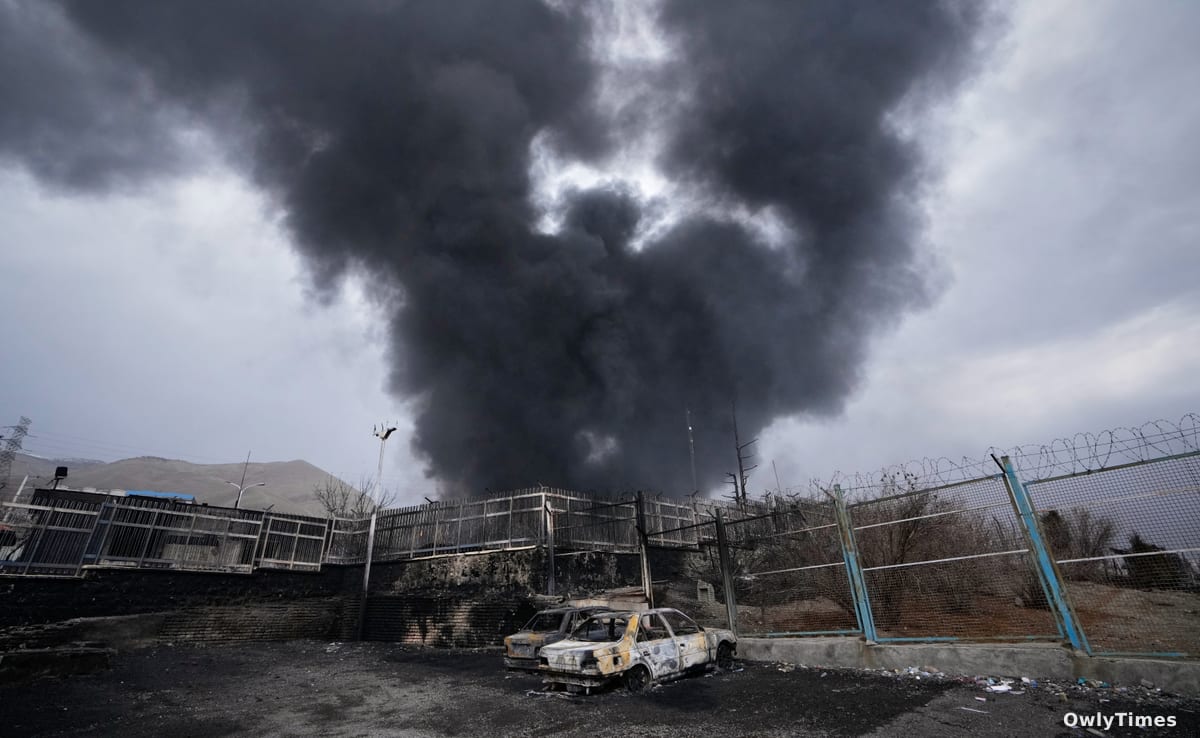

Is the future of warfare less about bombs and more about bandwidth? Everyone’s focused on the escalating conflict between the U.S. and Iran, analyzing geopolitical strategy and military deployments. The real story here isn’t just the clash of nations – it’s the quiet, critical role technology is playing, not as a tool of war, but as a foundational layer for it. The recent strike on Tehran, captured in images by Vahid Salemi on March 8th, 2026, isn’t just a military event; it’s a stress test for the region’s digital infrastructure, and a stark reminder of how reliant modern conflict is on things most people never consider.
The Invisible Infrastructure of Conflict
We rarely think about data centers when we think about war, but Carla Sertin, head of editorial content at WIRED Middle East, points out they’re now as vital as oil pipelines. The entire operation – from intelligence gathering and drone coordination to cyber warfare and public messaging – depends on a stable, high-capacity network. The Middle East, already a region grappling with political instability, now faces the added pressure of protecting its digital backbone. A targeted attack on a key data center wouldn’t necessarily involve explosions; it could involve a sophisticated denial-of-service attack, crippling communications and disrupting critical systems. This isn’t science fiction. It’s the reality of 21st-century conflict, and the vulnerability is significantly higher than most realize. The fact that this is happening now, in early 2026, is particularly concerning given the relatively slow pace of investment in regional cybersecurity compared to other areas.
Reporting from wosu.org informs this analysis.
From Silicon to Steel: AI Enters the Physical World
While geopolitical tensions simmer, a different kind of technological shift is underway in Columbus, Ohio. Andy Lonsberry, CEO and co-founder of Path Robotics, is building “physical AI” – robots that can autonomously weld large-scale parts. This isn’t about replacing human welders entirely, Lonsberry clarifies, but about tackling projects too dangerous, complex, or repetitive for humans. Think shipbuilding, bridge construction, or even building fortifications. The implications are huge. For decades, AI has been confined to the digital realm, analyzing data and making predictions. Now, it’s starting to manipulate the physical world with increasing precision and autonomy. This isn’t just about efficiency; it’s about reshaping manufacturing and potentially altering the balance of power in industries reliant on heavy fabrication. The current market for automated welding is estimated at $8 billion, but Path Robotics’ approach, focusing on large-scale, complex projects, could unlock a far larger potential.
The Consumer Tech Counterpoint: Distraction or Innovation?
Amidst these weighty developments, the usual churn of consumer tech continues. Russell Holly, director of commerce content at CNET, highlights Apple’s upcoming “NEO” laptop, positioned as a more affordable alternative, and TCL’s new anti-glare phone screen. And, perhaps most surprisingly, Fortnite is finally coming to mobile devices. It’s easy to dismiss these as trivial distractions, especially when the world feels like it’s on the brink. But that’s a mistake. These innovations aren’t happening in spite of the global situation; they’re happening because of it. The demand for affordable technology remains constant, even during times of crisis. The push for better mobile experiences is driven by the increasing reliance on smartphones for communication and information. And, let’s be honest, sometimes people just need an escape. The fact that Apple is responding to market pressure with a lower-priced laptop (estimated to start at $799, a 20% decrease from their base model) signals a growing awareness of economic realities.
Supply Chain Realities and the Semiconductor Squeeze
The conflict in the Middle East is already exacerbating existing supply chain issues, particularly concerning semiconductors. While the U.S. has made strides in reshoring chip manufacturing, the global supply remains fragile. Disruptions to shipping lanes through the Red Sea and the Persian Gulf could lead to significant delays and price increases for everything from cars to washing machines. This isn’t a theoretical problem. We’re already seeing lead times for certain chips extend by 15-20% compared to the beginning of 2025. The irony is palpable: the very technologies designed to enhance security and efficiency are vulnerable to the same geopolitical forces they’re meant to mitigate. The reliance on a handful of key suppliers, primarily in Taiwan and South Korea, creates a single point of failure that adversaries can exploit.
Looking ahead, expect to see a surge in investment in “digital resilience” – the ability of critical infrastructure to withstand cyberattacks and physical disruptions. But more importantly, watch for the increasing integration of AI into physical systems, not just in manufacturing like with Path Robotics, but in defense, logistics, and even everyday infrastructure. The next major escalation won’t be defined by who has the most tanks, but by who controls the algorithms. The question isn’t if AI will fundamentally alter the nature of conflict, but when the first fully autonomous military operation will be deployed. And that, frankly, is a scenario we should all be preparing for.