
$540 million in intercepted weaponry – that’s the estimated value of the drones and missiles launched at the United Arab Emirates this weekend, according to defense ministry figures, a stark illustration of how rapidly the Gulf’s long-held image of invulnerability has fractured. The attacks, a direct response to a US-Israeli assault, weren’t simply a military escalation; they were an economic shock, exposing the inherent fragility of a region built on perceived stability. Follow the money, and you’ll find that the Gulf’s prosperity isn’t derived from oil alone, but from the premium investors and tourists pay for safety – a premium now demonstrably at risk.
The Price of Perceived Security
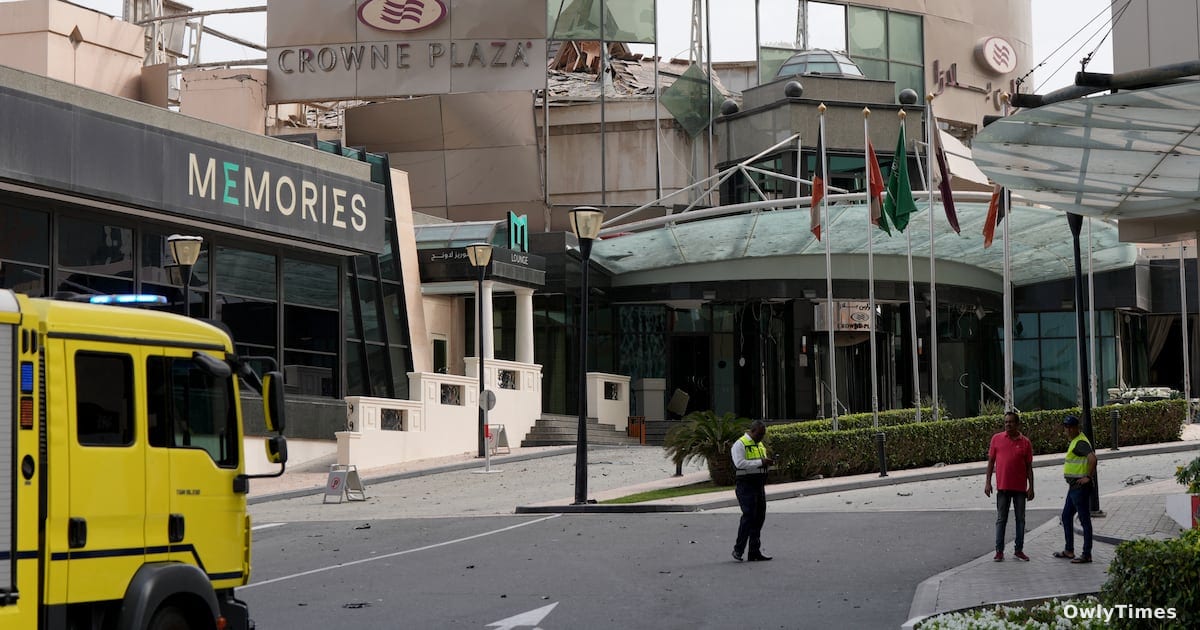
For decades, Dubai, and the UAE more broadly, has functioned as a financial and logistical hub, attracting capital from Iranian businesspeople, Russian oligarchs, and American celebrities alike. This success wasn’t accidental. As Cinzia Bianco, a visiting fellow at the European Council on Foreign Relations, points out, Gulf administrations “prided themselves on manoeuvring politically and hedging to be basically on the good books of everyone.” This careful balancing act allowed them to cultivate a reputation for security, a reputation that justified higher investment returns and tourism costs. The weekend’s barrage – comprising over 540 drones, 165 ballistic missiles, and two cruise missiles – directly challenges that narrative. While the vast majority were intercepted, the fact that 21 drones did strike civilian targets, igniting fires in five-star hotels and damaging the bustling international airport, is the critical detail.
Reporting from irishtimes.com informs this analysis.
Market Reaction and Regional Fallout
The immediate financial impact was visible in regional stock markets. Trading was suspended in Kuwait, while markets in Saudi Arabia, Oman, and Bahrain all experienced declines on Sunday. This wasn’t panic selling, but a recalibration of risk. The Gulf’s economic models are fundamentally tied to regional stability; the ability to offer a safe haven is not a peripheral benefit, but the core value proposition. Consider the UAE’s tourism sector, which contributed 7.1% to its GDP in 2022, according to Statista. Even a temporary disruption to air travel, as experienced this weekend with widespread airspace closures, translates to millions in lost revenue. The damage to infrastructure, while reportedly limited, adds to the cost. The four injuries sustained at Dubai International Airport, while thankfully not fatal, underscore the potential for far greater human and economic consequences.
Beyond the Headlines: The Human Cost
The attacks weren’t indiscriminate. Official reports tallied by The New York Times indicate at least four deaths and over 100 injuries across the UAE, Kuwait, Qatar, Bahrain, and Oman. Crucially, the majority of casualties were foreign workers – Pakistani, Nepali, and Bangladeshi nationals in the UAE, and predominantly foreign nationals in Kuwait. This highlights a critical tension: the Gulf’s economic prosperity is built on the labor of a large migrant workforce, a population particularly vulnerable in times of conflict. The narrative of a “shaken but not upended” Gulf, as suggested by Bader Al-Saif of Kuwait University, overlooks the disproportionate impact on those least equipped to absorb the shock. While the Gulf states demonstrated defensive capabilities, the human cost is a significant, and often overlooked, economic factor.
A Delicate Balancing Act and Future Risks
Gulf leaders now find themselves in an increasingly precarious position, caught between their primary security guarantor, the United States, and a demonstrably assertive Iran. While wary of Iran, Gulf administrations have actively pursued de-escalation and diplomatic engagement in recent years. This balancing act is now far more difficult. Yasmine Farouk of the International Crisis Group rightly points out the uncertainty surrounding US security guarantees, particularly as the potential for US withdrawal looms. The attacks expose a fundamental vulnerability: the Gulf’s reliance on external security providers. The question now isn’t whether the Gulf can defend itself, but whether it can maintain its economic viability in a region where the perception of safety has been irrevocably damaged.
What this means for your wallet: watch for increased insurance premiums for travel and investment in the region. More importantly, anticipate a potential shift in investment flows as investors demand a higher risk premium for exposure to the Middle East. The era of the Gulf as a guaranteed safe haven may be over, and that shift will be felt globally.