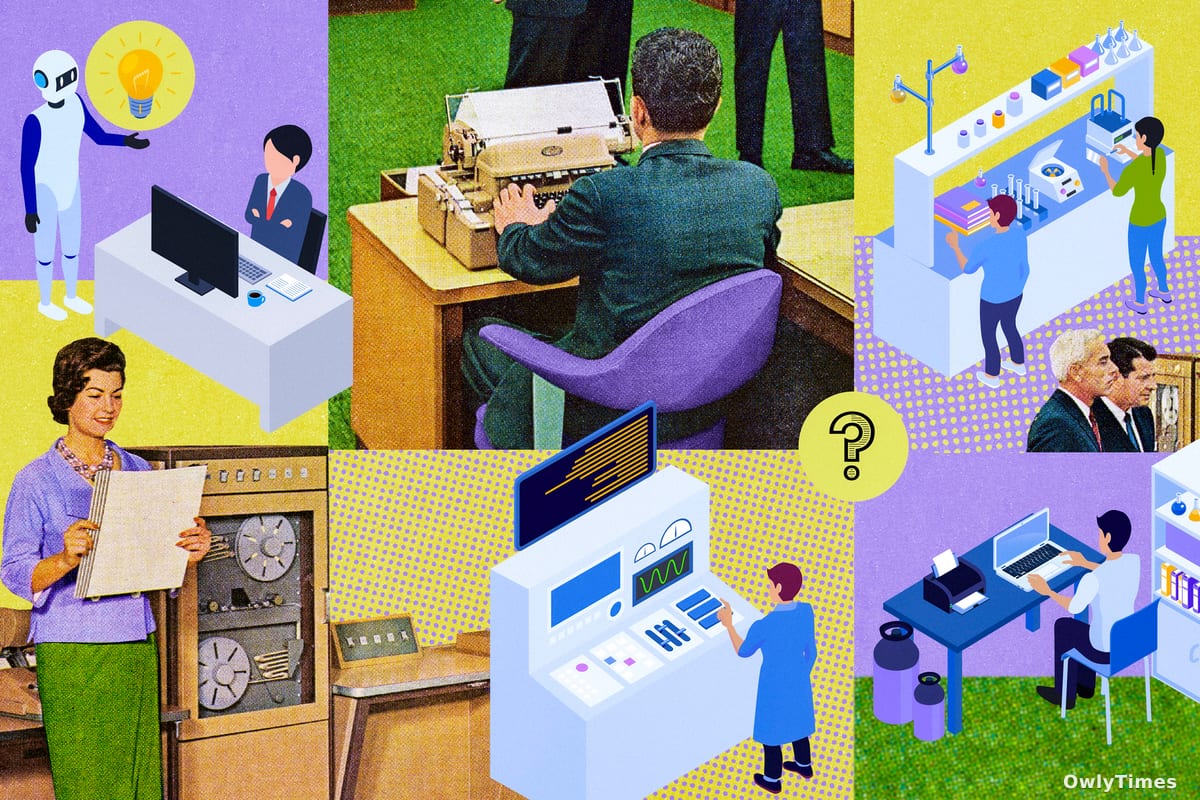

Is the current obsession with artificial intelligence blinding us to the fundamental mechanics of how new jobs are actually born? We treat technological progress like a bolt of lightning—an unpredictable, exogenous event that simply strikes the economy, leaving us to scramble for cover.
The real story here isn’t the existential dread surrounding AI’s ability to replace tasks; it’s the historical evidence that we have consistently failed to cultivate the demand-side environments necessary to turn that disruption into meaningful employment.
A new study of U.S. employment, led by MIT labor economist David Autor, sheds light on exactly how these shifts function. In a paper titled “What Makes New Work Different from More Work?”, forthcoming in the Annual Review of Economics, Autor and his co-authors—Caroline Chin, Anna M. Salomons, and Bryan Seegmiller—peel back the layers of the American labor market from 1940 to 2023. Their findings suggest that the "new work" we so desperately crave doesn't just spontaneously generate; it requires a specific, often government-backed, catalyst.
The Myth of the Spontaneous Professional
To understand the labor market, think of it like the transition from a local cobbler to a modern sneaker factory. In the 1940s, the U.S. government didn’t just hope for innovation; it effectively forced it through massive, state-sponsored expansion of research and manufacturing in response to World War II. That wasn't just "more work"; it was the creation of entirely new categories of expertise.
The data shows that between 1940 and 1950, 85 to 90 percent of new work was technology-driven. Yet, as Autor notes, this wasn't an accident of nature. “If you create a large-scale activity, there’s always going to be an opportunity for new specialized knowledge that’s relevant for it,” he explains. When we treat innovation as a "Eureka!" moment rather than a purposive, cumulative activity, we ignore the fact that the market needs a destination for that new expertise to live.
The Youth and Education Premium
The study reveals a stark reality for the average worker: new lines of work are not distributed equally. As Autor and his colleagues demonstrate, these roles have historically benefited college graduates under 30 more than any other demographic. In the 2011–2023 period, roughly 18 percent of workers were in lines of work introduced since 1970.
This isn't just about initial hiring; it's about trajectory. People employed in new work in 1940 were 2.5 times as likely to be in new work a decade later. College graduates were 2.9 percentage points more likely than their high school-educated peers to land these roles. For the ordinary worker, this creates a "scarcity premium." Expertise is valuable precisely because it is rare, but as Autor warns, “If everyone is an expert, then no one is an expert.” Once a skill becomes common—like using word-processing software, which was once a specialized talent—the wage premium evaporates, and the job essentially becomes "old work."
The AI Fork in the Road
The conversation around AI today is dominated by fear of task erosion. But Autor argues that eroding tasks is not the same as eroding jobs. The critical question for the next decade is whether we will use AI to simply automate existing roles out of existence, or use it to allow workers with varying levels of expertise to perform more complex, specialized tasks.
Take the healthcare sector as a primary example. Because more than half of the dollars spent on healthcare in the U.S. are public, there is a massive lever available to influence how innovation is applied. We can either subsidize a race to the bottom—replacing human labor—or use that public leverage to steer AI toward increasing the productivity of existing roles.
The next reading of the American Community Survey (ACS) data will provide the first real evidence of whether the current wave of AI-driven automation is following the historical pattern of creating new, specialized roles, or if we are witnessing a genuine departure from the job-creation cycles of the 20th century. If we don’t prioritize the demand side of innovation, we risk finding out that the "new work" of the future is a luxury only the youngest and most educated among us can afford to access.