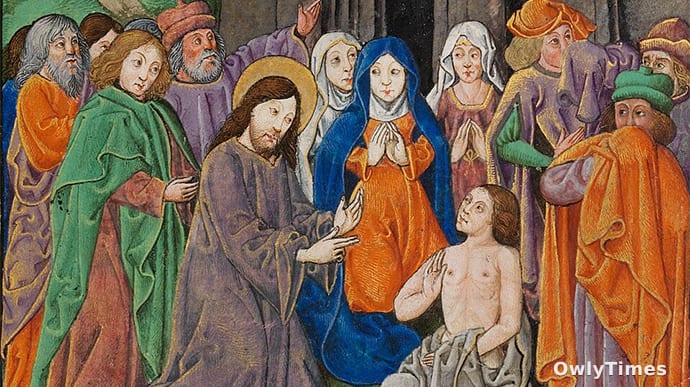

We stand at a curious juncture in human history. Daily, we witness advancements that would have been considered fantastical just decades ago – gene editing, artificial intelligence, explorations into the deepest reaches of space. Yet, despite this relentless pursuit of scientific mastery, one fundamental human experience remains stubbornly, universally, inescapable: mortality. This isn’t a failure of science, but a recognition of its inherent limitations, a point powerfully underscored not by a laboratory finding, but by ancient scripture and artistic depictions like the illumination of “The Raising of Lazarus,” created around 1504 and now held by the National Library of Wales. The image, and the story it portrays, doesn’t offer a scientific solution to death, but a theological framework for understanding it.
The core question raised by both modern science and the biblical narrative isn’t simply how we die, but why death exists in the first place. Saint Paul, writing in Romans 5:12, locates the origin of death within the context of sin: “Therefore, as sin came into the world through one man and death through sin, and so death spread to all men because all men sinned…” This isn’t a punitive decree, but a description of a fractured reality. The inherent drive to overcome death, to prolong life, is understandable, even admirable. However, as Pope Benedict XVI observed in Spe Salvi, an endless extension of earthly existence isn’t necessarily desirable; it risks becoming monotonous, ultimately “unbearable.” The appeal of immortality, he suggests, only makes sense when viewed through the lens of faith, as a transition through death, not an avoidance of it.
Reporting from catholicworldreport.com informs this analysis.
This distinction is crucial. Headlines often trumpet scientific breakthroughs as potential pathways to extending lifespan, even achieving “immortality.” But these claims frequently outpace the actual findings. Research into cellular senescence, telomere shortening, and genetic manipulation aims to address the mechanisms of aging, and has yielded promising results in model organisms. However, translating these findings to humans, and achieving anything resembling indefinite lifespan, remains firmly in the realm of speculation. The current focus isn’t on eliminating death, but on mitigating age-related diseases and improving quality of life in later years – a significant, and valuable, goal, but distinct from conquering mortality itself. The narrative often shifts from “extending healthy lifespan” to “defeating aging,” a subtle but important rhetorical leap.
The story of Lazarus, resurrected by Jesus, isn’t a demonstration of a technique to circumvent biological processes. It’s a manifestation of divine power over life and death, a power stemming from the Trinitarian nature of God. As Saint Paul explains in Romans 8:11, the same Spirit that raised Jesus from the dead can also give life to our mortal bodies. This “Trinitarian science of salvation,” as the author frames it, isn’t about understanding the how of resurrection through empirical observation, but about experiencing the who – the divine source of life itself. The illumination of Lazarus isn’t a medical illustration; it’s a theological statement, a visual representation of hope rooted in faith. Saint Hilary of Poitier’s description of baptism as a preparation for divine adoption further emphasizes this transformative process.
Limitations to consider are inherent in applying theological concepts to scientific inquiry, and vice versa. The language of faith operates within a different framework than the language of science, relying on revelation and belief rather than empirical evidence. To suggest that scientific advancements can “prove” or “disprove” religious doctrines is a category error. Furthermore, the human tendency to conflate correlation with causation can lead to misinterpretations. Observing positive health outcomes associated with religious practice, for example, doesn’t necessarily mean that faith causes those outcomes; other factors, such as social support and lifestyle choices, may be at play. The author rightly points to the importance of encountering Jesus “face to face” as the foundation of belief, a deeply personal experience that transcends scientific analysis.
The next crucial step isn’t to find a scientific workaround for death, but to continue exploring the intersection of faith and reason, recognizing the unique contributions of each. Specifically, research into the placebo effect, the neurobiology of spiritual experiences, and the impact of hope and meaning on health outcomes could offer valuable insights. But more importantly, we must ask ourselves: what kind of future are we building if we focus solely on extending lifespan without addressing the underlying spiritual and existential questions that make life meaningful? Will a longer life, devoid of purpose and connection, truly be a gift, or simply a prolonged existence? The image of “The Raising of Lazarus” serves as a potent reminder that the ultimate answer doesn’t lie within the realm of scientific possibility, but within the embrace of a power that transcends the limitations of our mortal world.