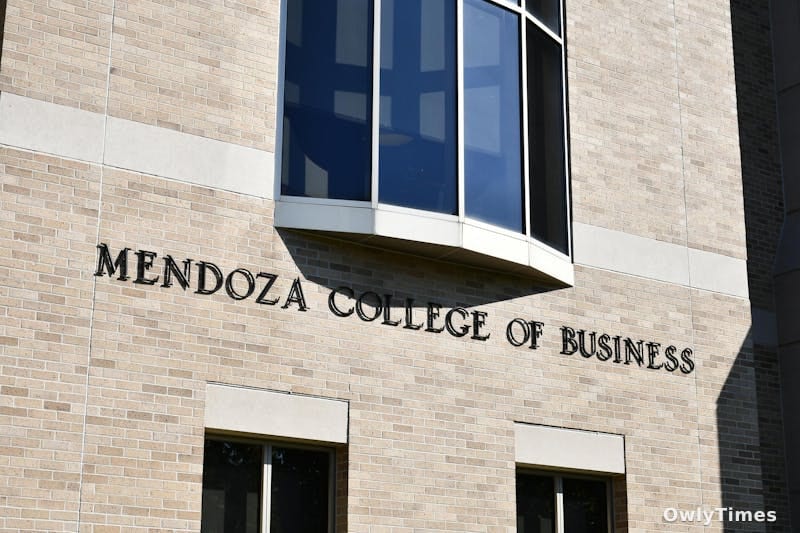

$3.8 Billion is the estimated annual economic impact of international students in the United States, a figure now poised for potential growth thanks to a seemingly academic decision at the University of Notre Dame. On October 27, 2025, the Mendoza College of Business announced its finance major will receive a STEM (Science, Technology, Engineering, and Mathematics) designation effective January 2026. While presented as a recognition of quantitative rigor, a closer look reveals this move is fundamentally about extending the pipeline of skilled labor available to U.S. companies – and significantly altering the calculus for international students weighing their post-graduation options. Follow the money, and the story isn’t about curriculum, it’s about visas and workforce development.
The core benefit of the STEM designation lies in expanded work authorization. Currently, F-1 students – the most common visa type for international students – receive 12 months of Optional Practical Training (OPT) after graduation. A STEM-designated degree unlocks an additional 24-month extension, known as STEM OPT. This 36-month window is critical. As Leah Zimmer, Director of the Office for International Student and Scholar Affairs, explained, it provides more opportunities to apply for the highly competitive H-1B visa, a lottery system for skilled workers. The odds of securing an H-1B visa are notoriously low; increasing the number of application cycles dramatically improves a candidate’s chances. Notre Dame’s move doesn’t change the H-1B lottery itself, but it effectively increases the number of entries for its international finance graduates.
See the original ndsmcobserver.com story for the full account.
This isn’t a university acting in a vacuum. The Department of Homeland Security (DHS) maintains a list of STEM-eligible majors, and universities assign CIP codes to align curricula. The Mendoza College’s finance major simply received an updated code, reflecting a perceived increase in “financial mathematics” – a justification one current student finds questionable. “From what I know, the required classes don't seem to be very mathematics intensive,” the student, granted anonymity, told The Observer. This raises a key tension: the STEM designation is being granted despite a perceived lack of substantial curriculum change. The student’s experience highlights a pragmatic reality – the designation’s value lies almost entirely in the visa extension, not the academic content.
The impact extends beyond Notre Dame’s campus. While international students represent a relatively small percentage of the overall student body, their economic contribution is substantial. According to NAFSA: Association of International Educators, international students contributed $3.8 billion to the U.S. economy in 2023, supporting over 31,000 jobs. By making finance – a consistently popular major at Mendoza – more attractive to international applicants, Notre Dame is potentially increasing this economic influx. More importantly, the move signals a broader trend: universities are increasingly incentivized to seek STEM designations for programs traditionally outside the STEM fields, driven by the demand for skilled foreign labor and the economic benefits that follow. This is particularly acute in fields like finance, where specialized skills are in high demand.
However, the context of increasing geopolitical uncertainty cannot be ignored. The student interviewed expressed concerns about a declining number of employers willing to sponsor H-1B visas, citing both potential policy changes and a general risk aversion. “It’s obviously very hard to predict policy changes… but even from a perspective of increased uncertainty, that’s something that employers are not willing to take on.” This sentiment underscores a critical contradiction: while universities are actively working to extend work authorization for international students, the external environment for securing long-term employment remains volatile. The student’s decision to drop an economics major – previously used as a pathway to the STEM extension – solely for the visa benefit further illustrates this point. The academic pursuit has become secondary to immigration strategy.
What this means for your wallet: if you’re an American worker in the financial sector, Notre Dame’s decision – and similar moves by other universities – could subtly increase competition for entry-level positions. While the overall impact is unlikely to be dramatic, a larger pool of qualified international candidates with extended work authorization will inevitably affect the job market. For international students considering a finance degree, Notre Dame’s STEM designation presents a clear advantage, but it’s crucial to monitor the evolving landscape of H-1B visa sponsorship rates and potential policy shifts. The key question investors and prospective students should be asking now is: will this trend of expanding STEM designations continue, and will the benefits of extended work authorization outweigh the increasing uncertainty surrounding long-term employment prospects in the U.S.?