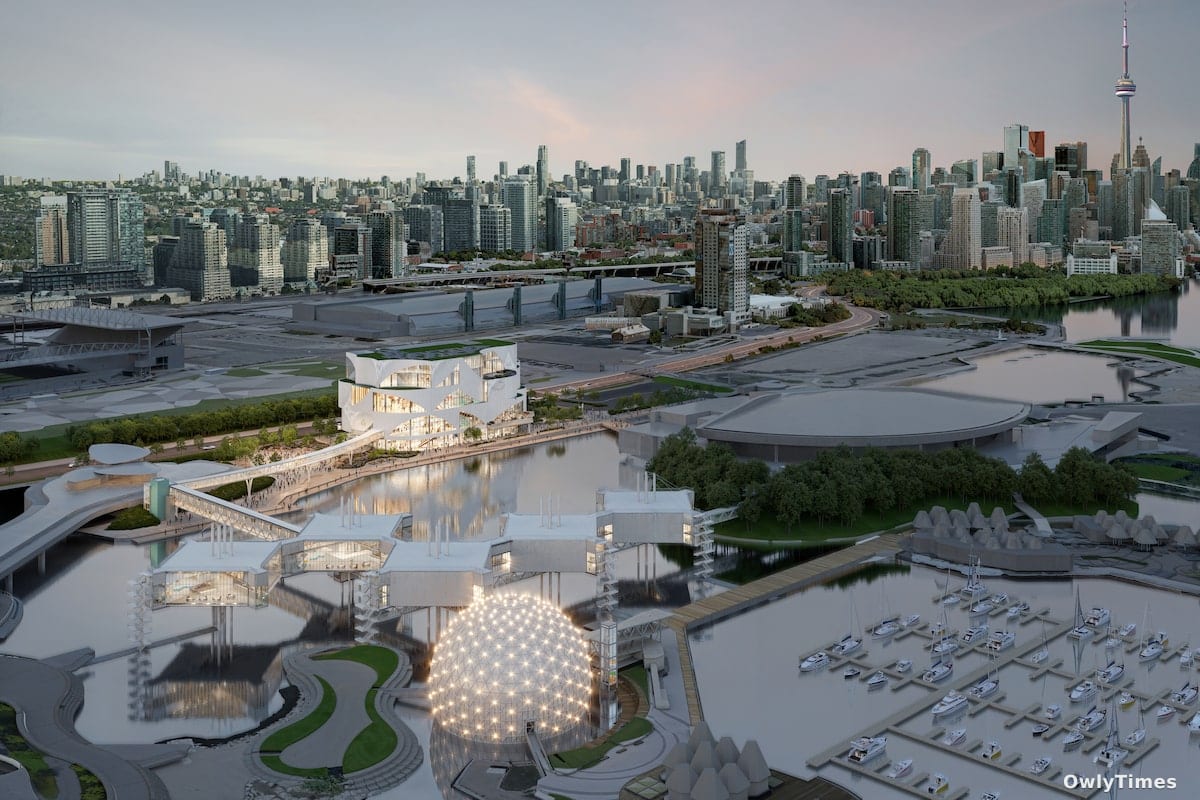

The question of how we publicly invest in scientific literacy is rarely framed as a demolition project. Yet, that’s precisely what’s unfolding in Toronto, as the Doug Ford government moves forward with a new Ontario Science Centre at Ontario Place – a facility demonstrably smaller, likely more expensive, and arguably less functional than the one it’s replacing. The unveiling of designs by the internationally recognized firm Snøhetta, alongside Hariri Pontarini Architects, has garnered headlines praising the architectural prowess brought to bear on the project. However, a closer examination reveals a narrative sharply at odds with the government’s initial promises and raises fundamental questions about priorities in public infrastructure. This isn’t simply a story about bricks and mortar; it’s about a calculated shift in how – and why – we fund spaces dedicated to scientific exploration.
The core issue isn’t the quality of the design itself, but the context surrounding it. The new Science Centre, projected to cost $1.04-billion over the next 30 years, represents more than double the $322-million initially pledged in 2023. Crucially, this figure exceeds the estimated cost of renovating the existing facility in Don Mills. This escalation in price is particularly striking when considered alongside the reduction in size. The original 1969 Science Centre, designed by Moriyama & Teshima Architects, boasts 568,000 square feet, including dedicated workshops, a planetarium, and even a tropical rainforest. The new complex will offer approximately 280,000 square feet, with exhibition space shrinking from 134,000 to 120,000 square feet, according to Ontario MPP Stan Cho. The government’s refusal to release detailed floor plans further complicates independent verification of these figures, creating a concerning lack of transparency.
This article draws on reporting from theglobeandmail.com.
The rationale for this move isn’t rooted in structural necessity, despite claims of immediate danger to the Don Mills building’s roof. Internal engineering reports, as reported, did not recommend closure, but rather a phased, ten-year renovation plan. The decision to shutter the existing centre appears strategically timed to minimize public scrutiny of the downgrade. By removing the existing facility from view, the government effectively controls the narrative, preventing direct comparison between what is being lost and what is being proposed. This tactic is further underscored by the concurrent development of a large-scale indoor waterpark by Therme Group at Ontario Place, suggesting the Science Centre’s relocation is less about scientific advancement and more about facilitating a broader, privately-driven waterfront redevelopment. The $2-billion investment in Ontario Place appears to be primarily geared towards supporting this waterpark project, with the Science Centre serving as a convenient justification for adding a substantial parking garage.
The architectural choice of Snøhetta, while seemingly a positive step, is complicated by recent labor disputes. The firm was cited by the American National Labor Review Board last month for alleged union-busting practices in their New York office. While this doesn’t necessarily invalidate their design capabilities – their work on the 9/11 Memorial Museum demonstrates a sensitivity to spatial experience – it introduces a layer of ethical consideration. The government’s attempt to leverage the firm’s reputation feels like a calculated effort to deflect criticism, a veneer of prestige masking a fundamentally flawed project. The original Science Centre was designed to immerse visitors in the scientific process, offering a sense of discovery through its unique architectural layout – a descent into a simulated natural environment. The new design, by contrast, risks feeling like a more conventional, and ultimately less inspiring, museum experience.
Several limitations must be considered when evaluating this situation. The lack of publicly available detailed plans hinders a comprehensive assessment of the new facility’s potential. Furthermore, the long-term financial implications of the 30-year project timeline remain unclear. However, the core issue isn’t about the specifics of the design, but the underlying principle at play: the dismantling of a successful public institution in favor of a project seemingly driven by political ambition and private interests. The next crucial step is to demand full transparency from the government, including detailed floor plans, a comprehensive cost-benefit analysis, and a clear explanation of how the new Science Centre will adequately serve the province’s scientific education needs. Ontarians should be asking: if the goal is truly to foster scientific literacy, why are we accepting a demonstrably smaller, more expensive, and potentially less effective facility? And, perhaps more importantly, what precedent does this set for the future of public investment in science and education?