
Are we fundamentally misunderstanding the origins of animal life? For decades, the “Cambrian explosion” – that burst of evolutionary innovation roughly 540 million years ago – has been treated as the starting gun for complex animal evolution. But a new fossil discovery in China isn’t just nudging that timeline back a few million years; it’s suggesting the entire narrative needs a rewrite. The real story here isn’t the sudden appearance of life, it’s the realization that we’ve been looking in the wrong places, and with the wrong expectations, for evidence of its earliest forms.
A ‘Dune’ Creature and the Problem of Preservation
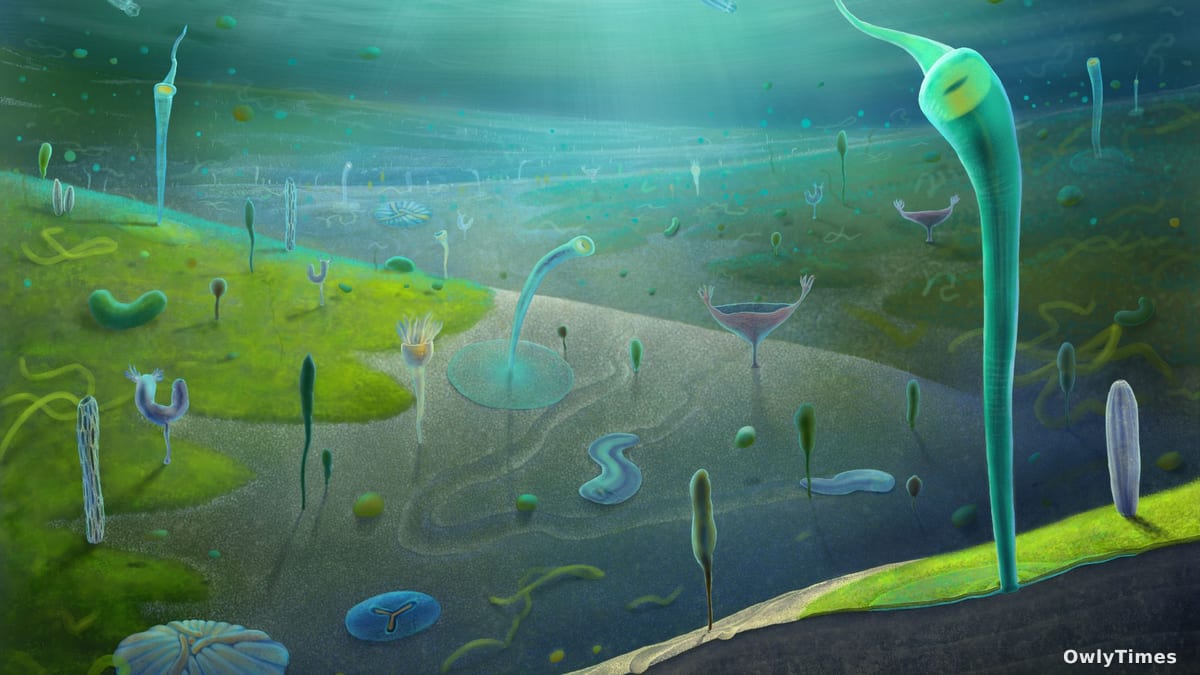
The find, published Thursday in Science, centers around the Jiangchuan Biota, a collection of over 700 fossils unearthed in southwestern China. These aren’t your typical dinosaur bones. Instead, they’re delicate carbonaceous films – essentially, flattened imprints capturing the soft tissues of organisms that lived between 554 and 539 million years ago, during the late Ediacaran period. As Frankie Dunn, a researcher at the Oxford University Museum of Natural History, put it, “One specimen looks a lot like the sand worm from Dune.” While a dramatic comparison, it highlights the surprising complexity of these creatures. This isn’t just a collection of simple blobs; we’re seeing evidence of guts, mouthparts, and body structures that challenge the idea that complexity arose only with the Cambrian explosion.
Reporting from Live Science informs this analysis.
For years, the Ediacaran period was considered a time of relatively simple, mostly soft-bodied organisms. Sponges were known to exist, but the expectation was that the intricate body plans of modern animal phyla – everything from insects to vertebrates – hadn’t yet evolved. The Jiangchuan Biota throws that assumption into question. Researchers have identified fossils resembling early cnidarians (jellyfish, sea anemones, and corals) and other complex forms, suggesting these groups were already present, and diversifying, before the Cambrian period began. The significance isn’t just what they found, but how they found it.
Why the Cambrian Still Matters, But Isn’t the Whole Story
It’s crucial to understand that this discovery doesn’t invalidate the Cambrian explosion. The Cambrian remains a period of rapid diversification, with the emergence of most modern animal phyla, including our own – the chordates. However, the Jiangchuan Biota suggests that the groundwork for this explosion was laid much earlier. The Cambrian wasn’t necessarily the birth of complexity, but perhaps its rapid acceleration. Luke Parry, a paleobiologist at the University of Oxford, described the initial reaction to the fossils as “something totally unique and unexpected.”
The key, according to the research team, lies in the method of preservation. Carbonaceous films are rare. Most fossils form when hard parts – bones, shells – are buried and mineralized. Soft tissues rarely fossilize, and even when they do, they’re often flattened and distorted. The unique conditions at Jiangchuan allowed for the preservation of these delicate structures, revealing a level of complexity previously unseen in Ediacaran fossils. As Ross Anderson, a researcher at the Oxford University Museum of Natural History, explains, the apparent absence of these animals at other Ediacaran sites “may reflect differences in preservation rather than true biological absence.” In other words, they were likely there, but we simply hadn’t found the right places to look.
The Implications for Understanding Our Deep Ancestry
This isn’t just an academic debate for paleontologists. It fundamentally alters our understanding of the evolutionary pressures and environmental conditions that shaped early animal life. If complex animals were already present in the late Ediacaran, it suggests that the environmental triggers for the Cambrian explosion – oxygen levels, ocean chemistry, predator-prey relationships – were perhaps less dramatic than previously thought. It also raises questions about the “molecular clock,” the technique used to estimate the timing of evolutionary events based on genetic mutations. If the fossil record indicates earlier origins for certain groups, the molecular clock may need recalibration.
The average person isn’t thinking about Ediacaran biota or molecular clocks, but this research has a ripple effect. It challenges the neat, linear narratives we often construct about the history of life. It reminds us that evolution isn’t a predictable march towards complexity, but a messy, contingent process shaped by chance, circumstance, and the vagaries of fossilization. It also highlights the importance of continued exploration and the potential for unexpected discoveries to upend our understanding of the past.
Looking ahead, the next crucial step will be finding more sites with similar preservation conditions. If Jiangchuan is an anomaly, it will remain a fascinating but isolated case. But if similar fossils are discovered elsewhere, it will confirm that complex animal life was more widespread and diverse in the late Ediacaran than we ever imagined. The question isn’t if more sites will be found, but when – and what bizarre, “Dune”-like creatures they will reveal.