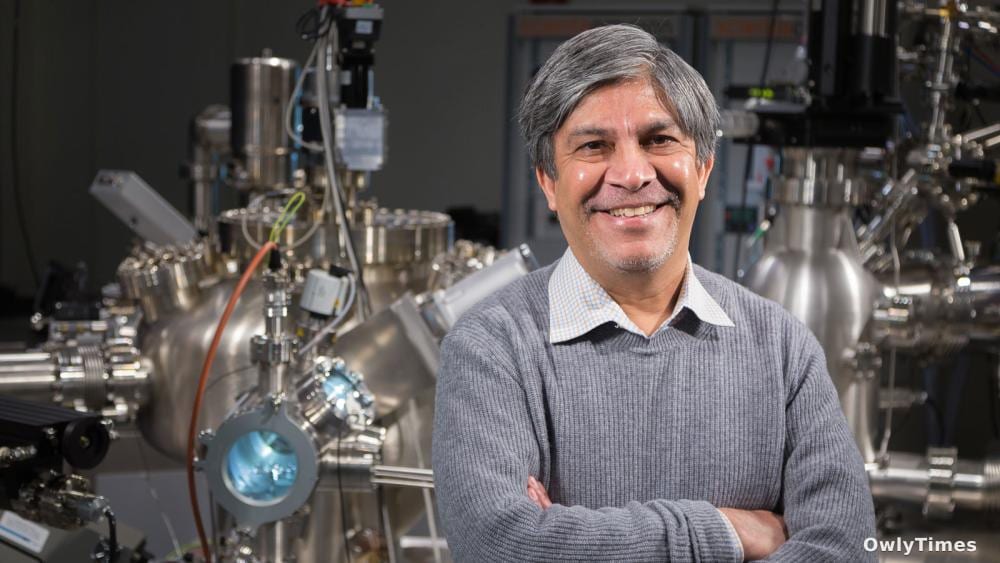

How does the intersection of atomic-scale manipulation and fundamental physics change our technological future? This question lies at the heart of the career of Nitin Samarth, the Verne M. Willaman Professor of Physics at Penn State, who was recently elected as a member of the American Academy of Arts and Sciences. While the headlines highlight this as a prestigious accolade—placing him among a cohort of 252 leaders elected in 2026—the true significance of the honor lies in the specific scientific milestones it recognizes in the field of quantum materials.
The Mechanics of Spin-Related Phenomena
The scientific community recognizes Samarth for his experimental work in semiconductor and topological spintronics. In simple terms, while traditional electronics rely on the charge of electrons, spintronics seeks to utilize the "spin"—a quantum mechanical property—to process information more efficiently. Samarth’s methodology relies on molecular beam epitaxy, a precise technique for growing materials layer by layer, which allows for the creation of new material platforms.
The distinction between the headlines and the research is subtle but vital. News coverage often frames such an election as a career-capping lifetime achievement. In reality, the Academy is recognizing specific, high-impact contributions, such as the observation of long-lived spin coherence in semiconductors published in Science in 1997, and the demonstration of efficient spin-charge conversion in topological insulators published in Nature in 2014. These papers did not just add to a literature pile; they established the foundational physics required for the potential development of next-generation, low-energy computing devices.
Limitations to Consider in Quantum Advancement
While Samarth’s work is foundational, it is important to maintain a realistic view of how these laboratory discoveries translate to public utility. The jump from observing spin coherence in a controlled, cryogenically cooled environment to a stable, consumer-facing device remains one of the most significant engineering hurdles in modern physics. The academy’s recognition of Samarth’s leadership—including his role as associate director of the 2D Crystal Consortium, a facility funded by the U.S. National Science Foundation—underscores that the current challenge is not just discovery, but scaling the synthesis of these 2D quantum materials for broader experimental use.
A Legacy Rooted in Scientific Communication
Beyond his laboratory output of 300 published papers, Samarth’s career is marked by a dual commitment to academic leadership and public literacy. Having served in the chair-line of the American Physical Society (APS) and co-chaired the APS Global Summit in 2026, he has actively navigated the interface between research and policy. His work has appeared in venues ranging from Scientific American to NPR, bridging the gap between highly technical concepts like topological insulators and the broader public interest.
This tradition of public engagement aligns with the historical roots of the academy itself. Established in 1780 by John Adams, John Hancock, and others, the institution was built on the premise that scientific knowledge is essential to a functioning democracy. As Academy President Laurie Patton noted, the election of this year’s class serves as a commemoration of the nation’s 250th anniversary, linking the pursuit of knowledge to the expansion of the public good.
As for what comes next, the scientific community is looking toward the upcoming induction ceremony in Cambridge, Massachusetts, in October. Beyond the ceremony, the trajectory of this research will be dictated by the ongoing output of the 2D Crystal Consortium and the next series of peer-reviewed data on spin-dependent phenomena, which will determine how quickly these quantum materials can move from academic validation to practical, real-world application.





