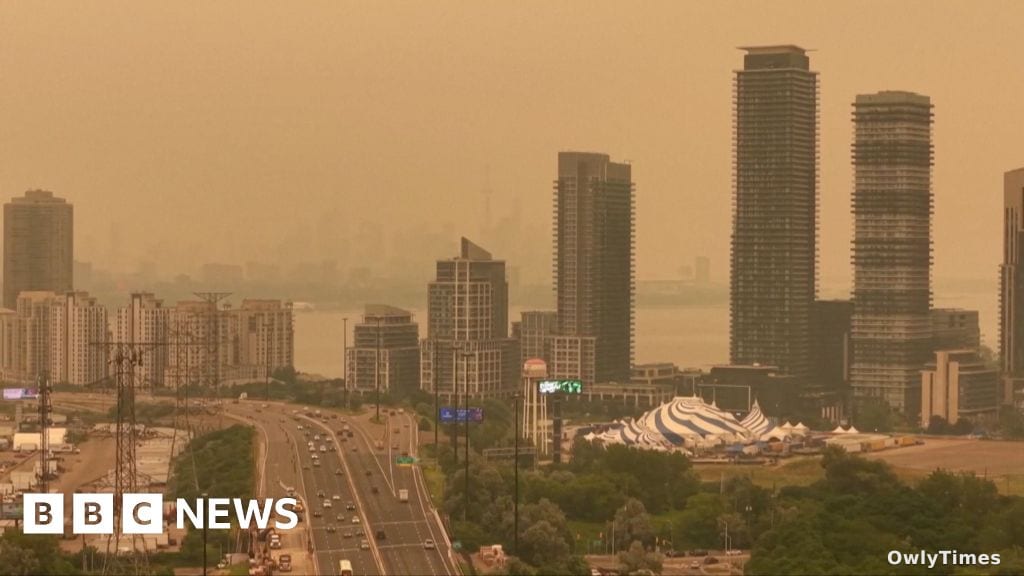

Is the sky outside your window turning a sickly, apocalyptic shade of orange? If you’re living anywhere from the Midwest to the Northeast, you’ve likely noticed the haze—and the real story here isn't just the aesthetic disruption of a yellow-tinged skyline; it’s the fact that our infrastructure is struggling to filter a “toxic soup” of modern debris.
As of Wednesday, July 15, 2026, millions of residents across the U.S. and Canada are breathing air heavily laden with fine particulate matter, specifically PM2.5s. According to WIRED, these particles are roughly 30 times smaller than the width of a human hair, allowing them to bypass our body’s natural filters and settle deep into the lungs. While the BBC reports that there are currently 838 wildfires actively burning across Canada, the situation has been compounded by fires in Minnesota, as noted by CBS News.
When the Environment Becomes a Hazard
The atmospheric shift is being driven by what experts call a “perfect storm” of severe drought and extreme heat. Dan Westervelt, an associate professor at Columbia University's Climate School, explains that these conditions provide abundant fuel for fires to burn with unprecedented intensity. This isn't just forest wood going up in smoke; as these fires push into populated areas, they are consuming homes, cars, and synthetic materials. WIRED points out that this produces a chemical cocktail far more dangerous than typical wildfire smoke, which standard N95 masks—while recommended by experts like Dr. Alexander Azan of NYU Langone Health—cannot fully neutralize.
The data underscores the severity of the situation. While CBS News reports that air quality in parts of northeast Minnesota reached “hazardous” levels, WIRED specifies that Duluth, Minnesota, saw its Air Quality Index (AQI) climb above 500. For context, any reading over 301 is considered unsafe for the entire population. Meanwhile, in New York City, the AQI hit 180 on Wednesday, placing the city firmly in the “unhealthy” category.
Why Your Tech-Driven Lifestyle Is Vulnerable
We often think of air quality as a public health issue, but it’s increasingly a logistical one. The smoke has become so dense that it is forcing operational shutdowns; CBS News detailed a harrowing account of a freight train near Armstrong, Ontario, that was surrounded by a wall of burning trees, leading the Canadian National Railway to suspend operations in the area.
For the average user, the impact is less dramatic but equally disruptive. As Jennifer Stowell of the University of Maryland School of Public Health noted to WIRED, even healthy adults should limit outdoor exposure when the AQI exceeds 100. The challenge is that our modern “havens”—like cooling centers or even our own homes—are not always equipped with the high-grade air purification systems necessary to scrub PM2.5s from the air, meaning we are effectively forced to shelter in place with the very pollutants we’re trying to avoid.
The Long-Term Cost of Hazy Skies
The connection between these spikes in air pollution and long-term health outcomes is becoming impossible to ignore. WIRED cites research suggesting that wildfire smoke already contributes to 40,000 deaths annually in the U.S., a figure that could climb to 70,000 by 2050 if current warming trends persist. Dr. Azan warns that chronic exposure to these pollutants increases the risk of developing long-term heart and lung conditions.
We are watching a shift where clean air, once a basic assumption, is becoming a luxury. The next indicator to watch is the movement of the smoke plume, which meteorologist Tyler Hasenstein of the National Weather Service projects could reach as far south as Washington, D.C., by midday Thursday. Expect air quality alerts across the Northeast and Michigan to remain in effect through the end of the week, with potential extensions based on shifting wind patterns.