
The story of life on land isn’t a simple march from predator to prey, but a surprisingly flexible negotiation with available food sources. For decades, the prevailing narrative held that the transition to herbivory in early land vertebrates occurred relatively late, with the rise of the amniotes in the Early Permian. Now, a remarkable discovery – the 307-million-year-old fossil of Tyrannoroter heberti – is forcing paleontologists to rewrite that story, revealing that plant-eating evolved much earlier, and perhaps more readily, than previously imagined. This isn’t merely about adding a new name to the tree of life; it’s about understanding the fundamental adaptability that allowed vertebrates to flourish on land.
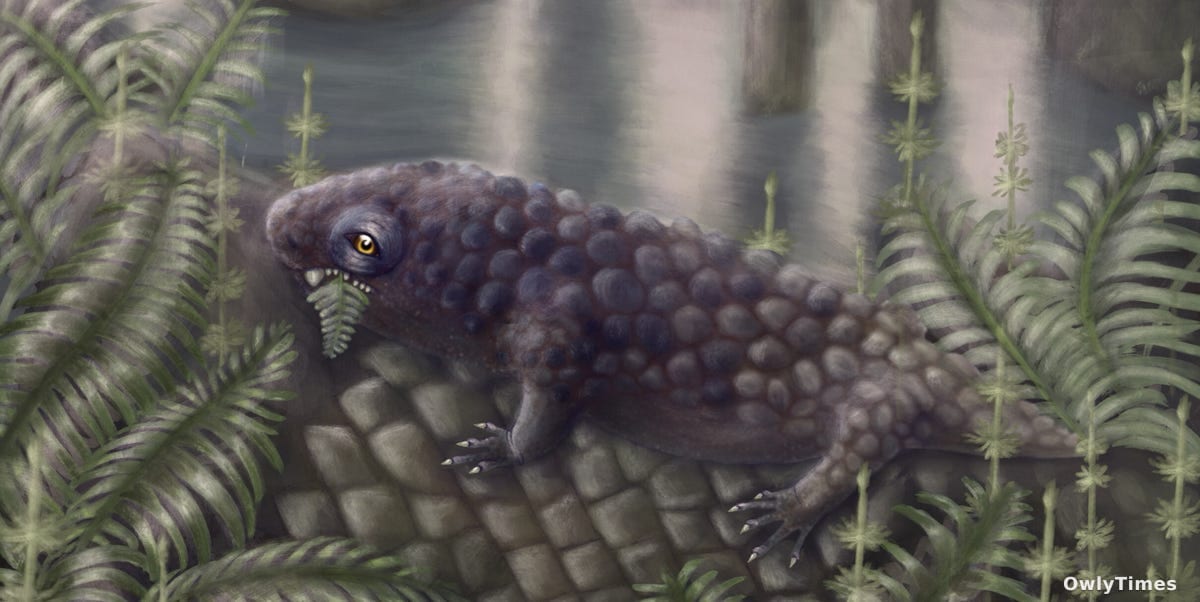
The fossil, a remarkably well-preserved skull unearthed and analyzed by Arjan Mann of the University of Toronto and colleague Zifang Xiong, presents a compelling case for early herbivory. The creature itself, roughly football-sized, lived during the Late Carboniferous period, a time of giant ferns and, famously, enormous insects. While its exact place on the evolutionary tree remains debated – existing before the clear divergence of reptiles and mammals – the structure of its teeth tells a clear story. As Mann and Xiong detail in their recent Nature publication, the teeth exhibit wear patterns indicative of both shearing and grinding motions, a hallmark of herbivorous diets. This isn’t the pointed, slashing dentition of a dedicated carnivore, but a more versatile toolkit suited for processing plant matter.
What’s particularly striking is the complexity of the dental arrangement. CT scans, necessary because the skull had fused shut during fossilization, revealed multiple rows of specialized, conical teeth, including an extra set covering the roof of the mouth. These teeth weren’t just present, they were worn – displaying the bluntness expected from crushing tough vegetation. This is a level of dental specialization previously unseen in animals of this age, and it directly challenges the assumption that early tetrapods were exclusively carnivorous. The researchers posit that Tyrannoroter likely began as a durophagous omnivore, consuming insects and shelled animals, before expanding its diet to include more substantial plant material. This suggests a gradual, opportunistic shift in feeding habits, rather than a sudden evolutionary leap.
The implications extend beyond Tyrannoroter itself. The animal belongs to the Pantylidae family, a group of early vertebrates considered “stem amniotes” – the ancestors of mammals, reptiles, and birds. The discovery suggests that the capacity for herbivory arose independently within this group, and potentially within other early tetrapod lineages as well. This challenges the idea of a single, linear progression towards herbivory and highlights the evolutionary flexibility of these early land dwellers. It’s a reminder that evolution isn’t always about developing entirely new traits, but about repurposing existing ones. The blunt marginal teeth, for example, appear to have taken over a function previously served by other dental structures.
See the original popularmechanics.com story for the full account.
However, it’s crucial to acknowledge the limitations of this study. The analysis is based solely on the skull; the absence of postcranial bones – the bones of the rest of the skeleton – makes it difficult to reconstruct the animal’s overall body plan and infer its locomotion or digestive system. Mann and Xiong have hypothesized a large gut, necessary for breaking down cellulose, based on comparisons with other pantylids, but this remains speculative. Furthermore, determining the precise proportion of plants in Tyrannoroter’s diet is impossible based on dental wear alone. It’s likely the animal remained an opportunistic feeder, supplementing its plant-based diet with insects or other available food sources.
Looking ahead, the search for more complete Tyrannoroter fossils – and those of other pantylids – is paramount. Uncovering postcranial remains would provide crucial insights into its locomotion, posture, and digestive capabilities. Furthermore, detailed analysis of fossilized gut contents, if possible, could reveal the specific types of plants consumed by Tyrannoroter and its relatives. But perhaps the most pressing question is this: if herbivory evolved so early in tetrapod history, why isn’t it more evident in the fossil record? Were these early herbivores simply less common, or are the traces of their plant-based diets more difficult to detect than those of carnivores? Answering this question will require a broader investigation of dental morphology and paleoecological contexts across the Late Carboniferous and Early Permian, potentially revealing a hidden world of early plant-eaters that have long remained obscured.