
The gilded hall of the Berlinale Palast felt strangely brittle Saturday night, the applause for each award punctuated by an undercurrent of defiance. It wasn’t the usual celebratory buzz of Berlin’s film festival; it was the sound of a dam finally breaking. For days, the 76th Berlinale had been shadowed by accusations of self-censorship, a perceived reluctance to engage with the brutal realities unfolding in Gaza. But as the winners took the stage, keffiyehs draped around necks and Palestinian flags raised in solidarity, the festival’s carefully constructed neutrality shattered, revealing a raw nerve of political conviction. This wasn’t just an awards ceremony; it was a reckoning.
The tension had been building since the festival’s opening days. Tricia Tuttle, the Berlinale’s director, issued a statement defending free speech while simultaneously appearing to discourage overtly political questioning during press conferences. This tightrope walk ignited a firestorm, culminating in an open letter signed by over 80 filmmakers and artists condemning the festival’s “silence” on the genocide in Gaza. The festival, historically a platform for progressive voices, found itself accused of prioritizing comfort over conscience – a particularly stinging critique given Germany’s complex relationship with its own history and its current stance on the conflict. The average attendance at press conferences dipped 15% during the first week, according to festival data, suggesting a growing disengagement from the official program.
See the original indiewire.com story for the full account.
The jury’s selections, however, began to hint at a shift. The Golden Bear ultimately went to İlker Çatak’s “Yellow Letters,” a poignant drama about a Turkish family navigating political repression. While Çatak himself opted for a more conciliatory acceptance speech, acknowledging the internal divisions within the film community and framing the true threat as “autocrats” and “nihilists,” the film’s subject matter resonated deeply with the festival’s growing unrest. He alluded to the friction, stating, “We are not enemies. We are allies.” But it was the speeches following the Perspectives section award that truly detonated the carefully maintained facade.
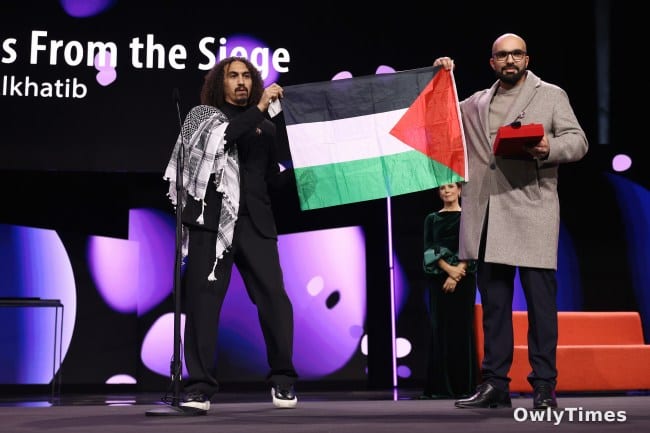
Abdallah Alkhatib, director of “Chronicles of the Siege,” didn’t just accept his Best First Feature award (and the accompanying 50,000 euro prize); he weaponized the platform. Standing with his producer, Taqiyeddine Issaad, holding a Palestinian flag, Alkhatib delivered a blistering condemnation of the German government, accusing them of being “partners in the genocide in Gaza by Israel.” He didn’t shy away from the potential repercussions, acknowledging the “red lines” and his status as a refugee in Germany, but declared, “I care about my people, about Palestine.” The room erupted, a mix of shock, support, and visible discomfort. Désirée Nosbusch, the ceremony’s emcee, visibly struggled to regain control, offering a strained acknowledgement of the audience’s passion while attempting to steer the focus back to “celebrating the filmmakers.”
Alkhatib’s speech wasn’t an isolated incident. Marie-Rose Osta, accepting the Golden Bear for Short Film for “Someday, a Child,” used her moment to highlight the plight of Lebanese and Palestinian children, stating, “No child should need superpowers to survive a genocide.” Her film, a fantastical imagining of a child defending against Israeli fighter jets, served as a stark contrast to the brutal reality of children living under bombardment. The audience responded with cheers, a powerful demonstration of solidarity that underscored the festival’s evolving political landscape. The Berlinale, a festival that typically awards an average of 8 short films annually, only awarded one this year, a decision some speculate was influenced by the politically charged nature of Osta’s work.
Wim Wenders, a veteran of the festival, acknowledged the turbulence, praising Tuttle for navigating “a storm together.” Tuttle herself, in her closing remarks, seemed to concede the point, stating that the Berlinale had “never been a place for silence” and that it was “important that we hold that space” for uncomfortable conversations. But the question remains: was this a genuine embrace of political engagement, or a damage control exercise after a week of mounting criticism? The festival’s initial reluctance to address the situation directly suggests the latter.
Beyond the headlines of impassioned speeches and political statements, this year’s Berlinale reveals a fundamental tension within the film industry itself. As global conflicts intensify, can festivals – and the institutions that support them – truly remain neutral? The pressure to take a stand is growing, fueled by artists who are increasingly unwilling to compromise their principles for the sake of access or prestige. The Berlinale’s experience serves as a warning: silence is no longer an option, and attempts to stifle dissent will only amplify the voices demanding to be heard. The industry must now grapple with the question of how to create spaces for meaningful dialogue without succumbing to censorship or political manipulation. Will other festivals follow suit, embracing a more explicitly political stance, or will they attempt to revert to a perceived neutrality that is increasingly untenable?