
The question of what the universe looked like moments after its birth has captivated physicists for decades. While theoretical models predicted a state of incredibly dense, hot plasma – a “quark-gluon plasma” or QGP – confirming its properties has proven elusive. Recent research, however, published in Physics Letters B, doesn’t just confirm the existence of this primordial soup, but demonstrates it behaved as a fluid, sloshing and swirling like any other liquid, albeit at a trillion degrees. This isn’t simply a validation of existing theory; it’s a demonstration of a novel experimental technique that allows us to probe the universe’s earliest moments with unprecedented clarity, and it reveals how much we still rely on indirect observation when studying phenomena beyond our everyday experience.
The initial universe, fractions of a second after the Big Bang, wasn’t filled with atoms, but with a “soup” of fundamental particles – quarks and gluons – unbound by the forces that typically hold matter together. This state, the QGP, is predicted to have existed for only a few millionths of a second before cooling and forming the protons and neutrons that make up atomic nuclei. Recreating these conditions requires immense energy, achievable only in particle colliders like CERN’s Large Hadron Collider (LHC). The challenge isn’t just creating the QGP, but observing its behavior within the chaotic aftermath of high-energy collisions between lead particles traveling at nearly the speed of light. Yen-Jie Lee of MIT, a key researcher on the project, succinctly puts it: “Now we see the plasma is incredibly dense, such that it is able to slow down a quark, and produces splashes and swirls like a liquid. So quark-gluon plasma really is a primordial soup.”
See the original ScienceAlert story for the full account.
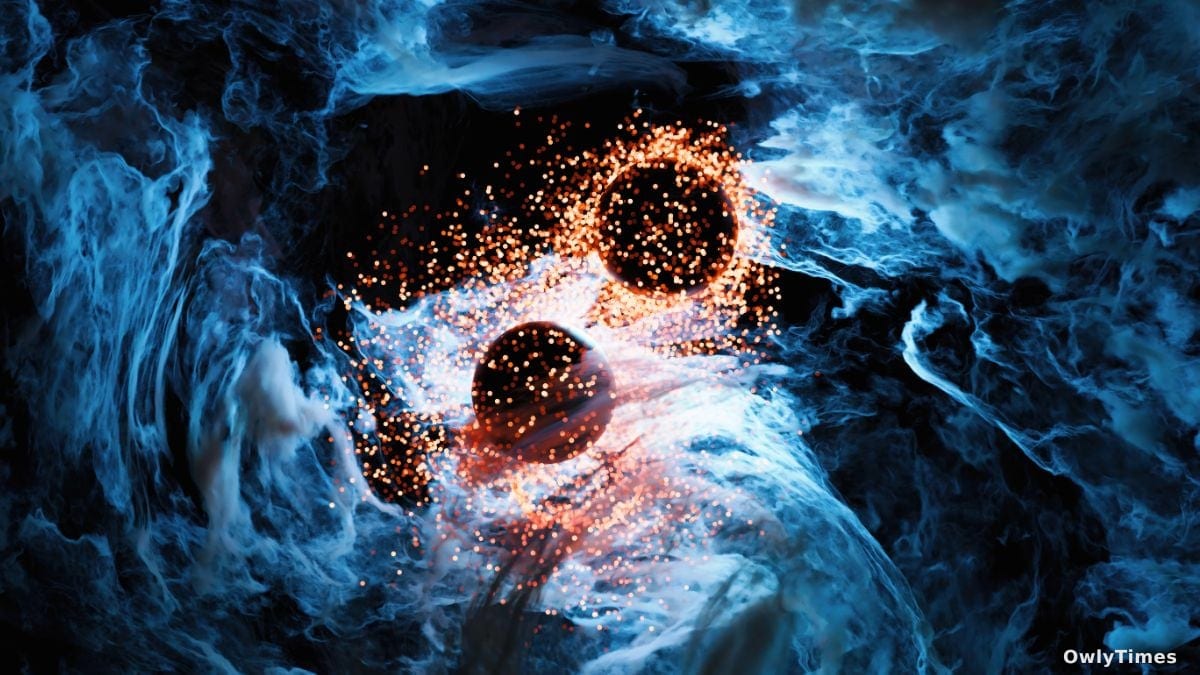
What makes this study different isn’t a new collision result, but a new way of seeing the results. Previous experiments attempted to track quark-antiquark pairs created in these collisions, but the simultaneous wakes created by both particles obscured the signal. The team, led by researchers at MIT and CERN, shifted focus to collisions producing a quark and a Z boson. The Z boson, crucially, doesn’t interact with the QGP, meaning it doesn’t create a wake of its own. This allowed the team, using the Compact Muon Solenoid (CMS) detector at CERN, to isolate and analyze the wake created solely by the speeding quark. The observed distortion of the QGP – a slowing of the quark and a measurable energy transfer to the surrounding plasma – aligns precisely with theoretical models predicting liquid-like behavior. Krishna Rajagopal, also of MIT, likened the effect to a boat moving through water, explaining via email that “the wake is water behind the boat that is moving in the direction of the boat…the boat has transferred momentum to some region of water, which is ‘following’ it.”
However, headlines proclaiming a definitive answer to the question of QGP fluidity should be approached with caution. While the data strongly supports the liquid-like behavior, the analysis required sifting through an enormous amount of noise – 13 billion collisions yielding only 2,000 events with a usable quark-Z boson pair. The statistical significance is high, but the complexity of the interactions within the QGP means alternative explanations, while less likely, cannot be entirely ruled out. Furthermore, the QGP created at the LHC is a tiny droplet, existing for a quadrillionth of a second, and may not perfectly replicate the conditions of the early universe. The study acknowledges this inherent limitation, emphasizing the need for continued scrutiny and independent verification of the results.
The true power of this research lies not just in confirming a theoretical prediction, but in establishing a new methodology for studying extreme states of matter. Rajagopal describes this approach as a fundamental principle of materials science: “the way you learn about the properties of a material is to disturb it in some way, and measure how the disturbance spreads and dissipates.” This technique can now be applied to other high-energy collisions, potentially unlocking further secrets about the strong force that binds quarks together and the nature of matter itself. The next step will be to refine this method, increasing the precision of the measurements and exploring different energy scales to map the phase diagram of the QGP – essentially, understanding how its properties change under different conditions. Will future experiments reveal deviations from the predicted liquid behavior, hinting at even more exotic states of matter? That’s the question physicists will be racing to answer.