
Beyond the Blue: Why Mapping Earth’s Faintest Atmosphere Matters Now
For decades, our understanding of Earth’s atmosphere has largely stopped where the air thins to near-vacuum. But a vast, diffuse cloud of hydrogen – the exosphere – still surrounds our planet, and it’s not merely an ethereal fringe. It’s a critical zone where Earth interacts with space, slowly losing water, and responding to the constant barrage of solar activity. On March 1st, NASA’s Carruthers Geocorona Observatory officially began its 24-month primary science mission, poised to deliver the most detailed picture yet of this often-overlooked atmospheric layer. This isn’t simply about completing a map; it’s about understanding the long-term habitability of our own planet, and refining our search for life elsewhere.
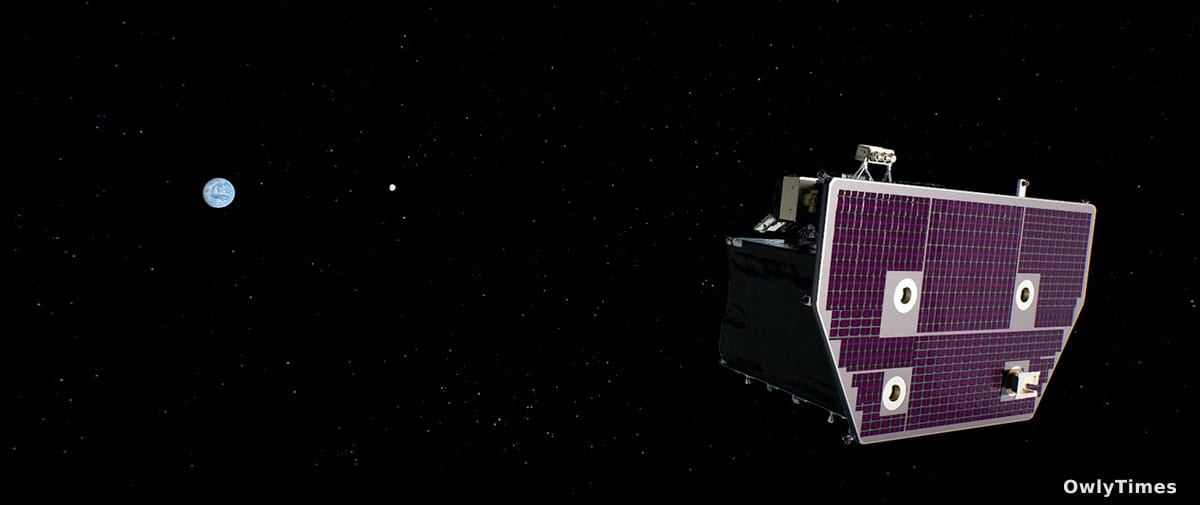
The observatory, launched from NASA’s Kennedy Space Center on September 24, 2025, and reaching its operational orbit at the Sun-Earth L1 Lagrange point in January, occupies a unique vantage point. Situated roughly one million miles sunward of Earth, Carruthers enjoys an uninterrupted view of the geocorona – the ultraviolet glow emitted by hydrogen atoms in the exosphere when struck by sunlight. This constant observation is key. Previous studies, including the pioneering work of Dr. George R. Carruthers himself with the Apollo 16 mission in 1972, provided snapshots. This mission, named in his honor, promises a continuous, high-resolution movie of the exosphere’s dynamic behavior. The two onboard ultraviolet imagers, one wide-field and one narrow-field, are designed to capture details invisible to the naked eye, revealing subtle shifts and changes in the geocorona’s structure.
What’s particularly compelling is the timing of this mission. We are currently in Solar Cycle 25, a period of increasing solar activity. The exosphere isn’t a static shield; it expands and contracts in response to solar winds and storms. These fluctuations directly impact space-based infrastructure – satellites, communication networks, and GPS systems – all of which are increasingly vital to modern life. While headlines might focus on dramatic solar flares, Carruthers will provide the crucial data needed to predict and mitigate the subtle, yet persistent, effects of space weather on these technologies. Initial projections suggest a peak in solar activity around 2025-2026, making the next two years of observation particularly valuable for establishing a baseline understanding of exospheric response.
Drawn from science.nasa.gov.
However, the implications extend far beyond protecting our satellites. The exosphere is the gateway for water loss from Earth. High-energy radiation breaks down water vapor into hydrogen and oxygen, with the lighter hydrogen escaping into space. While the rate of loss is currently slow, understanding this process is fundamental to understanding planetary evolution. Scientists plan to compare data from Carruthers with observations of Mars, a planet that lost its surface water billions of years ago, and lacks a global magnetic field to protect its atmosphere. This comparative planetology is crucial. The question isn’t just that Mars lost its water, but how and why, and whether similar processes could threaten Earth’s long-term habitability.
Limitations to Consider
It’s important to note that interpreting the data from Carruthers won’t be straightforward. The exosphere is incredibly tenuous, and disentangling the effects of different solar events from the natural variability of the atmosphere will require sophisticated modeling. Furthermore, the observatory’s focus is primarily on hydrogen. While hydrogen escape is a major pathway for water loss, oxygen loss also plays a role, and is more difficult to observe directly. The mission, led by Lara Waldrop of the University of Illinois Urbana-Champaign, acknowledges these challenges and is collaborating with researchers at the University of California, Berkeley, and Utah State University’s Space Dynamics Laboratory to develop robust analytical techniques. The spacecraft itself, designed and built by BAE Systems, represents a significant engineering achievement, but its capabilities are still limited by the constraints of space-based observation.
A Planetary Detective Story
The data collected by Carruthers will be publicly available, fostering collaboration and accelerating scientific discovery. NASA’s Goddard Space Flight Center, managing the mission for the Heliophysics Division, anticipates releasing initial findings within the first year. But the real impact will be felt over the long term, as these observations are integrated into larger models of Earth’s atmospheric dynamics and planetary habitability.
Looking ahead, the next critical step will be combining Carruthers’ data with observations from other missions, such as the European Space Agency’s upcoming Ariel space telescope, designed to study the atmospheres of exoplanets. By understanding how water is lost from Earth and Mars, we can refine our criteria for identifying potentially habitable worlds beyond our solar system. The question we should be watching for isn’t simply whether we find another “Earth,” but whether we can accurately assess its long-term capacity to sustain liquid water – and, by extension, life as we know it. Will the data from Carruthers reveal subtle warning signs about Earth’s own atmospheric stability, prompting a reevaluation of our planetary stewardship? That’s a question the next two years of observation may begin to answer.





