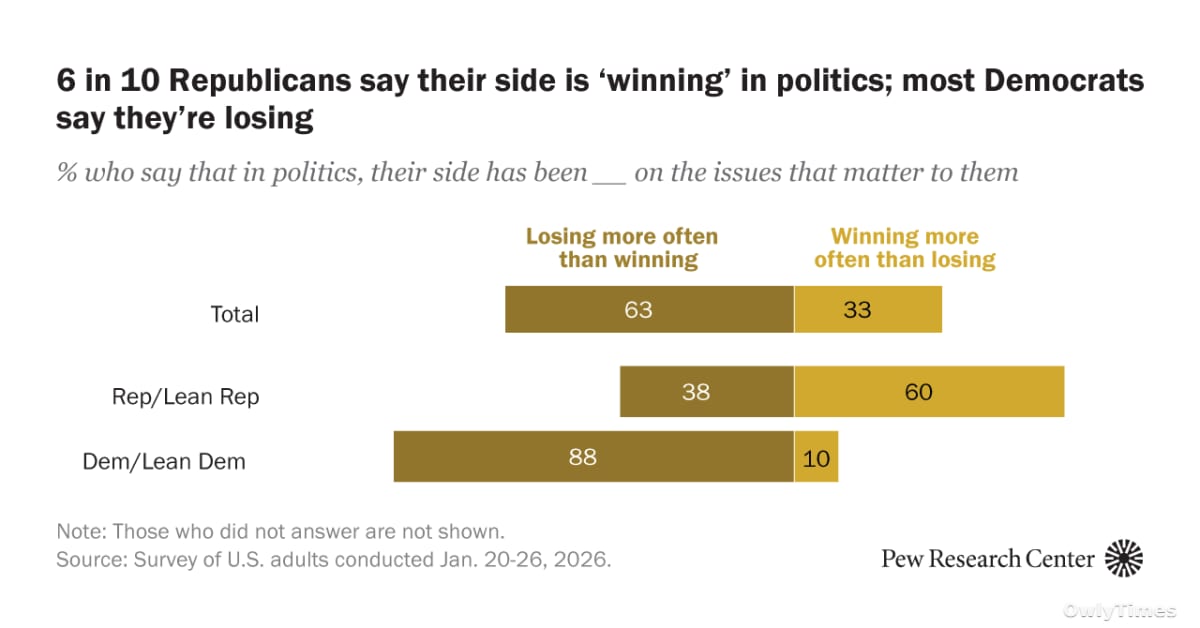

The surge in Republican optimism, revealed in a recent Pew Research Center survey, isn’t simply a reflection of policy victories – it’s a calculated re-establishment of narrative control. Six in ten Republicans now believe their side is “winning” in politics, a figure not seen since the latter half of Donald Trump’s first term, and a stark contrast to the pervasive sense of defeat among Democrats, 88% of whom feel their party is losing. This isn’t about objective gains or losses; it’s about the strategic deployment of perceived momentum, a tactic with deep roots in American political history. The data, collected January 20-26, 2026, reveals a widening partisan chasm – a 50-percentage-point gap – that speaks to a fracturing of shared reality and a hardening of political identities.
The Asymmetry of Political Perception
The key takeaway isn’t the numbers themselves, but the asymmetry. While overall Americans have consistently leaned towards feeling like their side is losing over the past decade, the current Republican surge surpasses even the peak optimism experienced during Trump’s initial years in office. This is a deliberate construction. The Trump administration, and now the forces aligned with it, have mastered the art of framing setbacks as strategic maneuvers and amplifying perceived wins, regardless of their actual impact. Compare this to the experience of Democrats during Joe Biden’s presidency, where peak optimism saw only 36% believing their side was winning. The difference isn’t merely policy-driven; it’s a difference in the ability to project strength and control the narrative. Ted Van Green, a research analyst at Pew Research Center, highlights the consistency of this pattern, but the current magnitude is what’s truly noteworthy.
Echoes of Historical Polarization
This dynamic isn’t new. Consider the period following the Civil War, where Reconstruction-era Republicans, despite facing significant resistance, actively cultivated a narrative of progress and national healing, even as the reality on the ground for African Americans remained deeply fraught. Or, look at the rise of the New Right in the 1980s, where Ronald Reagan skillfully projected an image of American resurgence, even as economic inequalities persisted. In each case, the ability to shape public perception – to convince supporters that “their side” is winning – was crucial to maintaining political power. The current situation echoes these historical precedents, demonstrating that political success isn’t solely determined by policy outcomes, but by the effective management of public sentiment. The 63% of all Americans who feel their side is losing underscores a broader disillusionment with the political process, a sentiment skillfully exploited by those who can offer a compelling alternative narrative.
Based on the original pewresearch.org report.
Who Benefits and Who Loses?
The immediate beneficiaries of this Republican surge are, predictably, those seeking to consolidate power within the party. A confident base is more likely to donate, volunteer, and actively participate in the political process. More subtly, this perception of winning creates a self-fulfilling prophecy. It attracts moderate voters who are drawn to perceived strength and momentum. The losers are those who rely on a sense of shared national purpose or a belief in compromise. A deeply polarized electorate, convinced that the other side is inherently illegitimate, is less likely to engage in constructive dialogue or find common ground. The 10% of Democrats who feel their side is winning represents a historic low, signaling a crisis of morale and a potential for further disengagement. This isn’t simply a matter of hurt feelings; it’s a threat to the foundations of democratic participation.
The Next Chess Move: 2028 and Beyond
The data from Pew Research Center isn’t a prediction of future events, but a snapshot of the current strategic landscape. The question now is whether this Republican narrative of victory can be sustained through the 2028 election cycle. Will the party be able to translate this perceived momentum into concrete policy gains, or will it ultimately be exposed as a carefully constructed illusion? The critical move to watch is how Republicans respond to potential setbacks. A single significant defeat could shatter the carefully cultivated image of invincibility. More importantly, will Democrats attempt to counter this narrative with a compelling vision of their own, or will they continue to languish in a state of perceived defeat? The next 18 months will reveal whether this is a genuine shift in power dynamics, or simply a temporary advantage in the ongoing battle for the American mind.