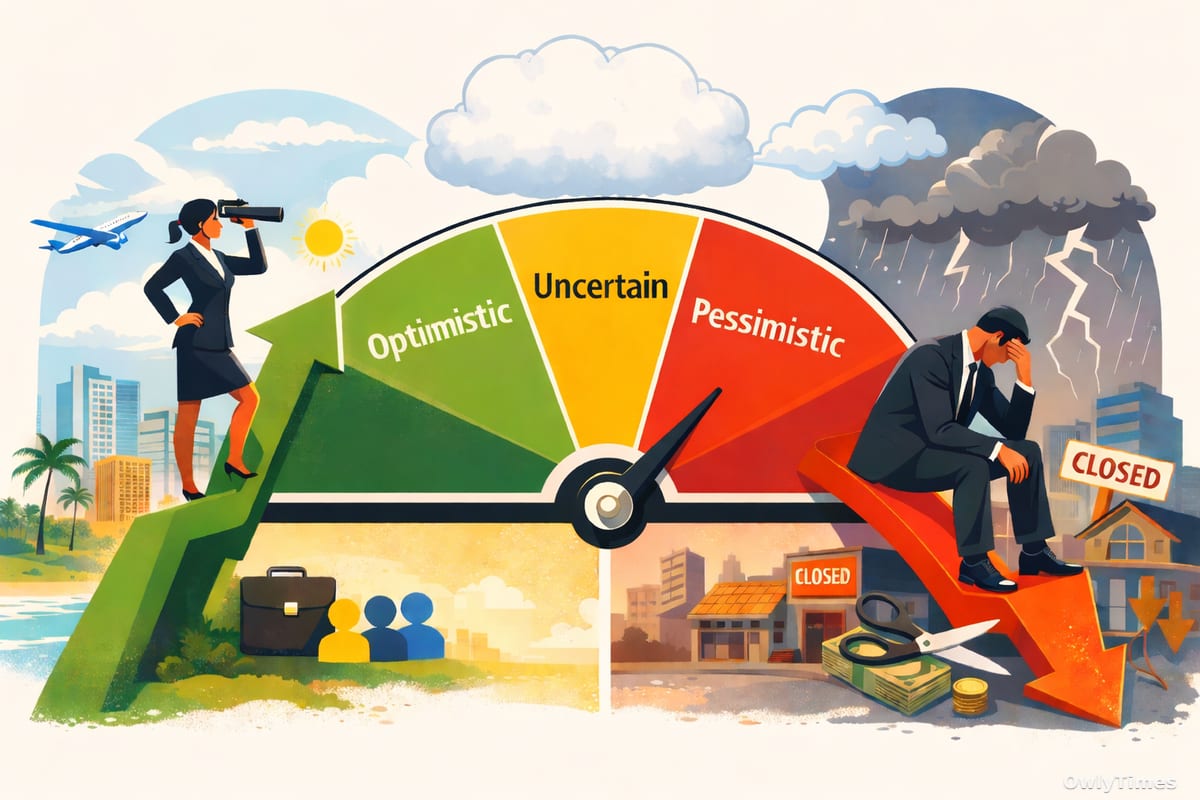

51%: That’s the share of Hawai‘i business leaders bracing for economic decline in 2026, according to the latest BOSS Survey – a figure that doesn’t simply reflect pessimism, but signals a likely contraction in investment and hiring across the state. While headlines often focus on topline economic indicators, following the money reveals a more nuanced, and concerning, picture: a widening divergence between the fortunes of tourism-dependent businesses and those operating outside the visitor industry, coupled with a growing hesitancy to invest in future growth. This isn’t merely a cyclical downturn; it’s a recalibration based on perceived systemic risks and a lack of confidence in the broader economic environment.
The BOSS Survey, conducted between October 8th and December 18th, 2025, polled 307 owners and executives across Hawai‘i. The resulting Optimism Index, historically averaging 111.5 since 2016, has plummeted in recent surveys, falling significantly below that benchmark in both 2025 assessments. This isn’t a slight dip; it represents a fundamental shift in sentiment. To put this in perspective, the index hasn’t consistently traded this low since the immediate aftermath of the COVID-19 pandemic, suggesting current anxieties are comparable to those experienced during a period of unprecedented economic disruption. The survey’s margin of error is ±5.59 percentage points, but the breadth of negative sentiment suggests the trend is robust.
This article draws on reporting from hawaiibusiness.com.
Digging deeper, the data reveals a stark split along sectoral lines. While over half of all respondents anticipate a worsening economy, that pessimism is significantly less pronounced within the tourism sector. A full 25% of tourism executives predict improvement in 2026, compared to just 13% of those outside the industry. This divergence is directly reflected in performance metrics. In the past year, 31% of tourism companies added employees, while only 14% of non-tourism businesses did. Similarly, 43% of tourism companies reported increased profits, versus 30% for the broader business community. This isn’t simply a case of tourism “holding steady” while other sectors struggle; tourism is actively expanding while others prepare for contraction.
This performance gap is translating into differing investment strategies. When asked about capital spending plans for 2026, 24% of tourism respondents indicated significant increases, compared to only 17% outside the sector. This suggests tourism businesses, buoyed by recent performance, are willing to double down on growth, while others are prioritizing cost-cutting measures. In fact, the survey found a greater proportion of businesses planning substantial cost reductions than those planning spending increases, indicating a defensive posture across much of the Hawai‘i economy. The BOSS Performance Index, which aggregates revenue, profit, and staffing data, confirms this trend: tourism companies consistently outperform non-tourism companies, with a substantial gap in overall index scores.
The state’s new “Green Fee” – a 0.75 percentage point increase to the hotel and short-term rental tax, effective January 1st, 2026 – further complicates the picture. While the general public expresses moderate support (scoring 3.6 on a 5-point scale), support is notably higher within the tourism industry (scoring 4.1). This suggests tourism businesses, while potentially absorbing some of the cost, view the fee as a necessary investment in the long-term sustainability of the industry. However, businesses outside of tourism are less enthusiastic, potentially viewing it as another burden in an already challenging economic climate. This division highlights a fundamental tension: the state’s reliance on tourism revenue versus the need to diversify the economy and support non-tourism sectors.
What this means for your wallet: Expect a bifurcated economic reality in Hawai‘i. Tourism-dependent areas will likely continue to see growth and job creation, but businesses outside of tourism may face increased pressure to cut costs and delay expansion. For consumers, this translates to potentially higher prices for goods and services outside the tourism sector, and a widening gap in economic opportunity between those employed in tourism and those in other industries. The key question now is whether the state can effectively leverage the revenue generated by the Green Fee to address broader economic challenges and foster sustainable growth beyond the visitor industry – or if Hawai‘i will remain overly reliant on a sector vulnerable to external shocks and shifting travel patterns.