
The human eye, remarkable as it is, acts as a biological filter that keeps us grounded in a relatively modest reality. While we perceive roughly 6,000 stars on a clear night, the true scale of our galaxy remains largely invisible to our naked senses. The latest collection from the Milky Way Photographer of the Year 2026 awards serves as a necessary corrective to this limited perspective, bridging the gap between what we see and the billions of stars actually illuminating the void.
Technology Meets the Ancient Sky
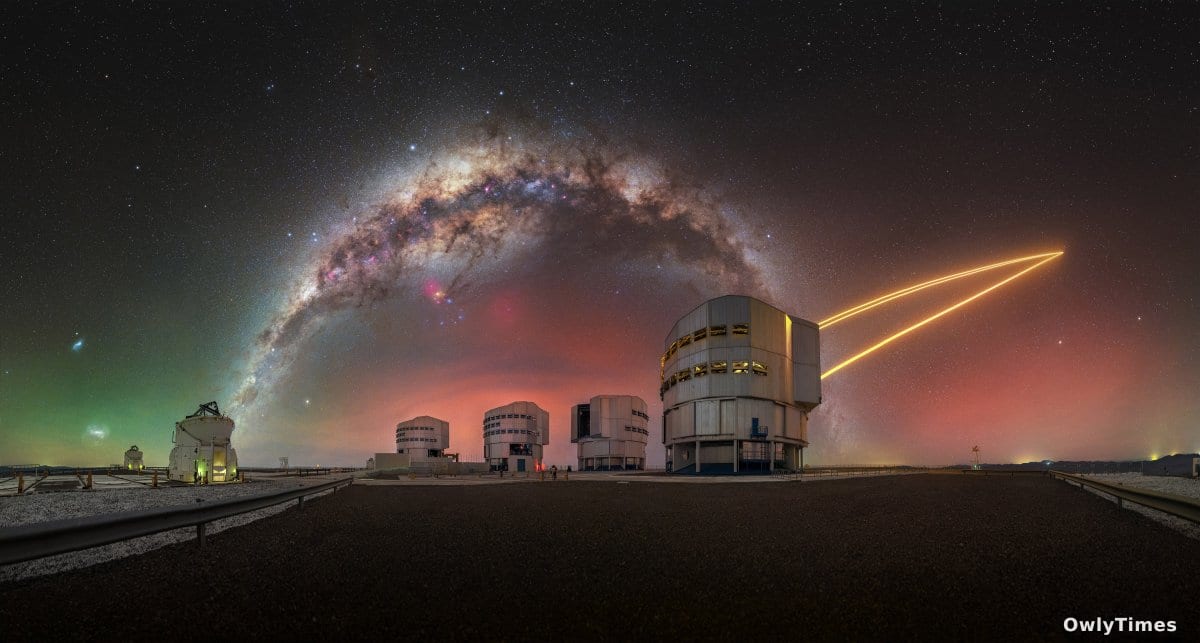
The intersection of high-end optical engineering and rugged wilderness is perfectly illustrated at the Very Large Telescope (VLT) in Chile’s Atacama Desert. Operated by the European Southern Observatory, the site sits at 2,635 meters above sea level, a location that offers more than 300 clear nights per year due to its extreme dryness and stable atmospheric layers.
Scientific headlines often focus on the raw output of such facilities, but the precision here relies on a sophisticated feedback loop. One of the four primary telescopes, UT4 (Yepun), utilizes four sodium laser beams to create artificial guide stars at an altitude of approximately 90 kilometers. These beams aren't just for show; they provide a reference point for adaptive optics systems to compensate for atmospheric distortion in real-time. What many casual observers might mistake for mere scenic lighting is actually a critical calibration tool that allows astronomers to see through the "shimmer" of our own atmosphere.
The Reality of Composite Imaging
While these photographs are stunning, it is essential to distinguish between a single frame and a constructed narrative. Many of the images in this year’s competition—which drew over 6,500 submissions, a record for the project—utilize techniques like focus stacking, time-lapse integration, and multi-exposure blending. For example, Luis Cajete’s work featuring both winter and summer Milky Way arcs is a composite capturing several hours of transition, a sight that does not exist in a single moment for the human eye.
Similarly, Stefano Pellegrini’s image of Botswana baobabs required a combination of one exposure for the landscape, eleven for light painting, and a stack of four tracked exposures for the sky. These methods are not "faking" the stars, but rather gathering light over time in a way our eyes cannot. The result is a scientifically dense representation of the night sky, revealing details like the Gum Nebula—a massive supernova remnant—that remain elusive in standard photography.
Limitations to Consider
Despite the beauty of these images, there is a mounting tension between the growth of astrophotography and the preservation of the environments that make it possible. As noted by Josh Dury, who documented the Perseid meteors over Durdle Door, beauty hotspots are seeing increased foot traffic. The challenge for the community is to avoid the "Instagram effect," where the pursuit of the perfect shot leads to environmental degradation of fragile ecosystems. Photographers are increasingly tasked with balancing their desire to document these "wild" skies with the urgent need to protect the dark-sky sanctuaries they rely on.
The Next Frontier for Dark Skies
The future of this field lies in the formalization of dark-sky tourism and preservation. Projects like the one led by Ignacio Pelaez in Baja California Sur aim to document and promote areas that meet the criteria for Dark Sky Sanctuaries, effectively using photography as a tool for historical and environmental conservation. As we look forward, the next reading of light pollution metrics in these regions will determine whether these "wild" pockets of the night sky can survive the encroachment of human development. The value of these images may ultimately be measured not by their aesthetic appeal, but by their success in convincing a wider public that the night sky is a heritage worth defending.