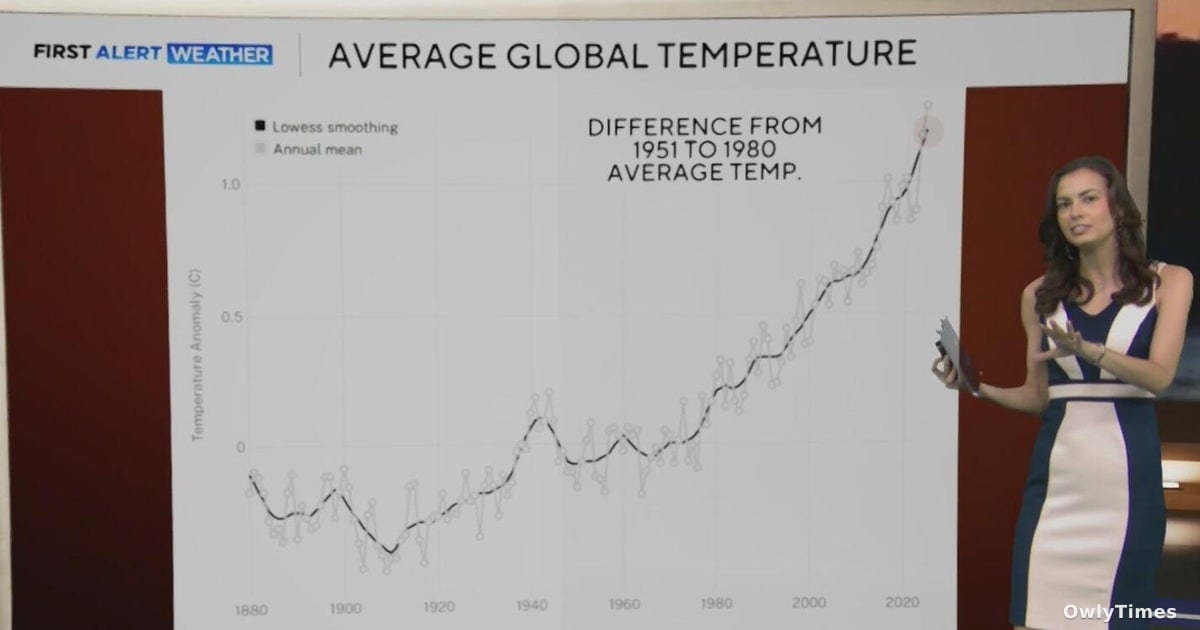

The persistent claim that the Earth is warming isn’t a matter of belief, but a conclusion drawn from decades of meticulous data collection. While headlines often frame “climate change” as a future threat, the scientific record, as of March 8, 2026, demonstrates a warming trend already firmly underway – and accelerating at a rate that demands attention not for its novelty, but for its potential to reshape life on Earth with unprecedented speed. The core of this understanding rests on a simple, yet powerful, visualization: a graph charting global temperature shifts since 1880, compiled by NASA scientists from over 25,000 data points worldwide.
A Historical Perspective on Temperature Fluctuations
This isn’t to say the Earth’s temperature has always been stable. The NASA data, based on departures from the 1951-1980 average, reveals a period of natural warming and cooling cycles from 1880 to around 1970. These fluctuations are expected; Earth has experienced warm periods and ice ages long before human influence. In fact, we are currently emerging from an ice age, meaning current temperatures are relatively cool when viewed across geological timescales. However, the critical distinction lies in the pattern observed since 1970. Unlike the cyclical ebb and flow of previous decades, global temperatures have exhibited a consistent upward trend, with no significant cooling periods recorded in the last 56 years. This sustained warming isn’t simply a return to a warmer state, but a departure from established climatic behavior.
This article draws on reporting from CBS News.
The Rate of Change and Historical Parallels
Since 1950, the Earth has warmed by 2 degrees Fahrenheit. While this may seem incremental, the historical context is alarming. The largest mass extinction event in Earth’s history occurred when temperatures rose by more than 18 degrees Fahrenheit – but over a period of 50,000 years. Extrapolating current warming rates, which are actually increasing (we’ve warmed 2°F in just the last 70 years), suggests we could reach that same 18-degree threshold in less than a quarter of the time. This isn’t a prediction of inevitable doom, but a stark warning about the speed at which the climate is changing, a speed that far exceeds the capacity of many species to adapt.
Impacts on Biodiversity: A Warning Sign
The consequences of this rapid warming are already visible in the natural world. The International Union for the Conservation of Nature and Natural Resources reports that 44% of all coral reefs and 41% of all amphibians are currently at risk of extinction. While a mass extinction event is technically defined as the loss of 75% of all species, the current trajectory is deeply concerning. These aren’t isolated incidents; they represent a systemic stress on ecosystems worldwide. The data isn’t suggesting we will reach a mass extinction, but rather that avoiding one will require unprecedented and sustained conservation efforts. Furthermore, the last four decades have each been warmer than any previous decade since 1850, reinforcing the trend and diminishing the likelihood of a natural reversal.
Limitations to Consider and Future Research
It’s important to acknowledge the limitations of this data. While 25,000 data points provide a robust global picture, regional variations and data gaps inevitably exist. The 1951-1980 baseline, while widely used, is itself an arbitrary point in time and could influence the perceived magnitude of warming. Moreover, attributing warming solely to human activity requires further investigation – a topic CBS San Francisco’s “Zoomin’ with Zoe” plans to address. The next crucial research steps involve refining climate models to better predict regional impacts, investigating the complex feedback loops within the Earth’s climate system, and, critically, determining the precise contribution of various factors to the observed warming trend. But the fundamental question – is the Earth warming? – is no longer a subject of scientific debate. The question now is: what will happen when temperatures reach 4, 6, or 8 degrees Fahrenheit above the 1950 average, and what proactive measures can we take to mitigate the most severe consequences?