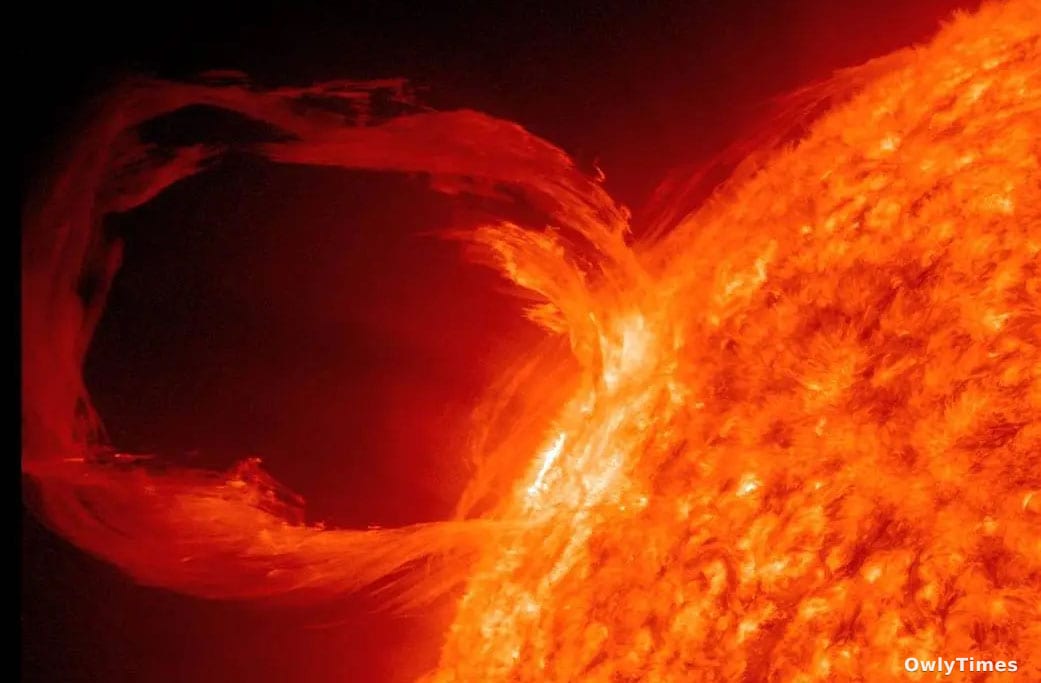

How do massive, gravity-defying structures of plasma remain suspended in the Sun’s volatile atmosphere for weeks or months at a time, and what triggers their sudden, violent transformation into a threat to Earth? For years, the physics governing solar prominences—dense, flickering clouds of plasma that hover above the solar surface—have remained an elusive puzzle for heliophysicists. New research from the Max Planck Institute for Solar System Research (MPS) has finally moved beyond simple observation, offering a dynamic look at the internal mechanics that sustain these solar features.
The Physics of a Solar Balancing Act
Solar prominences are striking not just for their scale, but for their thermal defiance. While the surrounding solar corona reaches temperatures of one million degrees, these structures maintain a relatively cool 10,000 degrees. They are also significantly denser than their environment, roughly 100 times more so. Dr. Lisa-Marie Zessner, lead author of the study published in Nature Astronomy on April 23, 2026, likens the density contrast to a wooden ship floating in Earth’s atmosphere.
The new study, titled “Self-Consistent Numerical Simulations for the Formation and Dynamics of Solar Prominences,” identifies the magnetic field as the primary architect of these structures. By developing complex simulations of plasma-magnetic field interactions, the team at MPS discovered that prominences form in the dips between magnetic field arches. Turbulent, small-scale movements of the magnetic field push plasma into these dips, where it becomes trapped. This mechanism reveals how the Sun’s deeper, cooler layers—including the 6,000-degree surface and the 20,000-degree chromosphere—exert influence on the plasma’s behavior.
Beyond Static Models
Previous models of solar prominences effectively demonstrated how these clouds condense, but they failed to account for the continuous supply of material that keeps them stable over time. This research provides a more nuanced view: a prominence is not a static object, but a dynamic system caught in a tug-of-war. The simulation shows that while plasma is constantly lost in the form of "rain" falling back to the solar surface, it is simultaneously replenished by new bursts of material.
It is important to clarify that while these findings represent a significant leap in computational modeling, they remain simulations. The study successfully bridges a gap in our understanding of mass balance, yet these models are still simplifying the incredibly complex, three-dimensional magnetic environment of the Sun. We are observing a theoretical framework that aligns with observed solar phenomena, but further validation through high-resolution observational data will be necessary to confirm the exact thresholds at which these mass-supply processes tip from maintenance into eruption.
Why Predicting Solar Eruptions Matters
The urgency of this research lies in the potential for these prominences to transition from stable clouds to explosive events. When a prominence erupts, it drives charged solar particles into space, a phenomenon that poses a documented risk to modern infrastructure. While Earth’s atmosphere provides some protection, our growing dependence on orbital satellites for GPS and global communications makes us increasingly susceptible to solar-induced disruptions.
As Sami K. Solanki, Director of the “Sun and Heliosphere” Department at MPS, notes, a deeper understanding of these features is a vital component in creating reliable space weather forecasts. By identifying the interplay between plasma loss and mass gain, scientists are better positioned to predict the stability of these "ticking time bombs." The next step for researchers will be integrating these findings into predictive models that can provide earlier warnings for solar activity, with the ultimate goal of mitigating the impact of space weather on the technological systems that underpin daily life on Earth.