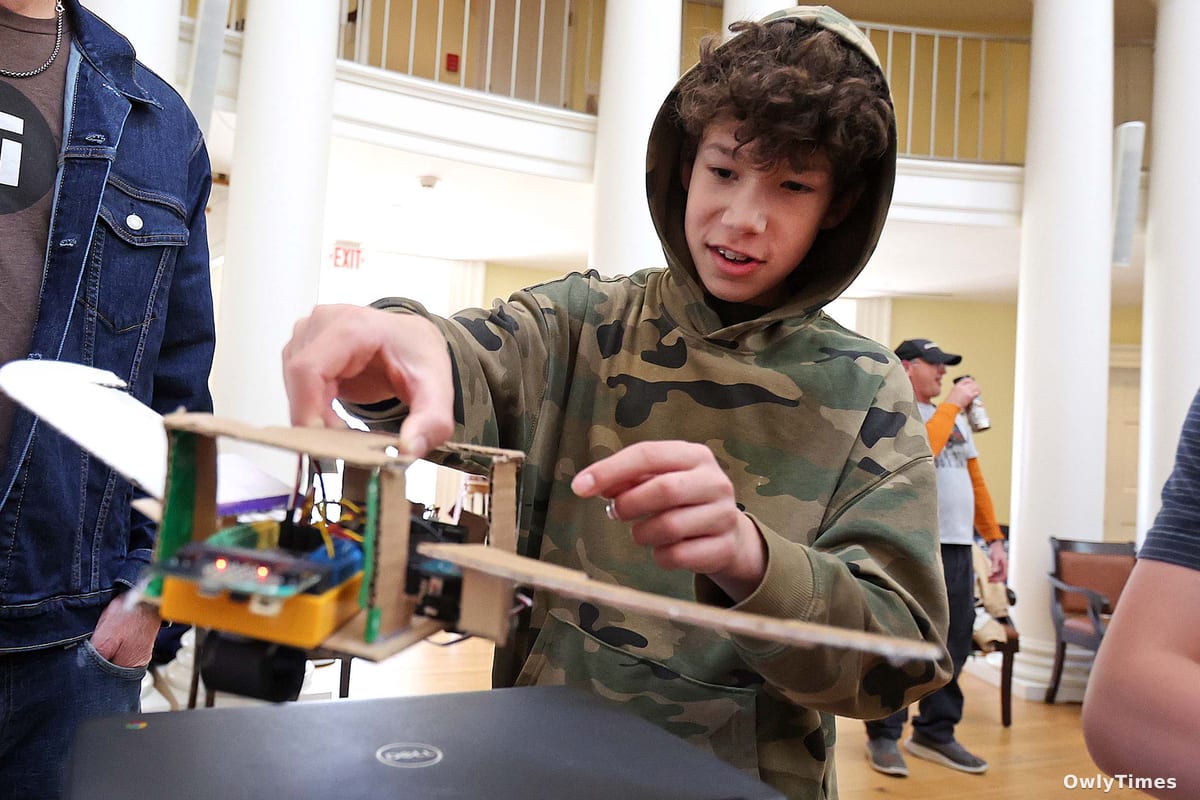

Is Silicon Valley’s obsession with “innovation” finally trickling down to places that actually need it – and in a way that isn’t just another expensive gadget for affluent kids? The scene at the University of Virginia’s Rotunda this week, where seventh graders showcased bio bots ranging from LED-lit anglerfish to robotic Venus flytraps, suggests something genuinely different is happening in Charlottesville. The real story here isn't about cute robots—it’s about a radical shift in STEM education that’s prioritizing access and practical application over flashy tech demos.
From Tuesday through Thursday, students from Charlottesville Middle School presented their creations, a vibrant display of computational thinking applied to biology. Cecilia Lally, a seventh grader, built a Venus flytrap that closes its “mouth” using a rotation servo and distance sensor, wrestling with the “kinks” of aligning the mechanics. These aren’t isolated projects; they’re the output of the Innovation Hub, a partnership between Charlottesville City Schools and UVA’s School of Education and Human Development launched last fall. While lab schools aren’t new, the Innovation Hub’s model is. It’s not a separate, selective program for gifted students—every seventh grader at Charlottesville Middle School participates, making it unique in Virginia. This is a deliberate move, a rejection of the “STEM for the elite” narrative that often dominates the conversation.
Original reporting: news.virginia.edu.
The Virginia Mathematics and Science Coalition already recognized the Innovation Hub as a leading STEM education model, but the scale of integration is what’s truly noteworthy. Director Conner Brew credits Tonya Coffey, Charlottesville City Schools’ science and innovation coordinator, with the logistical feat of embedding this program into existing science classes. This isn’t an add-on; it’s a fundamental restructuring of how science is taught. Jennie Chiu, an associate professor at UVA’s School of Education and Human Development, explains that “infusing computation into core academic subjects…enables students to use computing skills to solve meaningful and relevant problems.” That’s a crucial distinction. Too often, STEM education focuses on abstract concepts; the Innovation Hub is about applying those concepts to the world around them.
What’s also compelling is the program’s commitment to research-driven improvement. A full-time researcher, Jessica Forrester, ensures the program evolves based on student feedback and demonstrable results. This isn’t a top-down initiative imposed on teachers; it’s a collaborative effort. This year, four science teachers are participating in a yearlong fellowship alongside colleagues in other disciplines—math, English, and history—learning to integrate technology and computer science into their curricula. Elke Doby, a seventh-grade life science teacher and returning fellow, noted increased student participation and engagement through hands-on activities, observing that students “learned a lot more by being able to apply the knowledge they learned in class.” That’s a simple observation with profound implications. It suggests that the key to unlocking student potential isn’t more technology, but better application of it.
The success of the Innovation Hub isn’t just about the robots. It’s about empowering students like Cecilia Lally to experience “creative freedom” and a “sense of purpose” in their learning. It’s about teachers rediscovering the power of hands-on engagement. But here’s the question we should all be asking: can this model be replicated outside of Charlottesville? Will other school districts prioritize equitable access to computationally rich STEM education, or will the gap between the haves and have-nots continue to widen, leaving the next generation of innovators concentrated in a handful of privileged zip codes? Watch for the Virginia Department of Education’s next round of STEM funding allocations – they’ll reveal whether this is a genuine statewide priority or just a local success story.





