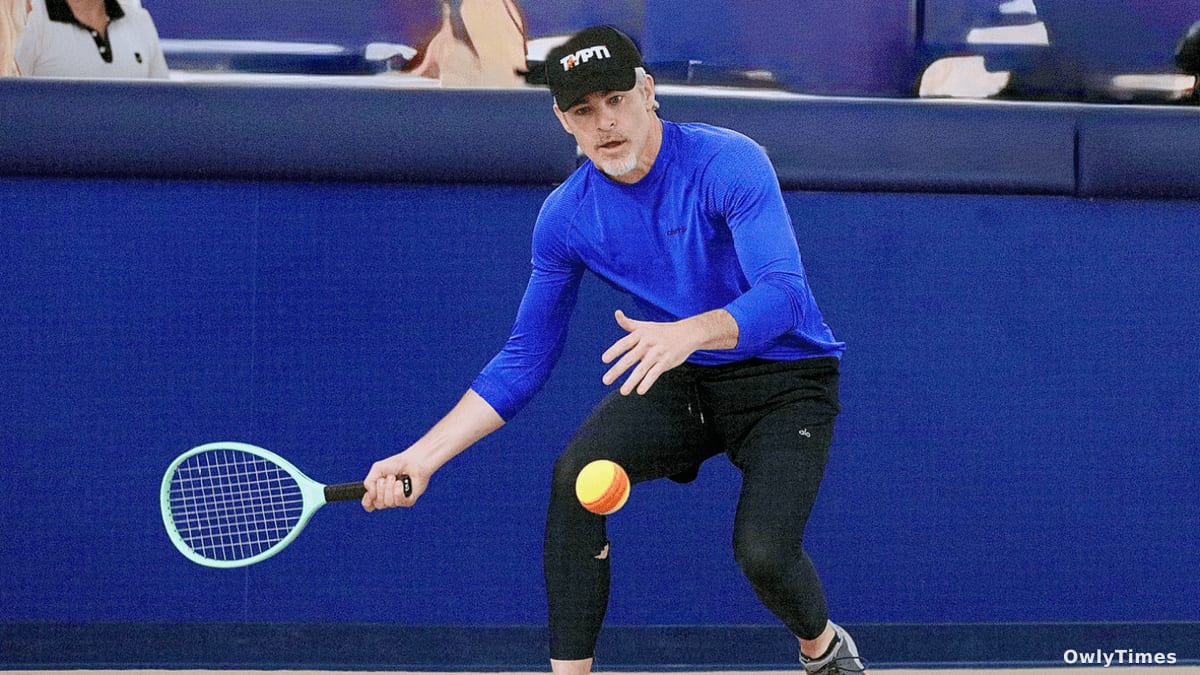

The sound of a professional racquet sport is usually defined by the percussive, high-decibel "pop" that has become the sonic signature of the pickleball boom. But this weekend, the Calabasas Pickleball Club in Los Angeles will host something distinctly different. The inaugural U.S. Open TYPTI Championships will feature a game that promises to be nearly noiseless, played with a 3.5-inch channeled foam ball and a 22-inch strung racquet. It is a moment of refined "bedlam," as founder Steve Bellamy describes it, marking the public arrival of a sport he has been refining for over three decades.
Beyond the polished presentation, the launch of TYPTI represents a strategic maneuver to capitalize on the massive infrastructure already laid by the pickleball craze. With nearly $100 billion worth of pickleball courts now existing across the United States, Bellamy—the former president of Motion Picture and Entertainment at Kodak—has designed a game that requires zero new real estate. By utilizing standard courts, TYPTI positions itself not as a competitor to the current racquet revolution, but as a secondary utility for the same space, much like how snowboarding once breathed new life into the ski industry.
The human drama behind this launch is as star-studded as a Hollywood premiere. Bellamy, who previously founded the Tennis Channel, the Ski Channel, the Surf Channel, and the Skate Channel, has successfully courted a massive list of strategic investors including Tony Robbins, Drew Brees, Chris Pine, JJ Abrams, and Nick Kyrgios. The game’s rules were even galvanized during sessions on Necker Island, where Bellamy and Brees stress-tested the concept alongside local tennis matches. For a sport that only officially launched four months ago, the rapid adoption has been jarring; Bellamy reports that they have already outsold initial racquet forecasts by 1,400 percent, with tens of thousands of players currently active.
This weekend’s tournament offers $100,000 in total prize money, a significant incentive for the field of competitors that includes Ashley Harkleroad, Clay Thompson, and Vicky Duval. The stakes are elevated by the distribution deal inked with Tennis Channel, which will broadcast all five championships on Sunday starting at 11 a.m. PT on Tennis Channel 2, while Saturday’s matches stream via the Tennis Channel app and YouTube. Commentary will be provided by Vince and Duke Van Patten, with Vince, a former professional tennis player, comparing the birth of this tournament to the historic 1877 opening at the All England Club.
The cultural significance of TYPTI lies in its deliberate attempt to lower the barrier of entry for physical fitness. While professional-level play is described as dynamic and artistic, the sport’s mechanics—specifically the absence of an overhead serve and the use of shockless ball strikes—are intended to make it sustainable for aging joints and accessible to beginners. Investors like Robbins are betting that this ease of use will turn the sport into a new standard for physical and mental health programming at clubs nationwide.
As the Calabasas Pickleball Club positions itself as the "official birthplace" of the tournament, the industry is watching to see if this can truly become the "new golf" for the Hollywood crowd and beyond. The next reading of the sport's growth will be determined by the broadcast reception this weekend and the subsequent integration of the game into the hundreds of clubs currently programming it. Whether TYPTI can evolve from a celebrity-backed curiosity into a lasting fixture of the American sports landscape remains the central question as the first ball is served.