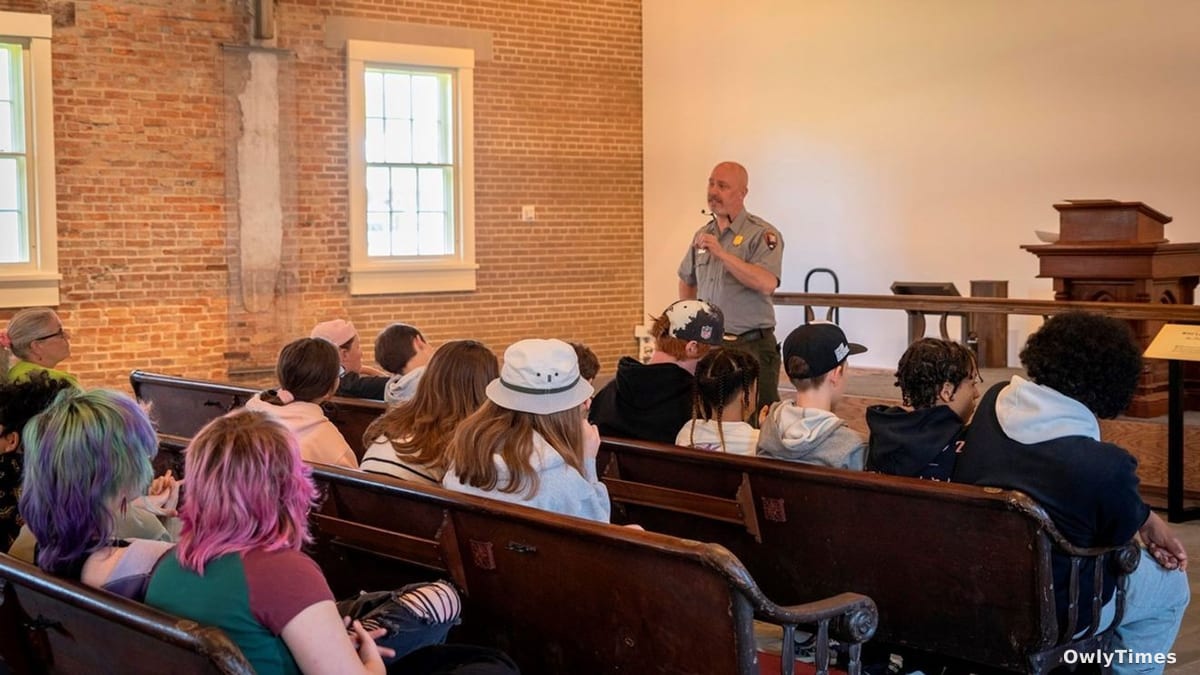

The narrative of the women’s suffrage movement often centers on political rallies and legislative battles, but a new program at the Women’s Rights National Historical Park and Harriet Tubman National Historical Park, “Suffrage & Science Week,” reveals a crucial, often overlooked dimension: the deep entanglement of early feminist activism with scientific observation and environmental awareness. Running from April 17-22, this event isn’t simply a historical commemoration; it’s a timely reminder that the fight for social justice has always been, and continues to be, inextricably linked to our understanding of – and relationship with – the natural world. While many celebrate Earth Day with calls for recycling and conservation, this program asks us to consider how advocating for the Earth was, for many early feminists, fundamentally intertwined with advocating for women.
Beyond the Ballot: How Activists Used Environmental Observation
The connection might not be immediately obvious, but the program highlights how women’s rights activists, freedom seekers, and female scientists of the 19th and early 20th centuries utilized environmental observation and scientific innovation as tools for social reform. This wasn’t about abstract scientific inquiry; it was about practical application. Harriet Tubman’s profound knowledge of the landscape – the stars, the plants, the waterways – wasn’t simply survival skill, but a critical component of the Underground Railroad. Her ability to navigate and conceal freedom seekers relied on a detailed understanding of the natural environment, a knowledge often dismissed or undervalued in a society that relegated women to the domestic sphere. Similarly, early naturalists like Martha Maxwell, though not directly involved in the suffrage movement, challenged prevailing scientific norms by meticulously documenting and illustrating the natural world, asserting a woman’s intellectual authority in a field dominated by men. The program aims to showcase these interwoven stories, demonstrating how challenging established scientific hierarchies mirrored the challenge to established social hierarchies.
Original reporting: 13wham.com.
A Convergence of Movements: Earth Day and Women’s Rights
The timing of “Suffrage & Science Week,” coinciding with Earth Day, is deliberate. The program organizers aren’t suggesting a simple chronological link, but a conceptual one. Both movements – environmentalism and feminism – grapple with issues of power, exploitation, and the interconnectedness of systems. The historical context is important here. The late 19th and early 20th centuries witnessed rapid industrialization and environmental degradation, alongside the burgeoning women’s suffrage movement. Activists began to recognize the parallels between the exploitation of natural resources and the exploitation of women – both were seen as resources to be used and controlled, rather than autonomous entities deserving of respect and agency. This perspective isn’t widely taught in standard history curricula, which often compartmentalizes these movements. The event’s focus on this intersection is a corrective, offering a more nuanced understanding of the historical forces at play.
What the Study Actually Found vs. What Headlines Claim
It’s crucial to clarify what this program is and isn’t. It’s not presenting new research findings in the traditional sense of a scientific study with data analysis. Rather, it’s a curated educational program drawing on existing historical scholarship to illuminate a previously under-emphasized connection. Headlines might suggest a “new discovery” of science within the suffrage movement, but the program’s strength lies in re-framing existing knowledge. The park service has compiled stories of women who demonstrably used scientific understanding in their activism, and is presenting these narratives to the public. This is a vital distinction. It’s not about rewriting history, but about enriching it with a more complete and accurate picture. The free and open access to these programs – including guest speakers, ranger programs, and family activities – is a deliberate effort to broaden participation in historical understanding.
Limitations to Consider: Accessibility and Scope
While the program’s intent is laudable, limitations exist. The event is geographically centered at the Women’s Rights NHP in Seneca Falls, New York, limiting accessibility for those unable to travel. While online resources are mentioned, the full immersive experience of the in-person events will be unavailable to a wider audience. Furthermore, the program’s focus on New York State figures – particularly Susan B. Anthony and Harriet Tubman – while historically significant, may not fully represent the diversity of experiences within the broader suffrage and environmental movements across the United States. The program’s scope, while intentionally focused, could benefit from explicitly acknowledging the contributions of women of color and Indigenous communities, whose relationship with the land and experiences with environmental injustice were often distinct from those of their white counterparts.
Looking ahead, the success of “Suffrage & Science Week” hinges on its ability to spark further research and dialogue. Will this program inspire historians to delve deeper into the intersection of these movements? Will it encourage educators to incorporate this perspective into their curricula? Perhaps most importantly, will it prompt visitors to consider how the struggles for social and environmental justice continue to be intertwined today – for example, in the disproportionate impact of climate change on marginalized communities? The question isn’t simply whether we can learn from the past, but whether we can recognize the enduring relevance of these historical connections in shaping a more equitable and sustainable future.





