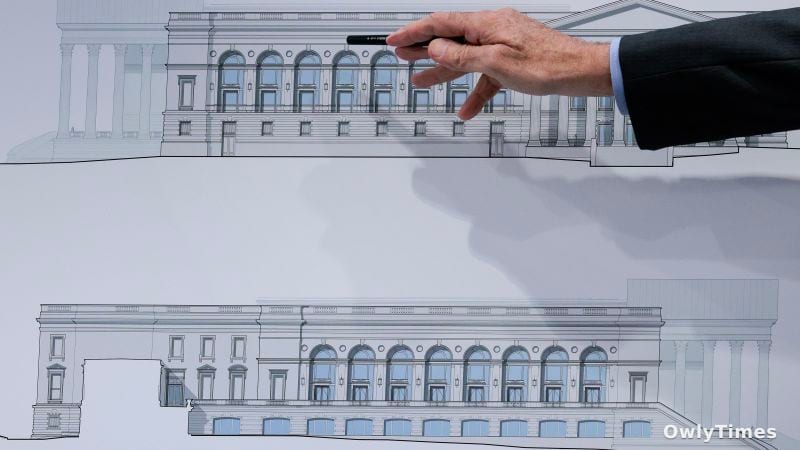

The delay in the National Capital Planning Commission’s vote on President Trump’s East Wing ballroom project isn’t a sign of hesitation, but a calculated response to a surprisingly potent demonstration of public opposition. The postponement to April 2, announced Thursday, isn’t about reconsidering the project’s merits – the commission’s chairman, Will Scharf, a Trump aide, made that clear – but about managing the optics of a pre-ordained outcome. Over 32,000 public comments, 97% of them negative, represent a strategic challenge to a power play designed to swiftly reshape the White House in Trump’s image. This isn’t simply about a ballroom; it’s about testing the limits of executive authority and the efficacy of stacking regulatory bodies with loyalists.
The sheer volume of dissent, detailed in 9,000 pages of submissions, is the critical factor. While administrations routinely face public pushback, the intensity and uniformity of opposition – with criticisms ranging from aesthetic objections (“brothel,” “Vegas casino”) to accusations of “authoritarian self-aggrandizement” – is unusual. This isn’t a narrow interest group protesting a policy detail; it’s a broad cross-section of the public reacting viscerally to a perceived overreach. The AI-assisted analysis by CNN, verifying 99% accuracy in categorizing the comments, lends further weight to the scale of the opposition. The strategic value of this opposition lies in its potential to erode the legitimacy of the project, even if it ultimately proceeds.
Trump’s approach to remaking the White House mirrors historical precedents of leaders using architecture to project power and legacy. Roman emperors commissioned grand structures to demonstrate imperial authority, and Louis XIV’s Palace of Versailles was explicitly designed to intimidate rivals and showcase the absolute power of the French monarchy. However, the key difference is the context. While those projects were often funded by state coffers and accepted as expressions of sovereign power, Trump’s ballroom is facing resistance precisely because it’s perceived as a personal indulgence, funded – according to the White House – privately, yet imposed upon a publicly owned space. This contradiction fuels the narrative of “Trumpification” and raises questions about the appropriate use of presidential authority.
This piece references the CNN report.
Who benefits and who loses in this scenario? Trump clearly benefits from a visible demonstration of his control and a tangible manifestation of his personal brand. His allies on the NCPC and the Commission of Fine Arts, who have already signaled their approval, benefit from maintaining the President’s favor. The losing parties are broader: those concerned with historical preservation, architectural integrity, and the principle of a “People’s House” that reflects democratic values rather than individual vanity. The legal challenges brought by groups like the National Trust for Historic Preservation, now arguing a violation of the separation of powers, represent a last-ditch effort to protect those interests, but face an uphill battle given the recent dismissal of their initial lawsuit.
The speed with which the project has moved forward – demolition of the East Wing last October, swift approvals from stacked commissions – underscores the administration’s intent to present a finished ballroom before the end of Trump’s second term. This timeline is crucial. It suggests a desire to create a lasting symbol of his presidency, regardless of potential legal or political fallout. White House press secretary Karoline Leavitt’s dismissive characterization of opponents as “Trump deranged liberals” is a predictable tactic, designed to delegitimize criticism and rally support among the President’s base. However, the sheer volume of independent, articulate objections suggests a broader discontent than the administration is willing to acknowledge.
The validity of the upcoming NCPC vote itself is now under scrutiny. Public Citizen’s report alleging that three key appointees – Scharf, Stuart Levenbach, and James Blair – lack the required experience in city or regional planning introduces a procedural challenge that could further delay or even invalidate the approval process. This is the political chess move to watch next: will the NCPC address these allegations of ineligibility, or will it proceed with the vote, risking further legal challenges and reinforcing the perception of a rigged process? The answer will reveal whether this project is truly about architectural vision, or simply about demonstrating the limits of accountability in the face of presidential will.