
The persistent cultural divide between “art” and “science” feels increasingly artificial in an era demanding interdisciplinary solutions to complex problems. A new exhibit at the University of Alabama at Birmingham’s Abroms-Engel Institute for the Visual Arts (AEIVA), Blue Moon Cocoon, isn’t simply displaying this connection – it’s actively building it, and offering a model for how institutions can foster a more integrated understanding of the world. While many art exhibits aim for emotional resonance or intellectual stimulation, Blue Moon Cocoon distinguishes itself by grounding aesthetic experience in rigorous biological process, specifically the life cycle of the luna moth. This isn’t about illustrating scientific concepts with art; it’s about presenting a situation where the artistic and scientific investigations are fundamentally intertwined.
From Studio to Specimen: The Artist as Naturalist
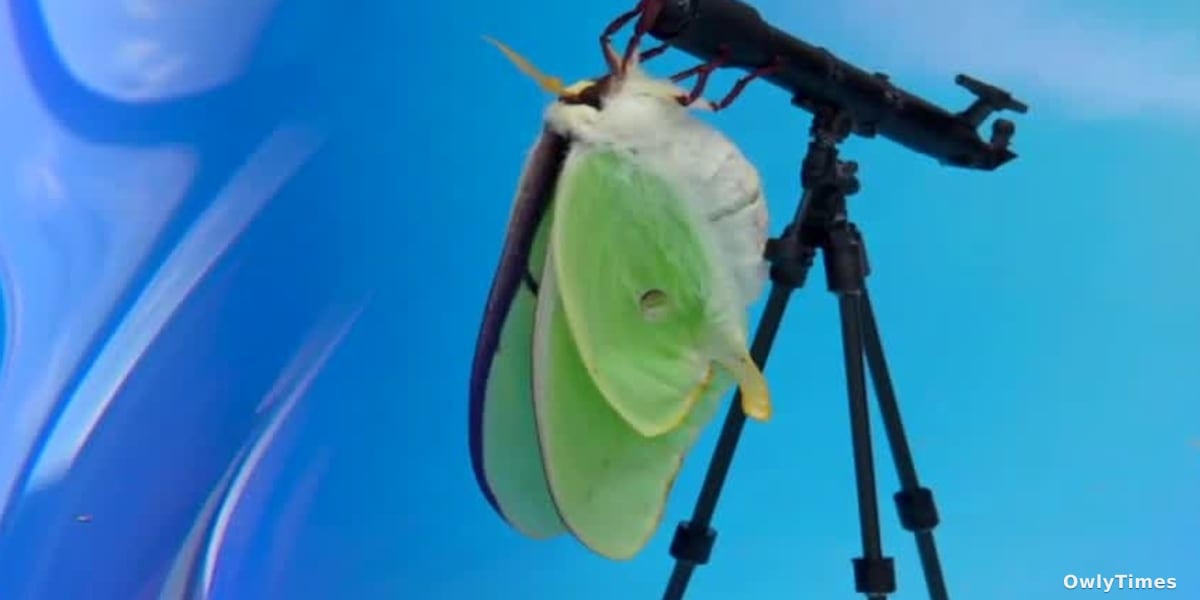
The exhibit centers around the work of artist Virginia L. Montgomery, whose practice uniquely blurs the lines between observation and intervention. Montgomery doesn’t merely depict luna moths; she actively raises them in her studio, meticulously documenting their metamorphosis. This isn’t a casual hobby informing her art – it’s a core component of her creative process. The resulting artwork, featuring imagery of these striking insects, explores themes of nature, light, and transformation, but carries with it the weight of direct, empirical observation. This is a crucial distinction. Many artists draw inspiration from nature, but Montgomery’s work is informed by a level of engagement that demands a different kind of viewing. It asks us to consider not just the beauty of the moth, but the complex biological mechanisms that create that beauty, and the artist’s role in witnessing – and, to a degree, facilitating – that process.
Drawn from wbrc.com.
Beyond Observation: AEIVA’s Commitment to Experiential Learning
The exhibit’s impact extends beyond the gallery walls thanks to AEIVA’s deliberate programming. Organizers aren’t content to simply present the art; they’re actively working to make the underlying science accessible and engaging, particularly for families. “Hands-on Science Night” events and activities are designed to allow visitors to interact with the concepts explored in Blue Moon Cocoon. This is a significant move, as museum attendance figures consistently show a desire for more interactive experiences. A 2022 study by the American Alliance of Museums found that 68% of museum visitors prioritize hands-on activities, demonstrating a clear shift away from passive observation. The collaboration with the Birmingham Zoo further reinforces this commitment to experiential learning, highlighting the potential for nature to inspire curiosity and discovery in novel ways. This isn’t simply about teaching children about moths; it’s about demonstrating how scientific inquiry can be sparked by aesthetic appreciation.
A Delicate Balance: Addressing the Ethics of Artistic Intervention
While the exhibit is laudable in its aims, it’s important to acknowledge the ethical considerations inherent in Montgomery’s practice. Raising insects for artistic inspiration, even with careful attention to their welfare, raises questions about human intervention in natural processes. The exhibit materials don’t explicitly address these concerns, and that’s a notable omission. While Montgomery’s intent is clearly not exploitative, the act of confining and manipulating a creature’s life cycle for artistic purposes warrants critical discussion. This isn’t to suggest the exhibit is inherently problematic, but rather that a more nuanced exploration of the artist’s methodology – including a frank discussion of the ethical trade-offs – would strengthen its impact. It’s a reminder that even well-intentioned scientific engagement can have complex implications.
What Comes Next for Integrated Art-Science Initiatives?
Blue Moon Cocoon offers a compelling case study for other institutions seeking to bridge the gap between art and science. AEIVA is open from noon until 5 p.m. Tuesday through Saturday, with free admission, making it a remarkably accessible resource. However, the true value of this exhibit lies not just in its current form, but in its potential to inspire further inquiry. The next crucial step is to assess the long-term impact of these integrated programs. Are visitors demonstrating a greater interest in STEM fields after experiencing exhibits like this? Are artists incorporating more scientific methodologies into their work? Tracking these outcomes will be essential for justifying continued investment in these types of initiatives. More broadly, we should be asking: how can we design learning environments that actively dismantle the artificial barriers between disciplines, and cultivate a more holistic understanding of the world around us? The success of Blue Moon Cocoon suggests that art, far from being a distraction from science, can be a powerful catalyst for scientific engagement.