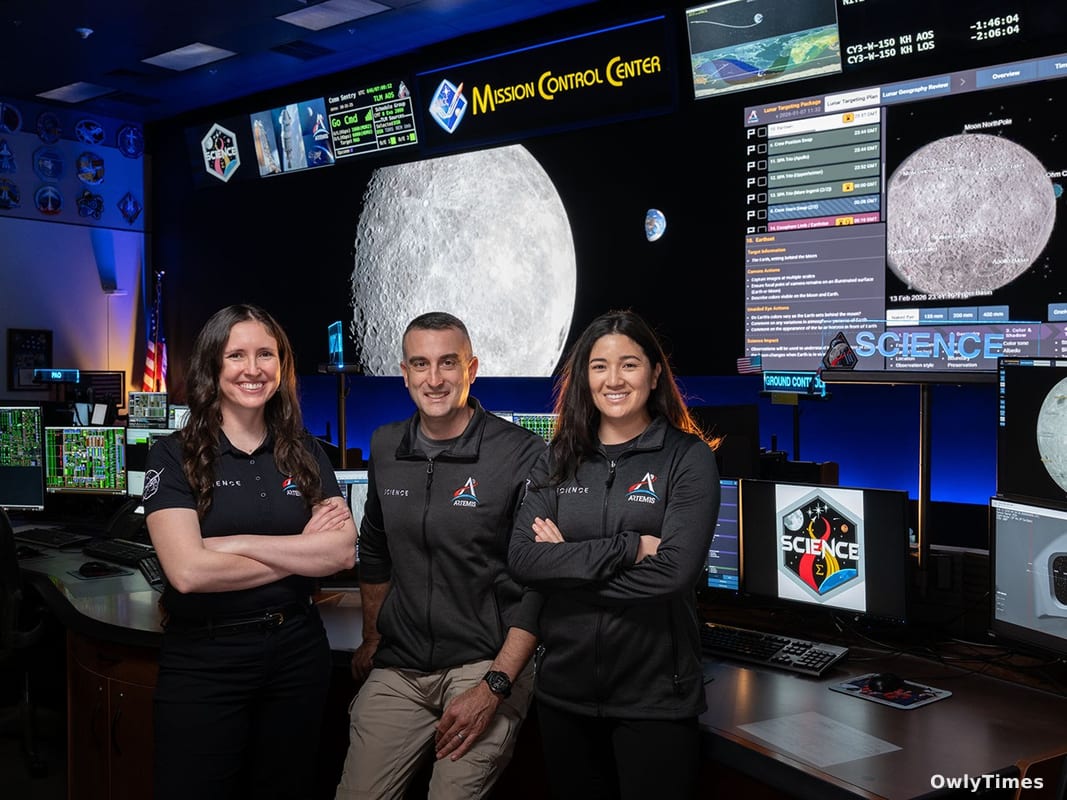

The upcoming Artemis II mission isn’t just about sending humans around the Moon again; it’s a carefully orchestrated experiment in how we do science in space. While headlines focus on the crew of four – and rightly so – a less visible but equally crucial development is the certification of Kelsey Young, Trevor Graff, and Angela Garcia as NASA’s first dedicated Artemis II science officers. This isn’t simply a return to the Apollo era of astronauts doubling as field geologists; it’s a deliberate restructuring of Mission Control to prioritize real-time scientific input, a shift that speaks to the evolving ambitions of lunar exploration and the recognition that even a flyby can yield significant discoveries.
The integration of science into human spaceflight isn’t new. As Young, who also serves as NASA’s Artemis II lunar science lead, points out, the Apollo missions had a geology back room at Johnson Space Center. However, Artemis II introduces a dedicated position within the front room of Mission Control, fundamentally changing the flow of information and decision-making. This isn’t about adding science to the mission; it’s about building the mission around science. The science officer, as Young explains, is “the senior flight controller responsible for lunar science and geology objectives,” tasked with ensuring those objectives are “seamlessly integrated into mission execution.” This means coordinating with all other console disciplines – communications, life support, propulsion – to maximize scientific return during the lunar flyby planned for Monday, April 6.
The preparation for this new role has been rigorous. Young, Garcia, and Graff underwent months of traditional flight controller training, simulations, and testing. But crucially, they also participated in intensive geology and lunar observation training, and integrated simulations with the Artemis II astronauts. This collaborative approach is key. The astronauts aren’t just pilots; they’re becoming trained observers, equipped to identify and describe lunar features with scientific precision. Graff emphasized the value of these simulations, calling them “the most exciting, challenging, and rewarding components of the process,” where they tested their skills in realistic mission scenarios. The goal isn’t to replace remote sensing data – the high-resolution images and spectral analyses already gathered by orbiting spacecraft – but to complement it with the unique capabilities of human perception.
What makes human observation so valuable? Our brains are remarkably adept at recognizing patterns, subtle color variations, and textural differences that automated systems might miss. As Young anticipates, “Hearing the excitement and scientific meaning behind their descriptions will be an incredible moment.” She’s particularly eager to hear the astronauts’ firsthand accounts of the lunar surface, after months of studying visualizations. This qualitative data, combined with the astronauts’ photographs and audio recordings, will be relayed to two science back rooms at NASA Johnson – the Science Evaluation Room and Science Mission Operations Room – where experts will provide real-time analysis and guidance to the science officer in Mission Control. This entire process is, in essence, a dress rehearsal.
This piece references the science.nasa.gov report.
It’s important to understand that Artemis II is, in many ways, a test flight for the science team itself. The mission will evaluate workflows, technical requirements, and the integration of the science officer into the established Mission Control structure. This isn’t about discovering a new lunar mineral during this flyby, although that would be a welcome surprise. It’s about refining the processes that will enable more ambitious scientific investigations during future Artemis missions, particularly those involving lunar landings. The current structure represents a significant increase in resources dedicated to real-time science support compared to Apollo; in the early missions, the science team operated largely independently.
However, limitations to consider remain. The Artemis II flyby is relatively brief, limiting the amount of observational data the crew can collect. The reliance on human observation also introduces subjectivity, requiring careful calibration and validation of the astronauts’ descriptions. Furthermore, the success of this new model hinges on seamless communication and collaboration between the astronauts, the science officer, and the back room experts – a complex system that will be tested under the pressure of a live mission.
Looking ahead, the crucial question isn’t just what the Artemis II astronauts will observe, but how those observations will be incorporated into our understanding of the Moon. Will the new science officer role prove to be a sustainable and effective model for future missions? And, perhaps more importantly, will the lessons learned from Artemis II lead to a more proactive and integrated approach to science planning for the eventual return to the lunar surface? The data from this mission will determine whether the investment in this new operational structure truly unlocks a new era of lunar discovery.