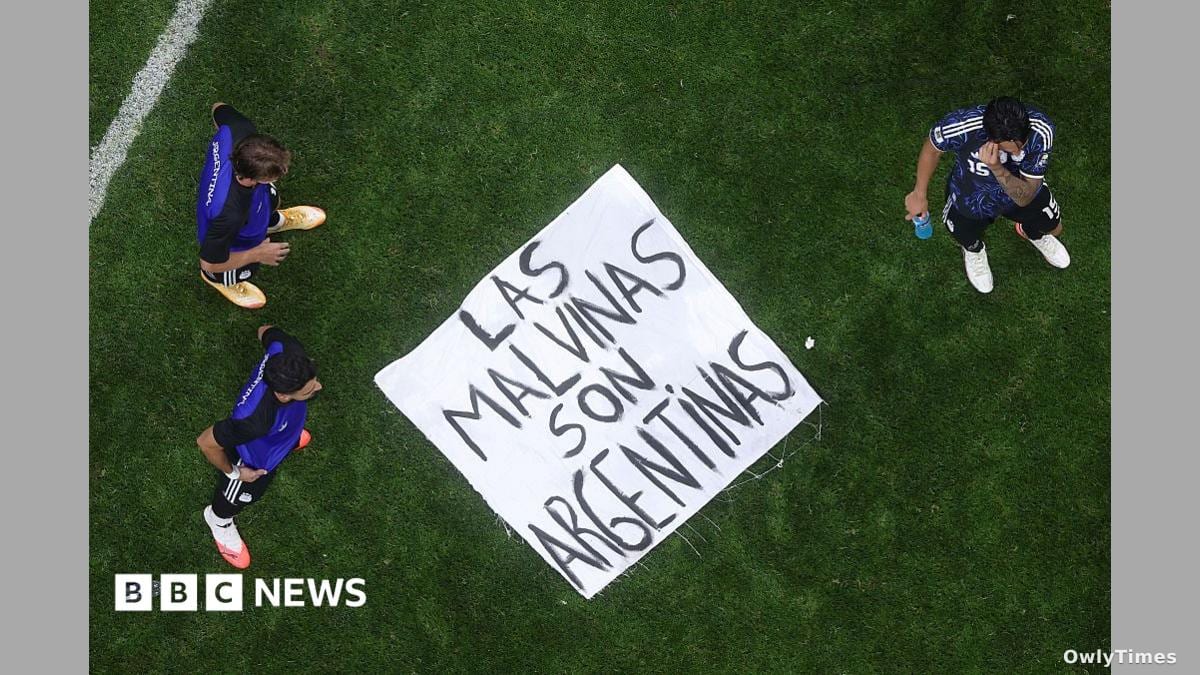

The atmosphere inside Atlanta’s stadium last Wednesday was already electric, but as the final whistle blew on Argentina’s 2-1 victory over England, the tension shifted from the pitch to the geopolitical arena. Moments after securing their place in the World Cup final, several Argentine players hoisted a banner emblazoned with the words "Las Malvinas son Argentinas," a defiant assertion of their country’s claim over the British-administered Falkland Islands. While the display ignited immediate calls for regulatory intervention, it simultaneously drew an unexpected defense from the United States, creating a diplomatic ripple effect that has reverberated far beyond the world of sport.
According to reports from the BBC and The Guardian, the White House has officially weighed in on the controversy. Andrew Giuliani, head of the White House FIFA task force, explicitly defended the players' actions on Friday, citing the First Amendment of the U.S. Constitution. "We believe in our First Amendment rights here in the United States of America," Giuliani stated, noting that the players possessed both the "opportunity and ability" to make such statements while on American soil.
This stance stands in stark contrast to the position held by the British government. As noted by The Independent, a spokesperson for Downing Street reaffirmed the UK’s unwavering commitment to the territory, stating, "The World Cup might not be ours, but the Falkland Islands definitely are." The British government, alongside the government of the Falkland Islands, has urged FIFA to investigate the incident as a violation of the governing body's rules against political displays in sport. The Guardian reports that Peter Kyle, the UK Business Secretary, labeled the act an "egregious violation," while FIFA has confirmed that its independent disciplinary committee is currently reviewing match reports to determine if further action is warranted.
The sensitivity of the moment is rooted in a history of conflict, most notably the 74-day war in 1982 that resulted in the deaths of 649 Argentine soldiers, 255 British personnel, and three islanders, as documented by the BBC. This legacy continues to color modern interactions, with The Guardian noting that tensions were already simmering due to a recent transit of the Royal Navy vessel HMS Medway through waters claimed by Argentina. The deep-seated nature of this dispute was further underscored by a 2013 referendum, where, according to the BBC, 1,513 out of 1,517 voters chose to remain a UK overseas territory.
The cultural fallout of the semi-final extends beyond the boardroom and into the wider Latin American landscape. Al Jazeera reports that a broad coalition of neighboring nations—including Mexico, Colombia, and Chile—has united in their support for Spain ahead of Sunday’s final. Sociologists point to a shift in perception, noting that while legends like Diego Maradona were once viewed as revolutionary figures, the current squad is increasingly perceived through a lens of political polarization and alleged favoritism by FIFA leadership.
The volatility of this rivalry was on full display just days after the football match, when the two nations met in a rugby Nations Championship test. Sky Sports reports that the match in Santiago del Estero was "ill-tempered" and hosted before a hostile crowd, with fans in the stands unveiling further Falklands-themed banners. England ultimately secured a 31-24 victory, a result that served as a brief, high-stakes respite from the geopolitical drama currently defining the encounter between the two nations. As FIFA’s disciplinary committee prepares its next steps, the industry faces a growing challenge: maintaining the neutrality of the pitch in an era where athletes are increasingly emboldened to use their platform to voice deeply held nationalistic claims.