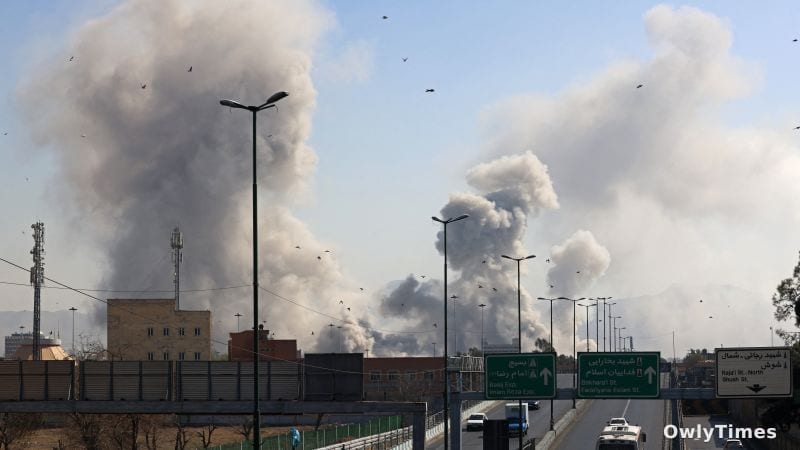

Is anyone actually keeping track of the receipts? Days into Operation Epic Fury, the US is engaged in a conflict with Iran with no clear exit strategy, and the White House is remarkably silent on the price tag. We’re not talking about a few extra dollars on the defense budget; we’re staring down the barrel of a potentially multi-trillion-dollar expenditure while simultaneously debating the merits of a $15 minimum wage. The real story here isn't the strategic objectives in Tehran – it's the looming financial burden that will inevitably land on the shoulders of American taxpayers, impacting everything from infrastructure projects to social security.
The Daily Bill Comes Due
The Pentagon’s silence is, frankly, infuriating. They haven’t even bothered to ask Congress for a supplemental spending bill, despite the fact that the war is already hemorrhaging money at a rate of $891.4 million per day. That figure, compiled by a Washington, DC-based think tank analyzing Pentagon data, isn’t some abstract projection. It’s the cost of keeping aircraft carriers afloat ($6 million daily), stealth fighters in the air ($5 million daily), and tankers fueled ($9 million daily). To put that in perspective, that’s more than the annual budget of several small states. Lindsay Koshgarian, program director of the National Priorities Project at the Institute of Policy Studies, succinctly calls the conflict “not necessary” and points out the opportunity cost: funds diverted from policies that could actually improve everyday Americans’ lives.
Reporting from CNN informs this analysis.
Beyond Bombs: The Hidden Costs of Conflict
The initial 100 hours of Operation Epic Fury have already clocked in at $3.7 billion, dwarfing the $2.04 to $2.26 billion spent on last year’s Operation Midnight Hammer – a strike that lasted a mere two-and-a-half hours. The breakdown of Midnight Hammer’s costs is particularly telling: $49 to $70 million for 40 MOP 30,000-pound bombs, $31.75 to $37.8 million for seven B2 stealth bombers, and $36 to $45.6 million for 24 Tomahawk missiles. These aren’t just numbers on a spreadsheet; they represent concrete resources pulled from other areas. Kent Smetters, faculty director of the Penn Wharton Budget Model, attempts to justify the expense by framing it as a preventative measure against the “trillions upon trillions of dollars of damage” a nuclear-armed Iran might inflict. But that’s a classic case of trading a known cost for an uncertain threat.
Shifting Sands and Escalating Expenses
The Center for Strategic and International Studies (CSIS) predicts costs will decrease as the US switches to “less expensive munitions” and Iranian retaliation wanes. This is a dangerous assumption. It relies on the idea that escalation can be controlled, that Iran won’t adapt, and that the conflict will remain contained. Defense Secretary Pete Hegseth’s recent declaration that the US is “just getting started” and will be “accelerating” operations suggests the opposite. Moreover, the CSIS analysis conveniently overlooks the long-term costs: veteran care, reconstruction efforts (should they be necessary), and the inevitable economic fallout from disrupting global energy markets. The cost of the Iraq War ballooned to nearly $3 trillion precisely because of these unforeseen and underestimated expenses.
The Illusion of Precision Warfare
The narrative of “precision warfare” – minimizing collateral damage with expensive, high-tech weaponry – is a comforting illusion. While it may reduce civilian casualties (a moral imperative, certainly), it doesn’t reduce the overall financial burden. In fact, it often increases it. Each stealth fighter sortie, each Tomahawk launch, represents a massive investment. And for what? To achieve objectives that, according to critics like Koshgarian, are fundamentally flawed? The focus on military solutions ignores the diplomatic avenues that could have – and perhaps still could – de-escalate the situation.
The coming weeks will be critical. But don’t watch for breakthroughs in Tehran. Watch for the inevitable supplemental spending bill landing on Capitol Hill. And more importantly, watch how your representatives vote. Because the real question isn’t whether this war is winnable – it’s whether the American public is prepared to foot the bill for a conflict that, at this stage, feels less like a strategic necessity and more like a fiscal catastrophe. I predict that by the end of 2025, the total cost of Operation Epic Fury will exceed $100 billion, triggering a fierce debate about national priorities and forcing a reckoning with the true cost of endless war.