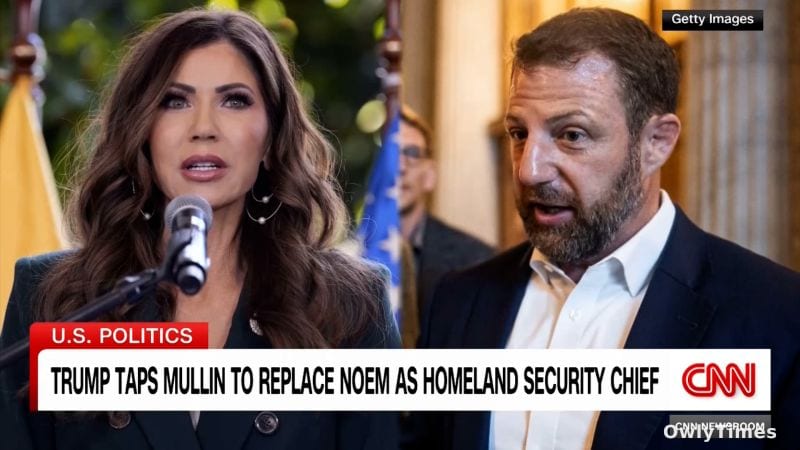

Is the revolving door at Homeland Security a sign of genuine crisis, or just another symptom of a White House operating on vibes? President Donald Trump’s decision to replace Kristi Noem with Oklahoma Senator Markwayne Mullin as Secretary of Homeland Security isn’t about border security, counterterrorism, or disaster preparedness. The real story here isn’t about finding the best person for the job – it’s about control, and the increasingly fragile alliances within the Republican party itself.
The official narrative, as predictably echoed by Mike Pence (“History will record Trump ‘made the right call’”), frames this as a standard personnel shift. But the CNN reporting paints a different picture: “frustrations build among White House officials and GOP lawmakers.” Translation: Noem wasn’t fired for incompetence, she was fired for being insufficiently loyal, for potentially harboring ambitions of her own, and for generally failing to play the game. This isn’t a security reshuffle; it’s a power play, and one that sets a worrying precedent. We’ve seen this before – qualified individuals sidelined because they don’t offer unquestioning fealty. The implications for national security are chilling. A department responsible for protecting the country shouldn’t be run like a fiefdom, but that’s increasingly the reality.
This piece references the CNN report.
The Oklahoma Angle: What Mullin Brings to the Table
Markwayne Mullin isn’t a typical Homeland Security pick. He’s a former mixed martial arts fighter and businessman, not a career bureaucrat or a seasoned national security expert. His background is in the private sector, specifically in plumbing and pipeline construction. While his supporters tout his “real-world” experience, it’s a stretch to see how that translates to managing a sprawling department with a $60 billion budget and over 240,000 employees. The appointment signals a clear preference for someone perceived as an “outsider,” someone who won’t challenge the established order within the White House. It’s a move designed to inspire confidence among Trump’s base, who often view Washington as hopelessly corrupt and out of touch. But confidence doesn’t equal competence, and a department dealing with complex threats requires more than just a tough-guy persona.
Beyond the Headlines: The Real Security Concerns
While the political drama unfolds, actual security threats are mounting. The CNN report also highlights ongoing investigations into US-Israeli strikes near hospitals, and escalating tensions with Iran. These aren’t abstract geopolitical concerns; they directly impact everyday Americans. Increased global instability translates to higher energy prices, potential supply chain disruptions, and a heightened risk of terrorist attacks. The focus on internal political squabbles distracts from the urgent need to address these real and present dangers. The Department of Homeland Security is tasked with coordinating responses to these threats, but a leadership vacuum – or worse, a leader preoccupied with political maneuvering – severely hampers its ability to do so. Consider the recent incident involving Sen. Tim Sheehy forcibly removing a protester from a Senate hearing. While seemingly minor, it underscores a broader trend of escalating political polarization and a disregard for due process, both of which erode public trust in institutions responsible for maintaining security.
The Cost of Instability: What This Means for You
This isn’t just about Washington politics. It’s about the TSA lines at the airport, the cybersecurity of your bank account, and the preparedness of your local community in the event of a natural disaster. Every time there’s a shakeup at the top of Homeland Security, institutional knowledge is lost, and critical programs are disrupted. The constant churn creates uncertainty, making it harder to attract and retain qualified personnel. The department’s ability to effectively respond to emergencies is diminished, and the risk of a catastrophic failure increases. The average American doesn’t think about these things until something goes wrong, but the consequences can be devastating. The cost of political instability isn’t measured in dollars and cents; it’s measured in lives and livelihoods.
Looking Ahead: The Border Wall as a Distraction?
The appointment of Mullin will almost certainly reignite the debate over border security, with renewed calls for completing the border wall. But the wall is a symbolic gesture, a distraction from the complex underlying issues driving migration. It won’t solve the problem, and it will likely exacerbate tensions with neighboring countries. What we should be watching for is whether Mullin will prioritize evidence-based solutions, such as investing in border technology, streamlining the asylum process, and addressing the root causes of migration in Central America. My prediction? He won’t. The focus will remain on optics, on satisfying the base, and on maintaining the President’s approval ratings. The question isn’t whether Mullin will secure the border, but whether he’ll be allowed to actually lead the department, or simply serve as a loyal foot soldier in a larger political game. And that, ultimately, is the most dangerous threat of all.