
If we are so obsessed with the "cloud" and the digital permanence of our data, why are we still so shocked when a dusty box in a basement turns out to be more reliable than a server farm?
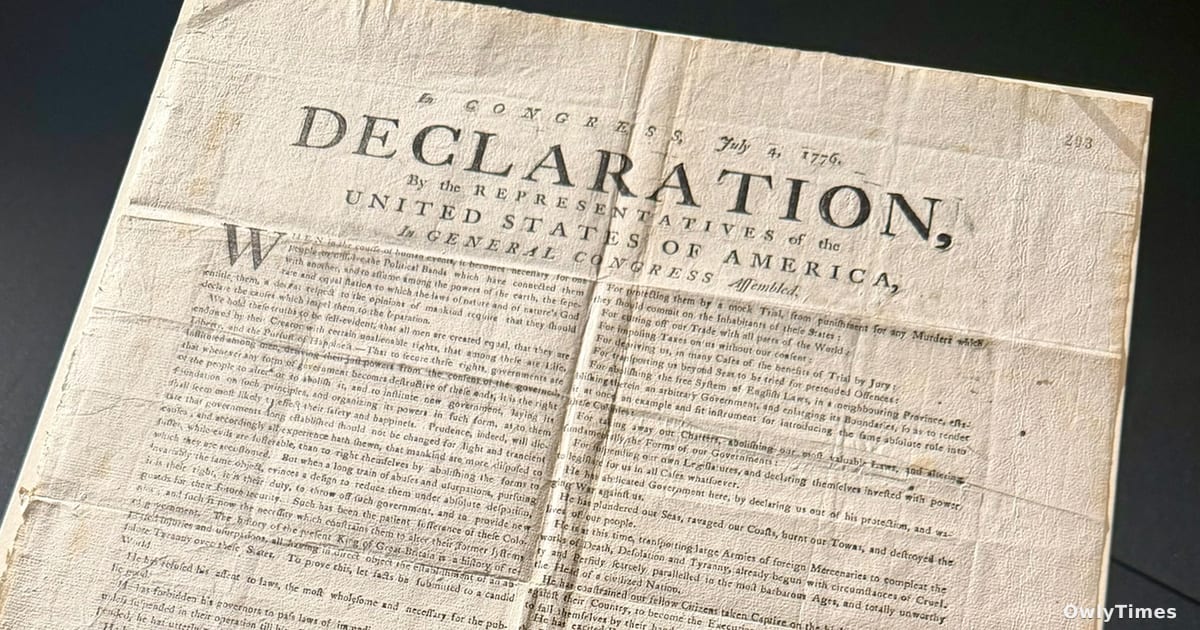
The real story here isn’t that a piece of paper was "lost" for 250 years—it’s that our historical record is essentially a massive, unindexed database waiting for a human search engine to run a query. This week, the U.K.’s National Archives confirmed that a volunteer, Michael Scurr, stumbled upon a rare 1776 printing of the Declaration of Independence while cataloging a box of correspondence.
A Digital Analogy for a Paper Problem
Think of the National Archives as the world’s most disorganized, legacy-tech cloud storage system. You have millions of files, but because they weren’t tagged with modern metadata, they remain "dark data"—invisible to researchers. Scurr, a retired insurance executive who has volunteered at the archives for 11 years, was performing the equivalent of a manual file-system audit when he identified a document simply labeled "another paper" as a high-value asset.
All three sources—CBS News, NBC News, and ABC News—agree that this is one of only 11 known surviving copies of the "Exeter printing." They also confirm it is the only one currently located outside the United States. However, the outlets provide slightly different windows for when the document was printed; while CBS and NBC broadly cite 1776, ABC News specifies the printing occurred between July 16 and July 19, 1776.
The Original 'Seized Data'
The document’s journey is a masterclass in how provenance works in the physical world. The Declaration was found among the papers of the Dalton, an American privateer vessel captured by the British Royal Navy on Christmas Eve in 1776. According to NBC News, the ship was pursued for seven hours by the HMS Raisonnable before being intercepted off the coast of Portugal.
Amanda Bevan, who leads the National Archives’ project on Revolutionary War correspondence, notes that the document wasn't just a souvenir. It was likely read aloud to the crew to ground their military mission in an ideological framework. It serves as a reminder that even in the 18th century, information warfare was critical; the Declaration was printed in Exeter, New Hampshire, specifically to spread the news of the colonies' break from Britain.
Why Context Collapses
The reason this document sat in the dark for two and a half centuries is simple: a lack of context. Nicholas Guyatt, a professor at the University of Cambridge, explained to NBC News that to the British Royal Navy, this wasn't a foundational historical artifact—it was just another piece of seized intelligence. It was filed away under "another paper," a classic case of mislabeled data that effectively deleted the file from public consciousness until someone with the right domain expertise—in this case, Scurr—looked at the actual content rather than the metadata.
For the ordinary user, this discovery is a sobering look at our own era of "digital rot." We assume that because we can search for a file, we’ve preserved it, but if we don't have people actively curating and contextualizing the data, we are just building larger, more expensive archives of "another paper."
As for what happens next, the National Archives has already performed a stabilization process to repair a tear in the document. With the 250th anniversary of American independence approaching this weekend, the document is expected to serve as a focal point for renewed discussions about the maritime front of the Revolutionary War—a theater of conflict that ABC News notes has historically received far less attention than the land battles at places like Valley Forge.