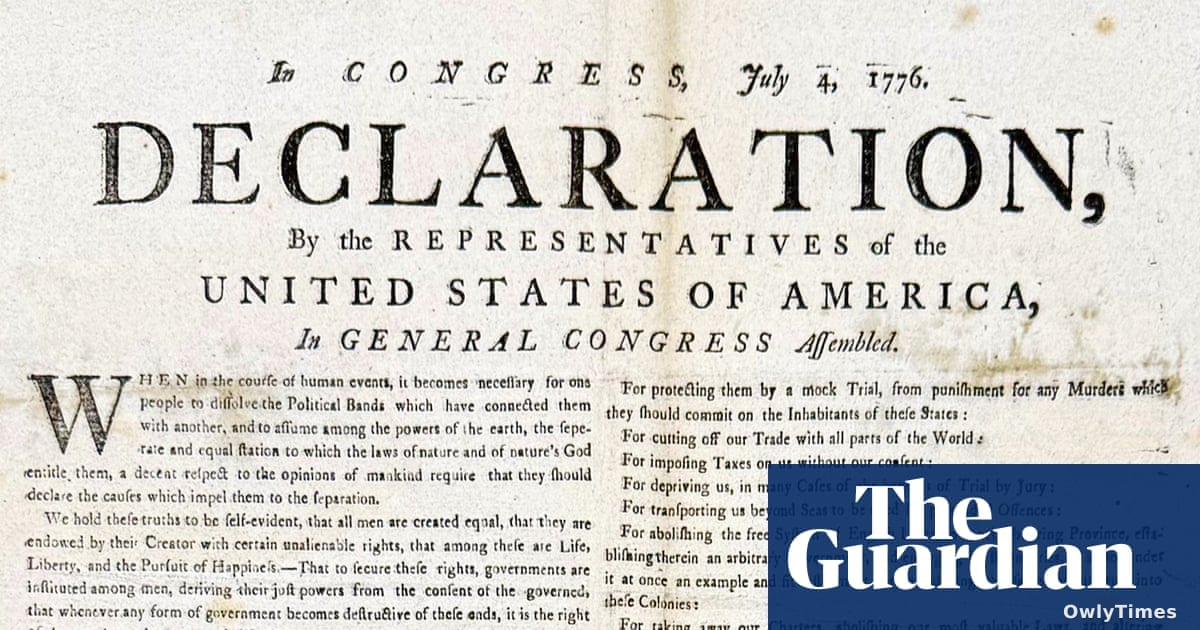

If we are so obsessed with digitizing our history, why are we still leaving the most important artifacts of the past buried in literal piles of paper? A volunteer at the UK’s National Archives has just stumbled upon a “vanishingly rare” copy of the US Declaration of Independence, proving that even in an era of cloud storage and instant metadata, the most profound tech-adjacent stories are still found in the analog equivalent of a "junk drawer."
The real story here isn't just the discovery of an old piece of paper; it’s the fact that for over two centuries, this document was effectively "hidden in plain sight." As reported by The Guardian, ABC News, and The Independent, Michael Scurr, a volunteer archivist and retired insurance executive, found the document last May while cataloging 18th-century Royal Navy correspondence. Tucked away as an enclosure merely labeled "another paper," the document had been ignored since the capture of the American privateer vessel Dalton in December 1776.
The original 'broadband' for revolution
Think of these early printings of the Declaration—specifically the "Exeter printing"—as the 18th-century equivalent of a viral tweet. Printed in Exeter, New Hampshire, between July 16 and July 19, 1776, these "broadsides" were designed for rapid-fire distribution. As Graham Moore, a records specialist at the National Archives, noted to The Guardian, these were built to be "read and consumed by as many people as possible in as short a time as possible." It was, in essence, the high-speed propagation of a radical idea across a network of colonies that were essentially offline.
While the document is one of only 11 known copies of this specific printing, its location is what keeps historians awake at night. It is the only copy identified outside the United States. ABC News and The Independent both highlight that this wasn't just a stray scrap; it was on board a privateer ship carrying a commission signed by John Hancock. This artifact traveled from a New Hampshire print shop to the high seas, where it was eventually seized by the HMS Raisonnable off the coast of Portugal.
Why provenance beats perfection
In the tech world, we often conflate "new" with "valuable," but this find reminds us that provenance—the chain of custody—is what actually creates worth. Amanda Bevan, head of the National Archives’ project to catalog these naval records, suggests the captain likely read the document to his 120-man crew to explain why they were risking their lives. It wasn't just a manifest or a shipping order; it was the "code" for their mission.
The human cost of this mission was brutal. ABC News and The Independent confirm the crew—which included a diverse mix of sailors and at least one free Black man named Daniel Cottle, according to The Guardian—faced harsh imprisonment in Plymouth, England. While we can track some of these men through the journals of Charles Herbert, the document itself remained a silent witness to their captivity, relegated to an archival footnote for 250 years.
The next discovery
For those of us tracking the intersection of data and history, the takeaway is clear: we haven't finished mining the past. Matthew Skic, director of collections and exhibitions at the Museum of the American Revolution, argues that this isn't just a historical curiosity—it’s an artifact that proves we still have significant gaps in our collective record. As we approach the 250th anniversary of the signing this weekend, the trigger for the next wave of discoveries will be the ongoing, meticulous cataloging of these unindexed naval archives. If a volunteer can find a founding document in a bundle labeled "another paper," it begs the question of what else is currently being ignored in the margins of our history.