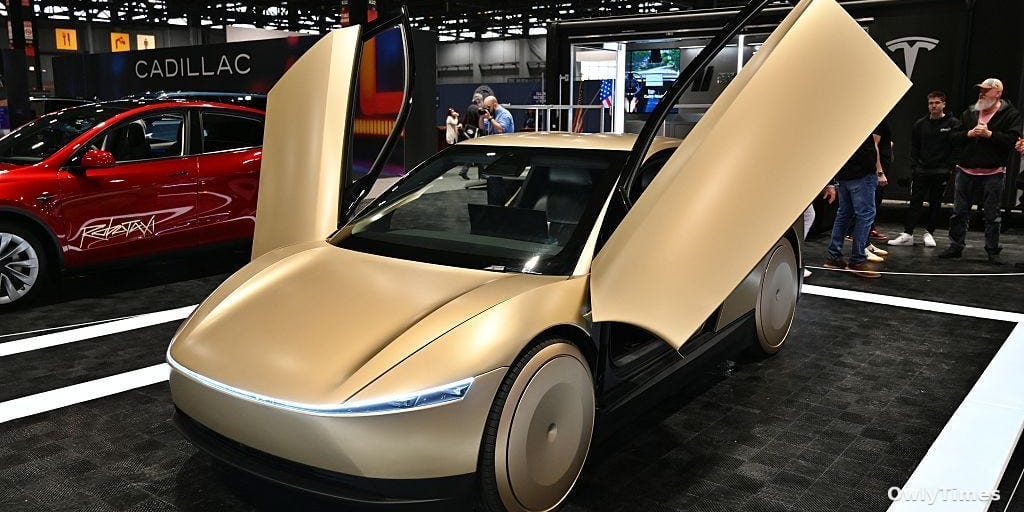

$460. That’s the price Bank of America now believes Tesla stock will reach within the next 12 months – a 13% increase over current levels – and it hinges on a radical re-evaluation of the company’s core business. Forget electric vehicles; Wall Street is increasingly pricing Tesla as an artificial intelligence play, specifically betting on the success of its forthcoming robotaxi network. This isn’t simply a shift in sentiment, it’s a fundamental recalibration of valuation, driven by a clear “follow the money” dynamic: investor capital is flowing towards projections of robotaxi revenue and away from concerns about slowing EV sales.
The dramatic pivot comes as Tesla navigates a challenging period. After losing its position as the world’s leading EV seller, and experiencing a 13% year-to-date decline through Tuesday, the company desperately needs a new growth narrative. Elon Musk’s vision of a fully autonomous ride-hailing fleet, once a futuristic promise, is now being treated as a potential lifeline. Bank of America’s revised outlook, which spurred a 3% jump in Tesla shares on Wednesday – the largest single-day gain in a month – underscores the market’s willingness to reward concrete projections, even if they are ambitious.
Drawn from Business Insider.
This bullishness is quantified by a staggering figure: 52%. That’s the proportion of Tesla’s entire valuation that Bank of America now attributes to its robotaxi business. This represents a dramatic shift from the traditional assessment of Tesla as a car manufacturer, with the core automotive business now accounting for just 21% of the firm’s valuation. To put this in perspective, just a year ago, the narrative centered on vehicle production and delivery numbers; now, the success or failure of a yet-to-be-fully-realized autonomous network dictates investor confidence. The speed of this transition is notable – a doubling of robotaxi’s valuation contribution in under 12 months.
The potential scale of the robotaxi market is fueling these projections. Analysts at Cathie Wood’s Ark Invest and Wolfe Research both estimate Tesla could capture 50% of the global robotaxi market, though timelines differ – Ark Invest projects this by 2030, while Wolfe Research anticipates it by 2035. This level of market dominance would translate to substantial revenue, justifying the current premium placed on Tesla’s stock. Andrew Percoco at Morgan Stanley forecasts 1 million robotaxis deployed by 2035, a massive increase from the projected 1,000 vehicles on the road by the end of 2026. This exponential growth is the core assumption driving the optimistic price targets.
However, realizing this vision requires significant investment. Tesla has announced a planned capital expenditure of $20 billion for 2026, more than double the $9 billion spent in the previous year. This aggressive spending, largely earmarked for AI development and infrastructure, is raising eyebrows among investors wary of “AI hype” and companies prioritizing long-term projects over immediate profitability. While RBC Capital Markets defends the expenditure as necessary for innovation, the market’s tolerance for continued losses while awaiting robotaxi revenue remains a key risk factor. The tension lies in balancing the need for substantial investment with the pressure to demonstrate tangible returns.
What this means for your wallet: the success of Tesla’s robotaxi push isn’t just about stock prices. If Tesla can successfully deploy a large-scale, affordable robotaxi network, it could fundamentally alter the economics of personal transportation, potentially lowering ride-hailing costs and increasing accessibility. However, the current projections are heavily reliant on achieving full autonomy, a technological hurdle that remains uncertain. The critical question for consumers – and investors – is whether Tesla can deliver on its promises, or if the robotaxi dream will remain just that: a dream. Watch closely for the actual deployment numbers in late 2026; a shortfall from the projected 1,000 vehicles will signal a significant setback and likely trigger a re-evaluation of Tesla’s AI-driven valuation.