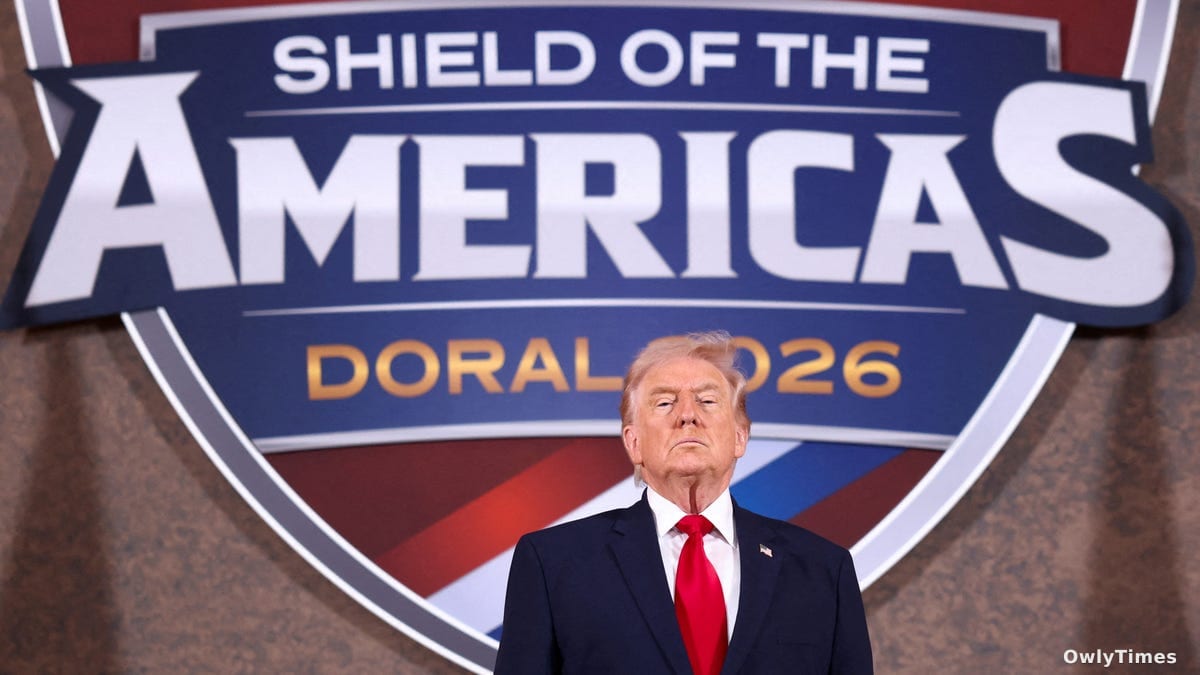

The calculus behind President Trump’s pronouncements on Cuba, delivered alongside the launch of the “Shield of the Americas” coalition on March 7, isn’t about humanitarian intervention or democratic ideals – it’s about reasserting U.S. dominance in a region increasingly open to alternative power centers. While the summit at Trump’s Doral golf club was framed as a collaborative effort to combat narcotrafficking, the explicit linkage between Venezuela and Cuba, coupled with talk of a “friendly takeover,” reveals a strategic intent to dismantle perceived threats to U.S. influence through direct, and potentially coercive, means. The offer to “take care of Cuba” for other Latin American leaders isn’t charity; it’s a transactional proposition, leveraging U.S. power to secure regional alignment.
The formation of the Shield of the Americas coalition – comprised of nations including Argentina, Bolivia, and Chile – is less a genuine partnership and more a carefully curated display of support. The coalition’s stated goal of combating narcotrafficking serves as a convenient justification for increased U.S. security presence and intervention in the hemisphere. Who benefits and who loses here is starkly defined: U.S. geopolitical interests benefit, while Cuban sovereignty and regional autonomy are demonstrably at risk. The timing is critical; the recent U.S. raid that captured Venezuelan leader Nicolás Maduro, and the subsequent easing of sanctions on Cuba following power blackouts, demonstrate a pattern of pressure followed by conditional relief – a classic leverage tactic.
Reporting from USA Today informs this analysis.
This isn’t a novel approach. President Trump’s invocation of the Monroe Doctrine, rebranded as the “Donroe Doctrine,” is a direct echo of 19th-century U.S. foreign policy. The original Monroe Doctrine, declared in 1823, explicitly warned European powers against further colonization or interference in the Americas, effectively establishing the Western Hemisphere as a U.S. sphere of influence. While ostensibly protecting Latin American nations, it served primarily to safeguard U.S. economic and strategic interests. Trump’s revival of this framework, and his assertion that the U.S. “will not allow hostile foreign influence to gain a foothold in this hemisphere,” signals a return to a more assertive, unilateralist approach reminiscent of the era. The difference now is the absence of a clear European counterweight, leaving a vacuum the Trump administration intends to fill.
Cuban President Miguel Díaz-Canel’s denunciation of the summit as an acceptance of “the lethal use of U.S. military force to solve internal problems” underscores the regional anxieties surrounding Trump’s rhetoric. Díaz-Canel correctly frames the situation as an attack on the Proclamation of Latin America and the Caribbean as a Zone of Peace, a regional aspiration for integration and non-intervention. The applause from other Latin American leaders when Trump offered to “take care of Cuba” is particularly telling. It suggests a willingness, either genuine or coerced, to acquiesce to U.S. dominance, even if it means sacrificing principles of sovereignty and self-determination. The fact that four leaders specifically requested U.S. intervention in Cuba reveals a deep-seated fear of instability and a reliance on U.S. power to manage it.
The role of Secretary of State Marco Rubio, a Cuban American, in ongoing negotiations with Havana adds another layer of complexity. While presented as diplomatic engagement, Rubio’s involvement also serves to legitimize the administration’s approach within the Cuban American community, a key demographic for Trump in Florida. The suggestion that Rubio take time off to “finish up a deal on Cuba” trivializes the sensitive nature of these negotiations and reinforces the perception that Cuba’s future is being decided not by Cubans, but by Washington. The administration’s willingness to relax sanctions temporarily as a pressure tactic, then threaten further action, demonstrates a calculated strategy of destabilization aimed at forcing concessions from the Cuban government.
The political chess move to watch next isn’t whether Trump will order a “friendly takeover” of Cuba – the immediate likelihood of a full-scale military intervention remains low. Instead, the critical development will be the outcome of the negotiations between Rubio and Havana. Will the Cuban government accept U.S. demands for political and economic concessions, effectively ceding control over key sectors? Or will it resist, risking further isolation and potential escalation? The answer to that question will determine not only the fate of Cuba, but also the future of U.S. influence in Latin America.