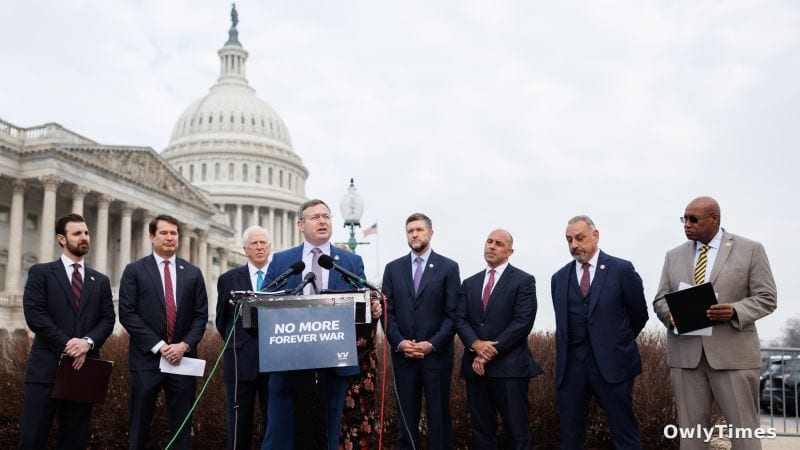

The calculated risk at the heart of President Trump’s decision to strike Iran isn’t simply about confronting Tehran; it’s a deliberate fracturing of the Democratic Party, exploiting existing fissures over foreign policy and forcing a public reckoning on national security just months before crucial midterm elections. The move isn’t a departure from Trump’s established playbook – it’s a refinement. He’s betting that a divided opposition, grappling with internal contradictions on interventionism, will be less effective at framing the narrative and more vulnerable to accusations of weakness. This strategy hinges on leveraging the pro-Israel wing of the Democratic party against a growing bloc of veterans who view endless war with deep skepticism.
A generation of Democrats, including Eugene Vindman of Pennsylvania, entered Congress specifically to challenge the “forever war” mentality that defined previous administrations. These veterans, having experienced the costs of prolonged conflict firsthand, are among the most vocal critics of escalating tensions with Iran – a position that immediately places them at odds with more hawkish elements within their own party. “I understand the threat but I also understand that wars are easy to start and hard to finish,” Vindman stated Wednesday, echoing a sentiment shared by Jason Crow of Colorado, a three-tour Iraq veteran, who pointedly observed that “elites in Washington…talk about the costs of war and act tough, they’re not talking about them doing it.” Who benefits and who loses from this positioning? Trump benefits from a fractured Democratic response, while these veteran-Democrats risk being painted as soft on national security, a potent accusation in the current climate.
Reporting from CNN informs this analysis.
The immediate fallout is visible in the internal Democratic struggle over a war powers resolution intended to curb Trump’s military authority. House Minority Leader Hakeem Jeffries is attempting to corral his caucus around a unified message, recognizing the historical precedent of the Iraq War – a conflict that deeply damaged the Democratic Party due to internal divisions. The party leadership is acutely aware that repeating the mistakes of 2003, when dissenting voices fractured the anti-war movement, could be politically devastating. Yet, as evidenced by a closed-door meeting with pro-Israel Democrats, securing that unity is proving exceptionally difficult. Greg Landsman of Ohio, despite attending the meeting, openly signaled his intention to oppose the resolution, prioritizing what he termed “national security” and praising the administration’s “window of opportunity” to “defang the Iranian regime.”
This divergence isn’t simply about policy; it’s about power dynamics. Landsman’s statement, and the contrasting views of veterans like Pat Ryan of New York – who excoriated “chicken hawks” who’ve never seen combat – reveal a fundamental tension within the party. The veterans, many in their 40s and having served multiple tours in Iraq and Afghanistan, are acutely aware of the human cost of intervention. Their experiences inform a skepticism that clashes with the more traditional, pro-Israel stance held by some senior Democrats. The fact that John Fetterman of Pennsylvania was the sole Democrat to oppose a similar measure in the Senate, accusing his party of being “afraid” of the base and questioning why Democrats wouldn’t simply acknowledge the “safer” world resulting from the strikes, further underscores this internal conflict. This echoes the post-9/11 environment where dissenting voices were often marginalized in the name of national unity, a pattern Democrats are now wary of repeating.
The immediate legislative battle over war powers is merely a prelude to a larger, more consequential fight: funding. Democrats will soon be forced to confront the reality of supporting US troops engaged in a potentially prolonged conflict, requiring billions in additional funding. This is where the contradictions will become most acute. Ruben Gallego, a Marine Corps veteran and Senator from Arizona, articulated the dilemma: the need to protect troops clashes with the broader question of funding “a war of choice” amidst existing budgetary pressures. Mark Kelly, also a Senator from Arizona and a veteran, acknowledged the need to “take a close look” at any supplemental funding request, signaling a willingness to support troops but also a recognition of the political minefield ahead. The question isn’t simply if Democrats will fund the war, but how – and whether they can do so without further exacerbating the divisions that Trump is actively exploiting.
The political chess move to watch next isn’t a vote on war powers, but the unveiling of the administration’s supplemental funding request. Will Trump present a narrowly tailored request focused solely on troop protection, or a broader package designed to escalate the conflict and force Democrats to take a definitive stand? The answer will reveal the true extent of his strategy and the degree to which he believes he can successfully weaponize foreign policy against a vulnerable opposition.