
The 123 dark activity events recorded in the Gulf serve as the definitive baseline for understanding the current maritime landscape, effectively masking a persistent, shadow-based economy even as official visibility metrics show a return to normalcy. While the 19 crossings recorded on April 25 through the Strait of Hormuz were characterized by full AIS compliance—a notable departure from the preceding period of suppressed movement—the sheer volume of deceptive shipping practices suggests that the "recovery" in transit is merely a shift in operational tactics rather than a retreat from sanction-evading behavior.
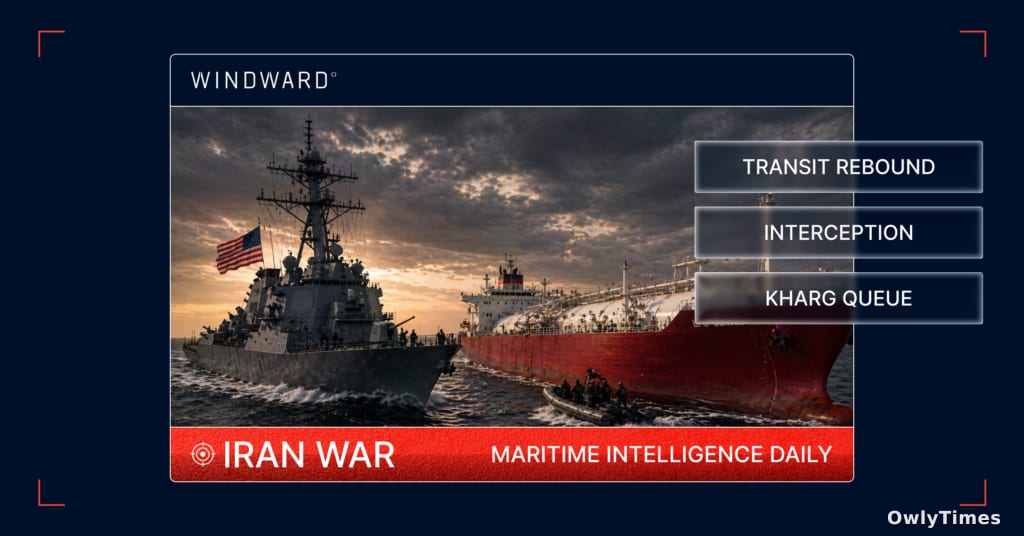
Follow the money, and the narrative shifts from the Strait to the central Arabian Sea. On April 25, U.S. naval forces intercepted the LPG SEVAN (IMO 9177806), a Panama-flagged tanker that had been designated under OFAC sanctions only one day prior. This move is significant; it signals a tactical pivot in enforcement. By striking in open waters rather than at traditional chokepoints, U.S. forces have fundamentally altered the risk calculus for the Iranian dark fleet. With the vessel previously linked to the transport of approximately 750,000 barrels of LPG to Bangladesh, the interception of its current 200.6 thousand barrel cargo acts as a direct financial disruption to a established evasion network.
The Bottleneck at Kharg Island
While the open sea sees active interdiction, the primary export hub at Kharg Island tells a story of structural strain. Data from April 26 reveals that while two tankers—one VLCC and one Suezmax—were actively loading at the terminal with a combined capacity of roughly 3 million barrels, they are outliers in a growing line of congestion. At least eight additional VLCCs were observed in an anchorage queue, waiting for their turn at the berths. This buildup is a critical indicator of throughput pressure; it suggests that export demand is present, but the infrastructure is struggling to maintain pace, likely hampered by the very enforcement dynamics that have made transit more perilous for the shadow fleet.
Gulf Activity and the Dual-Track Market
The broader Gulf region is seeing a surge in vessel presence, which climbed to 892 ships—a rise of 126 vessels compared to the previous day. This recovery is broad-based, with Panama-flagged vessels leading the count at 140, followed by Iran at 106 and the Comoros at 86. The composition of this fleet, which includes 149 bulk carriers and 138 product tankers, underscores a market attempting to normalize trade flows despite the high-risk environment.
Yet, this normalization remains fragile. The coexistence of high AIS compliance during transit and the 123 dark activity events indicates a dual-track operating model. Vessels appear to be toggling their visibility, maintaining compliance where monitoring is absolute while relying on deception in the periphery to facilitate sanctioned cargo movement.
What This Means for Your Wallet
For investors and stakeholders in global energy markets, the takeaway is clear: the volatility surrounding Iranian energy exports is not receding; it is becoming more geographically diffuse. The expansion of U.S. enforcement into the Arabian Sea means that insurance premiums and operational risks for tankers operating in the region are unlikely to stabilize in the near term. The next reading of the anchorage queue at Kharg Island and the ongoing volume of dark activity events will be the primary indicators of whether this "controlled reopening" can sustain current export levels or if the cumulative weight of sanctions enforcement will force a further contraction in regional throughput.