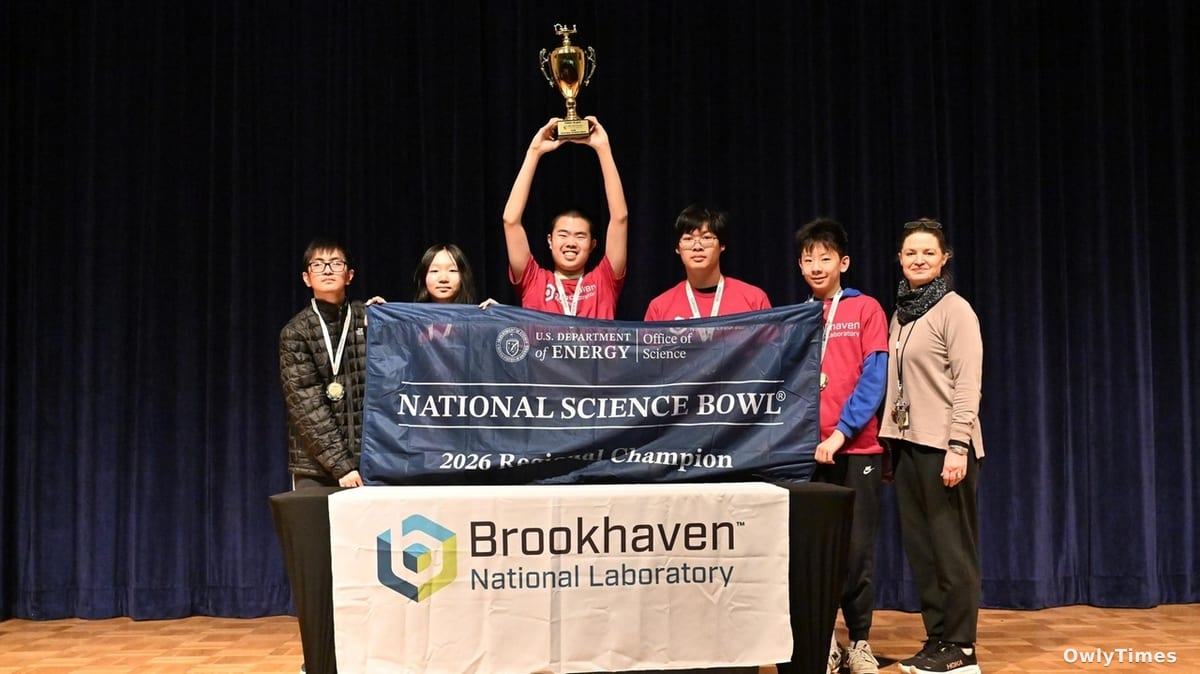

The consistent success of Long Island students in the National Science Bowl isn’t simply a feel-good story about academic achievement; it’s a barometer of a quietly shifting landscape in STEM education, one that increasingly prioritizes rapid recall and strategic team dynamics. While headlines celebrate the fourth consecutive win for Ward Melville High School and the repeated success of Great Neck South Middle School at the Long Island Regional Science Bowl held at Brookhaven National Laboratory in January, the underlying trend reveals a growing emphasis on specialized knowledge within these teams – a departure from the “general science” ideal of past decades. Harry Gao, captain of the Ward Melville team, explicitly noted the addition of a biology specialist to address a previous weakness, signaling a deliberate strategy to optimize for the competition’s breadth. This isn’t about students knowing more science, but about knowing targeted science, and knowing how to leverage that expertise within a team structure.
The Science Bowl, modeled after the “Jeopardy!” game show, tests students on biology, chemistry, physics, and other scientific disciplines. The winning teams – Ward Melville (members Eric Liu, Alan Mao, Anna Xing, and Jason Yin alongside Gao) and Great Neck South (teamed with Damian Fung, Bruce Peng, Nathan Yu, Zale Zhang, and Lucas Zhen) – now advance to the National Science Bowl in Washington D.C. this April. But the significance extends beyond individual accolades. The competition’s format, demanding quick-fire answers and collaborative problem-solving, mirrors the demands of modern scientific research, where interdisciplinary teams are the norm. Nathan Wong, coach of the Great Neck South team, aptly framed this potential, stating, “I keep telling them, ‘Look at the scientists around here, you might be them one day.’” This isn’t just encouragement; it’s an acknowledgement that the skills honed in the Science Bowl – rapid information processing, collaborative analysis, and the ability to perform under pressure – are directly transferable to future scientific careers.
However, it’s crucial to understand what these wins don’t tell us. The Science Bowl, while rigorous, is still a competition focused on recall and application of existing knowledge. It doesn’t necessarily measure creativity, experimental design, or the ability to grapple with genuinely novel scientific problems. The runner-up finishes from Roslyn High School and Paul J. Gelinas Middle School demonstrate a high level of scientific aptitude across multiple schools, suggesting a generally strong foundation in STEM education on Long Island. The competition doesn’t reveal why these schools are successful, only that they are. Furthermore, participation in the Science Bowl is likely self-selected, attracting students already highly motivated and engaged in science, potentially skewing the results and not reflecting the broader student population.
This focus on STEM excellence is echoed in other recent educational developments across Long Island. The New Hyde Park-Garden City Park Union Free School District’s recognition with a 2025 Innovative Technology Integration Award from the Center for Digital Education and the National School Boards Association highlights a broader trend of leveraging technology to enhance instruction. As noted by Brian Cohen, vice president of the Center for Digital Education, the award isn’t simply about adopting technology, but about “having a clear vision for how it can improve outcomes, and for governing it well.” Similarly, Sayville High School’s inaugural Sports Analytics and Business Conference, and East Broadway Elementary School’s implementation of a sensory hallway, demonstrate a commitment to diverse learning experiences and preparing students for a rapidly changing world. These initiatives, while distinct, share a common thread: a proactive approach to equipping students with the skills and knowledge they need to succeed in the 21st century.
Original reporting: newsday.com.
Looking ahead, the next step isn’t simply to celebrate these successes, but to investigate how these schools are fostering such a high level of scientific engagement. What specific pedagogical approaches are employed? How are teachers being trained to support these initiatives? And, crucially, how can these successful models be scaled and adapted to reach a wider range of students? The question isn’t just whether Long Island students will continue to excel in the National Science Bowl, but whether the underlying principles of their success can be translated into a more equitable and effective STEM education for all. Will we see a shift from simply identifying “science talent” to actively cultivating it across all demographics and learning styles? That’s the challenge, and the opportunity, that lies ahead.